7 Hairstyles Over 50 That Work with a Double Chin
Seven hairstyles for women over 50 with a double chin, each judged by how the cut's structure redirects the eye away from the jawline and what to tell your stylist.

Booking an appointment soon? Save this page. It is easier to skim in the chair than to remember.
At a glance
Works
- A graduated bob that angles from the nape to the chin, drawing a diagonal line past the jaw
- Long layers starting below the chin, which pull the eye down past the jawline
- A side-swept fringe that introduces a diagonal and breaks the horizontal read of the lower face
Depends
- A textured lob at the shoulder, which only redirects the eye if the ends hold some movement rather than sitting flat
- A pixie with crown volume, which shifts the proportion only if the crown has enough density to hold the height
Skip
- A blunt chin-length cut with no graduation, which creates a hard horizontal line at the widest part of the jaw
- A one-length cut that flips outward at the chin, which pushes the eye outward at the jaw
- Volume at the jawline from layers, curl, or blowout direction, which widens the lower face
A double chin is a structural feature, not a problem to solve. But the line a haircut draws beside the jaw changes whether the eye pauses there or moves past it. That is worth knowing before you sit in the chair.
After 50, individual hair strands are often thinner and overall density can drop. Both change what a cut can do, because a style that depends on volume to redirect attention may not hold its shape on finer hair.
Every cut below is judged on one question: does the line of the cut move the eye past the jawline, or does it frame it.
1. A chin-length bob with a soft graduation at the back
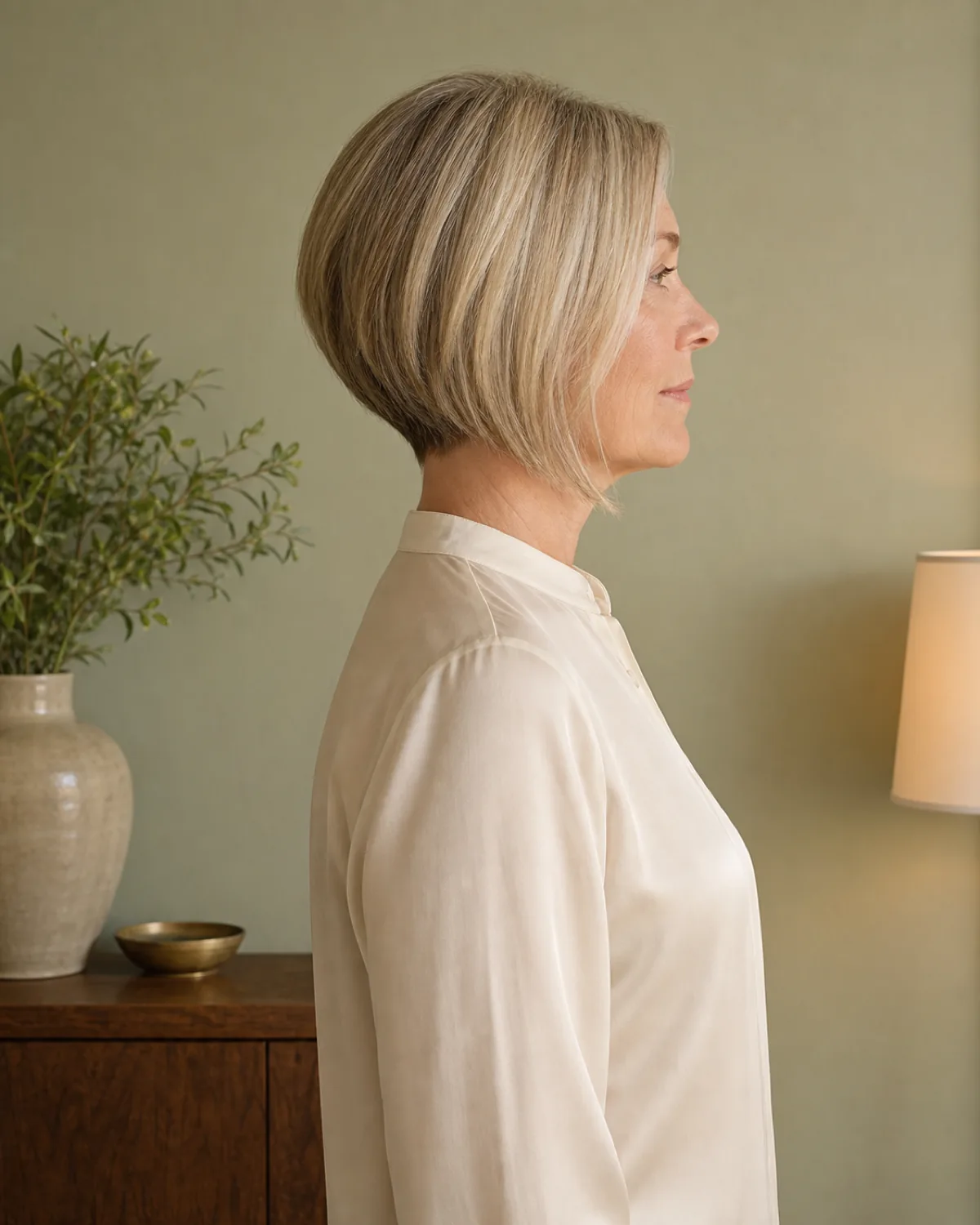
A graduated bob cuts the back shorter and angles the front pieces toward the chin. That diagonal line draws the eye along its own slope rather than across the horizontal of the jawline. The graduation is the structural move: it replaces the horizontal with an angle.
This works when the hair has enough density to form a solid edge at chin level. If the hair is too fine to hold a blunt perimeter, ask the stylist about internal texturing. That keeps the weight of the cut without showing thinness at the ends.
- Look at the ends of your current cut in a mirror and see whether they form a solid line or separate into thin wisps
- Ask the stylist to cut the graduation so the longest front piece sits at the chin, not above or below it
- If the ends are too thin to hold a solid edge, ask about internal texturing rather than thinning shears at the perimeter
2. Long layers starting below the chin

Layers that begin below the chin pull the silhouette longer. The eye follows the longest visible line, and when that line extends past the jaw, the chin becomes one point on a longer shape rather than the widest point.
The key is where the shortest layer starts. Layers that begin above the chin frame the jaw. Layers that begin at or below it redirect past it. Ask the stylist to keep the shortest layer at or below the jawline. The longest layer determines where the eye settles.
- Pull the hair straight down beside your face and see where the current shortest layer sits relative to your chin
- Ask the stylist to start the shortest layer at or below the jaw, not above it
- If you want to keep length, ask about two or three graduated layers below the jaw rather than one blunt length
Where to start
Find your situation, skip ahead
Your hair is fine or thinning and you want the cut to do the structural work
Start with the graduated bob or long layers below the chin. Both use a diagonal line to move the eye past the jaw without depending on volume you may not have.
01 A chin-length bob with a soft graduation at the back02 Long layers starting below the chin
You have enough density for a short cut and want the proportional shift that comes from crown height
A pixie with crown volume changes the vertical proportion, but only if the crown holds the height. Test this at the salon first.
You prefer a medium length and want to know which details matter most
The textured lob and face-framing layers both work at medium length. The lob needs textured ends; face-framing needs its shortest piece at the jaw.
04 A textured lob that sits at the shoulder06 Face-framing pieces at the jaw, not above it
3. A side-swept fringe that breaks the horizontal line

A side-swept fringe introduces a diagonal across the upper face. That angle disrupts the horizontal read of the jawline below it, because the eye picks up the diagonal before it settles on the horizontal. A straight-across fringe does the opposite. It creates a second horizontal that echoes the jawline, and two parallel horizontals reinforce each other.
This works on most face shapes when the fringe is long enough to sweep past the brow. A fringe that stops at the eyebrow creates a short horizontal rather than a diagonal. The sweep needs to reach at least the outer corner of the eye to read as a line rather than a blunt edge.
- Part your hair on the side and pull a section across your forehead to see whether the diagonal changes how the jawline reads
- Ask the stylist for a side-swept fringe that reaches at least the outer corner of the eye
- Avoid a straight-across fringe if the goal is to break the horizontal; a blunt line across the brow echoes the jawline below
4. A textured lob that sits at the shoulder

A lob that ends at the shoulder pulls the silhouette long enough that the chin area becomes one point on a longer line. The length alone does part of the work. But the ends matter: flat, limp ends at the shoulder can widen the lower face by sitting against it like a frame.
Point-cut or textured ends break up the bottom edge so it reads as movement rather than a hard line. Ask the stylist about point-cutting the last centimetre of the ends. The difference between a flat edge and a broken one changes whether the lower face reads as framed or as part of a longer line.
- Hold your current hair at the shoulder and see whether the ends sit flat against your face or break up with movement
- Ask the stylist about point-cutting the ends rather than cutting them blunt
- If the ends fall flat after styling, a light texturizing product at the tips can introduce enough separation
5. A pixie with volume at the crown and close-cropped sides
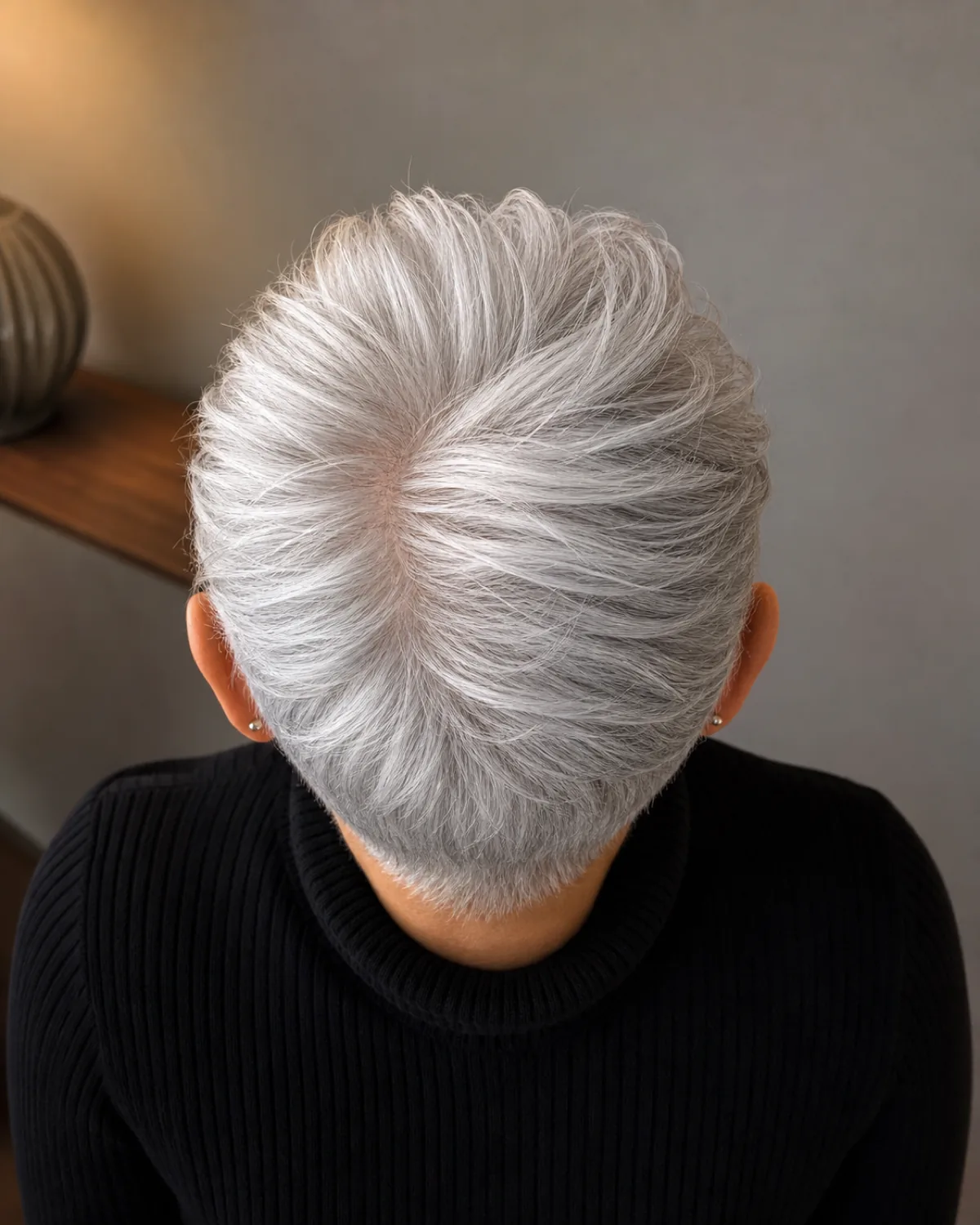
Crown height changes the vertical proportion of the face. When the tallest point of the silhouette is at the top of the head, the face reads longer and the chin becomes a smaller fraction of the whole shape. The close-cropped sides reinforce this by keeping the width narrow.
This works when the crown has enough density to hold the height. On very fine hair, the crown flattens within the first hour and the proportional shift disappears. Volume at the sides does the opposite of what you want: it widens the face at the jaw. Ask the stylist to keep the sides close to the head and to leave enough length at the crown to hold some lift.
- Run your fingers through the hair at your crown and see whether it stands up or falls flat
- Ask the stylist how long the crown holds height without product; if it falls within the hour, the proportional shift will not last
- Keep the sides close to the head; volume at the sides widens the lower face
6. Face-framing pieces at the jaw, not above it
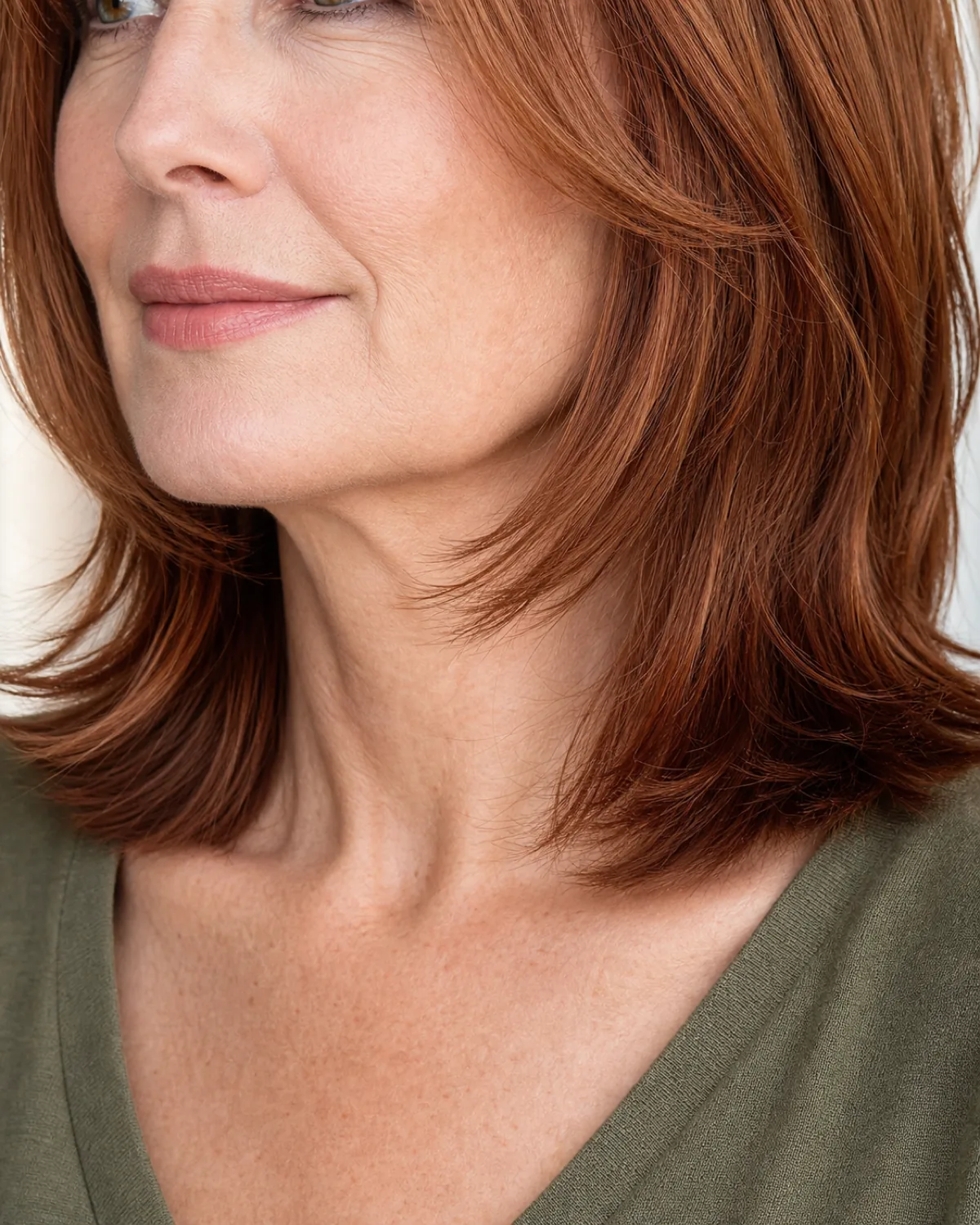
Face-framing layers are the shortest pieces that fall beside the face. Where those pieces land determines whether the jaw is softened or spotlighted. When they sit at the jawline, they drape across it. When they sit above the jaw, they stop short and draw a bracket around the fullest part of the lower face.
Ask the stylist to cut the face-framing with your head upright, not tilted back. When the head tilts back during the cut, the pieces land higher than intended once you stand straight. The difference between the jaw and two centimetres above it changes whether the layer works with the jawline or against it.
- Stand in front of a mirror and pull the shortest pieces beside your face to see where they fall relative to your jawline
- Ask the stylist to cut the face-framing while your head is upright and level
- If the pieces currently stop above the jaw, ask whether growing them out to jaw level would change the read
7. What to avoid: volume at the jawline and blunt horizontal cuts at chin level

Some structural choices amplify the jawline rather than redirecting attention past it. A blunt chin-length cut with no graduation creates a hard horizontal at the jaw. A one-length cut that flips outward at the chin pushes the eye outward at the widest point. Volume at the jaw from layers, blowout direction, or curl pattern widens the lower face.
None of these are wrong. But if the goal is to move the eye past the jawline, they work against it. The pattern to watch: anything that adds width or a hard horizontal at the level of the chin. Ask the stylist where the volume will sit, and whether the ends will flip out or fall in.
- Look at your current cut after styling and see whether the ends flip outward at chin level
- Ask the stylist whether the cut will hold its shape inward or tend to flip out with wear
- If you blow-dry, check whether you are directing volume outward at the jaw; try directing it under or back instead
Where the checkable claims come from
- Face shape — Wikipedia
- Hair diameter and aging — Birch, Messenger & Messenger, Journal of Investigative Dermatology (2001)
- Bob cut — Wikipedia
- Pixie cut — Wikipedia
- Bangs (hair) — Wikipedia
Keep this one
Save it for the appointment
Pin the image above to the board you actually open before a salon visit. This guide is written to be re-read, not read once.
Tonight, before you close this tab
- Stand in a mirror and hold the hair flat against your jaw to see where the shortest layer currently sits
- Part your hair on the other side for one day and notice whether the jawline reads differently
- Measure with two fingers from the bottom of your chin to the point where the jaw meets the neck
- Write down two questions for the stylist: where will the shortest layer sit, and will the ends hold texture or fall flat