10 Hairstyles for Women Over 50 That Make You Look Younger
Ten hairstyles for women over 50 judged by the structural features that change how a face reads. Layers, parts, bobs, pixies, and bangs by face shape.

Booking an appointment soon? Save this page. It is easier to skim in the chair than to remember.
At a glance
Works
- Layers starting below the cheekbone on a long or oval face to keep weight at the jaw where the face needs it
- A deep side part on a round face because the diagonal breaks the symmetry the circle relies on
- Crown volume on any face shape because vertical lift counters the flat roots that drag the eye down
Depends
- A textured pixie only if your hair holds some body on its own because flat fine hair reads sparse at the sides once cropped short
- Face-framing highlights only if your natural base is dark enough for warm pieces to read as contrast rather than blending into blonde
- A graduated back only if your hair density supports visible stacking at the nape without scalp showing through
Skip
- Layers starting above the cheekbone on fine hair because the short pieces cannot cover what the longer ones reveal
- A center part on a round face because the symmetry mirrors the width instead of breaking it
- Blunt heavy bangs on thinning front hair because the horizontal line demands density the section cannot deliver
The question is not whether a haircut can change how your face reads. It can. The question is which structural features do the work and which ones are just trend noise.
Every idea below is judged on two things: your face proportions and your hair density. A stylist who can see both in person outranks anything written here.
1. Soft Layers Starting Below the Cheekbone

The profile here shows exactly where the shortest layer sits: below the cheekbone, not above it. That placement keeps the weight at the jaw and shortens a long face optically by filling the space between the cheekbone and the shoulder.
Layers that start higher on fine hair expose the thinning they were supposed to hide. The short pieces lift away from the head and the longer ones beneath show through. On medium-to-thick hair, the cheekbone start point gives enough overlap to keep the silhouette solid.
- Suits long and oval faces best because the jaw-level weight breaks vertical length
- Medium-to-thick hair carries this cut without gaps; fine hair needs the layers to start even lower
- Ask your stylist to point-cut the layer ends rather than razor them so the texture stays soft
- Check the face shape guide if you are not sure whether your face reads long or oval
2. A Side Part That Shifts the Eye
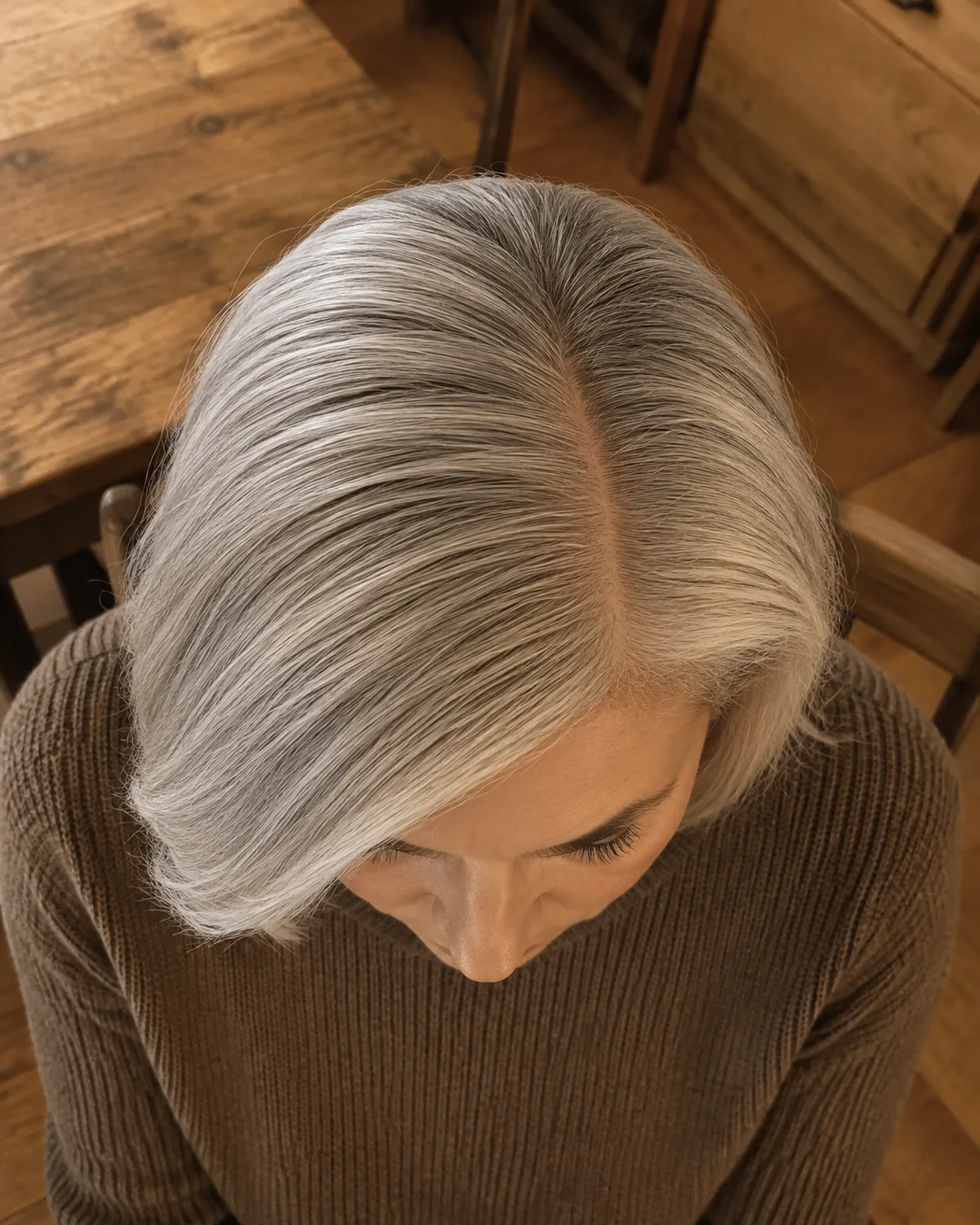
From above, the side part creates a visible diagonal across the scalp. One side carries more hair than the other, and that asymmetry is the whole point. A round or square face relies on symmetry to read as wide. The diagonal breaks it.
The deeper the part moves from center, the more asymmetry it produces. But past the temple the illusion collapses into a combover. The version here shows the part about two inches off center, which is enough to shift the balance without looking forced.
- A round face benefits most because the diagonal counters the circular silhouette
- A square face softens when one side carries more weight than the other
- Moving the part costs nothing and can be tested at home with a comb and a mirror
- If the part springs back to center within an hour, your hair's growth pattern is fighting you and you may need a stylist to set the direction
3. Face-Framing Highlights Blended Into Gray

The warm pieces sit at the temples and frame the face while the crown stays dark with silver threading through naturally. The contrast softens the line between skin tone and silver without erasing the grey.
This is a color judgment, not a how-to. Tell the colorist where you want the warmth: temples and the front pieces, not the crown. Ask how many sessions it takes to blend without creating a hard grow-out line. The goal is a transition that does not demand maintenance every four weeks.
- Works when your natural base is dark enough for the warm pieces to read as contrast
- Fails when the base is already light blonde because the highlights disappear into it
- Ask the colorist for the grow-out timeline before committing: if you cannot return for touch-ups the line becomes the problem it was supposed to solve
- The image shows chin-down framing where the warm pieces fall forward and catch the light naturally
Where to start
Find your situation, skip ahead
Your face is round or square and you want a cut that reads narrower
Start with the side part and then look at chin-length bobs or swept bangs. All three add diagonal lines that break the width.
02 A Side Part That Shifts the Eye04 A Chin-Length Bob With Rounded Edges08 Long Bangs Swept Off the Forehead
Your hair is fine and your main concern is looking flat
Crown volume is the quickest change. Feathered ends and a collarbone lob give the illusion of more hair without losing length.
07 Volume at the Crown Instead of Flat Roots05 Feathered Ends on a Shoulder-Length Cut09 A Collarbone Lob With Movement
You are growing out gray and want the transition to flatter your face
Face-framing highlights bridge the contrast, and a graduated back keeps the silhouette sharp while you wait.
03 Face-Framing Highlights Blended Into Gray10 A Graduated Back That Lifts the Nape Line
4. A Chin-Length Bob With Rounded Edges

The bob sits precisely at the chin and creates a horizontal line that breaks the vertical length of an oblong face. The edges here are point-cut rather than razor-straight, which softens the perimeter without losing the structure.
A blunt horizontal at the chin is one of the strongest face-shortening lines available. But on a round face it mirrors the width and doubles down on the problem. The chin-length bob works best on oblong and oval shapes where the horizontal interrupts a long vertical read.
- Oblong faces benefit most because the horizontal cuts the visual length
- Round faces should consider a slightly longer version that falls below the jaw to avoid reinforcing the width
- Point-cut edges keep the line clean but remove the severity that a sharp blunt edge can add
- Hair needs enough density to fill the horizontal line from ear to ear; thin hair at the sides shows gaps
5. Feathered Ends on a Shoulder-Length Cut
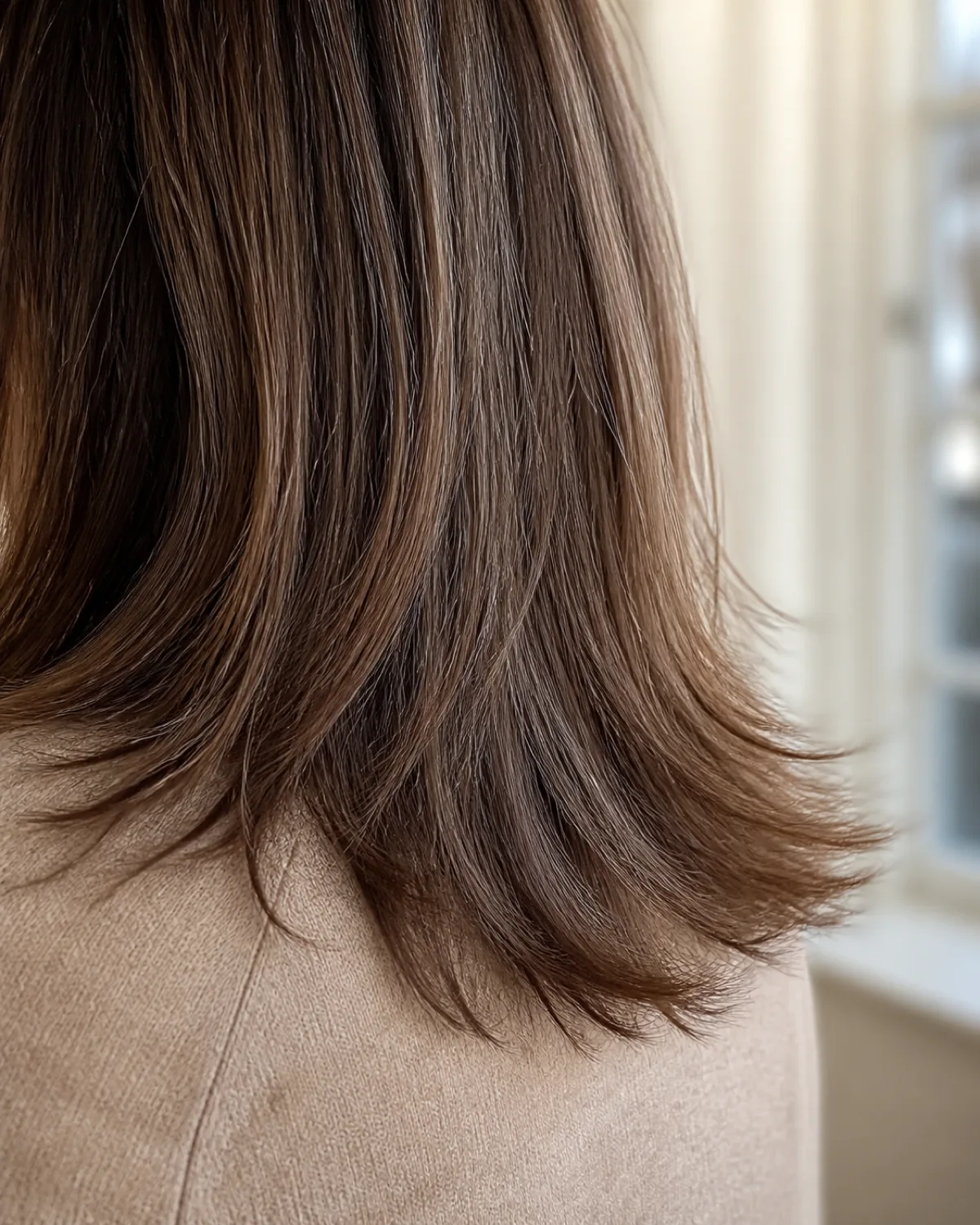
The close-up shows each strand tapering individually rather than ending in a blunt line. Feathered ends remove bulk at the perimeter without losing length, and the tapered texture hides thin ends by breaking them into pieces that move independently.
The risk is over-texturing. On fine hair that has already lost density at the tips, too much point-cutting turns feathered into stringy. The right amount leaves enough weight at the ends to hold a shape while thinning just enough to add movement.
- Works on most face shapes because the change happens at the perimeter, not the silhouette
- Medium-density hair handles feathering best; very fine hair needs a lighter hand
- Ask for point-cut feathering rather than razor texturing because the razor can split fine strands
- The tapered ends also dry faster and hold a natural bend without heat tools
6. A Textured Pixie With Weight at the Crown
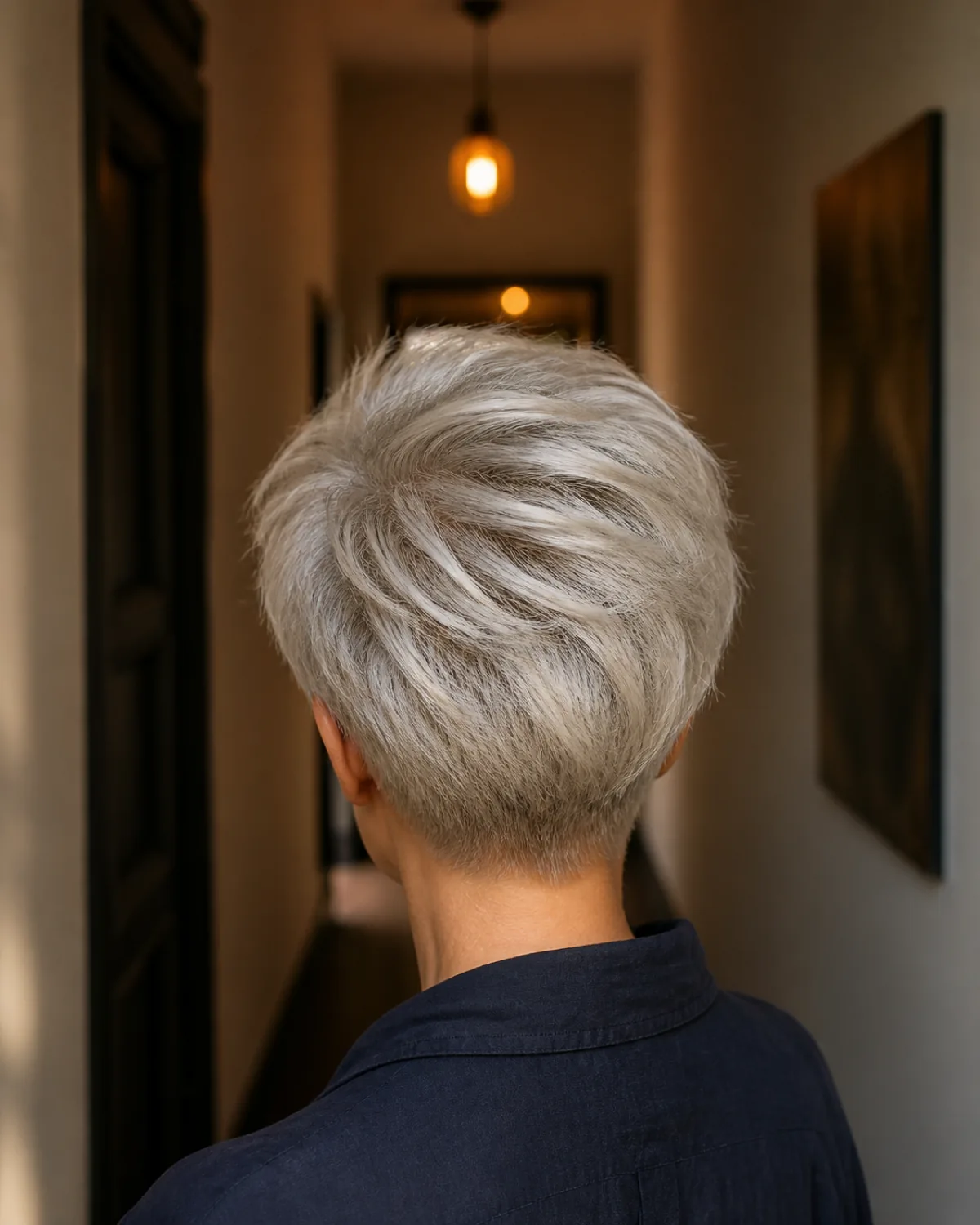
The back view shows the weight distribution clearly: longer textured pieces at the crown and closely cropped sides and nape. That top-heavy balance lifts the visual center of the head upward.
A pixie with weight at the crown reads differently on different face shapes. On oval and heart faces the upward lift works with the natural narrowing at the jaw. On a round face the lack of length below the ear removes the vertical line that would counter the width.
- Oval and heart shapes suit this best because the crown lift extends the face vertically
- Round faces risk looking wider without hair at the sides to create vertical length
- Hair needs some natural texture to hold the crown pieces upright; flat fine hair lies down and loses the lift
- The nape should be cropped close enough to show the neck line cleanly
7. Volume at the Crown Instead of Flat Roots

Root lift at the crown adds vertical length to the face. The image shows how the crown section stands noticeably higher than flat, creating a shadow line at the part that reads as fullness even when the hair itself is not thick.
This is a styling principle, not a cut. It applies to bobs, lobs, and layered cuts alike. Fine hair loses root volume over time as the strand diameter decreases and gravity wins. Lifting the roots at the crown is the simplest structural change that works across face shapes.
- Any face shape benefits because vertical lift stretches the proportions upward
- Fine hair needs root-lifting technique at the crown; the cut alone will not hold it
- Ask your stylist to show you how to direct a dryer at the roots for lift without a round brush
- The lift disappears in humidity if you skip a lightweight hold product at the roots
8. Long Bangs Swept Off the Forehead
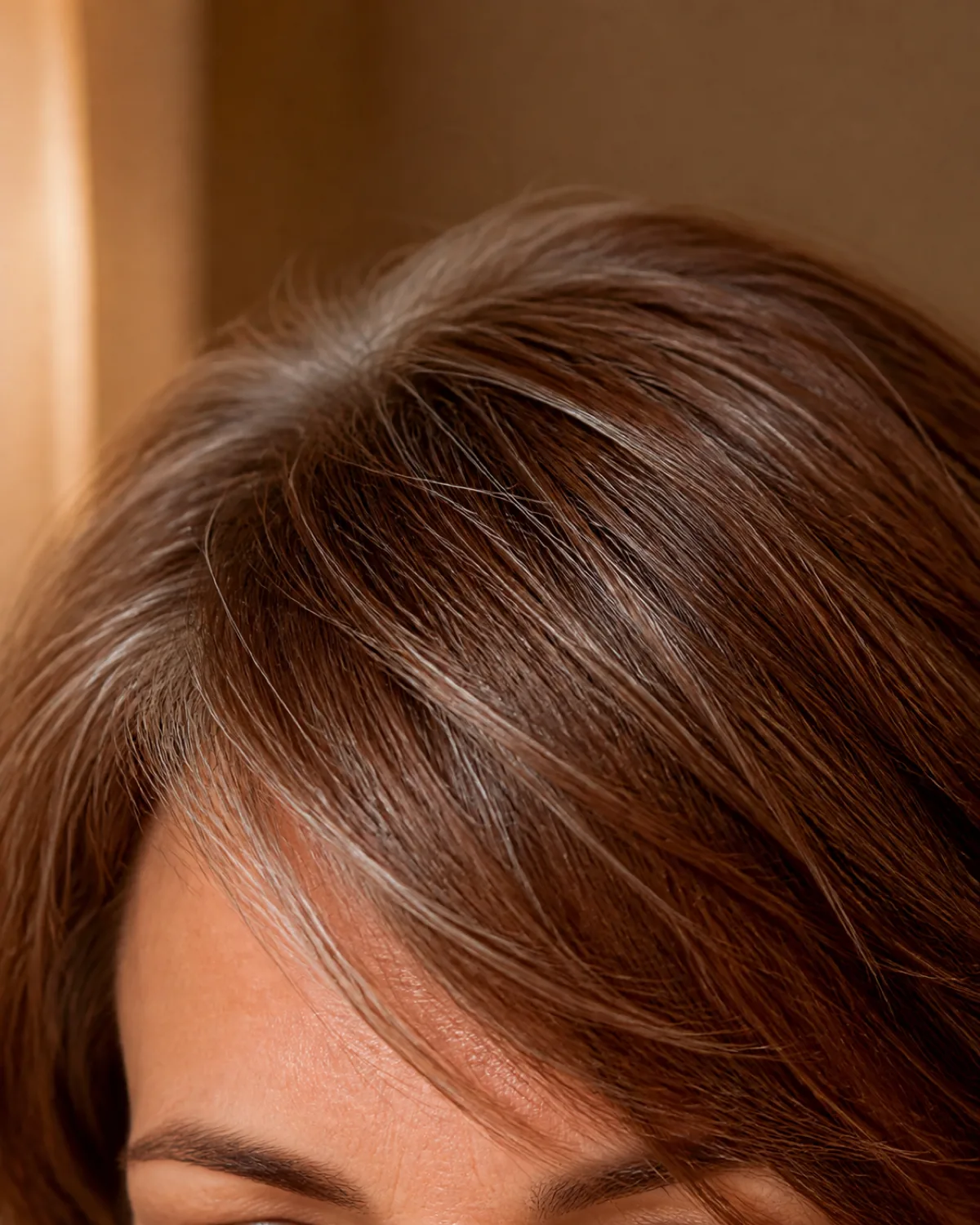
The close crop shows the fringe sweeping diagonally from one side. The bangs are long enough to reach past the brow and fall at an angle rather than hanging straight. That diagonal line covers a high forehead and creates the same asymmetry that a side part does, but lower on the face.
Different from blunt bangs, which need enough density to fill a horizontal line from temple to temple. A long swept fringe works with less hair because it lies on a diagonal and the thin edge fades into the rest. For more on which bang style suits which face shape, that guide covers seventeen variations.
- Covers a high forehead without the maintenance demand of a blunt fringe
- The sweep direction matters: sweeping away from the fuller cheek draws the eye toward the narrower side
- Fine front hair handles a swept fringe better than blunt bangs because the diagonal hides gaps
- Needs trimming every five to six weeks to keep the sweep from falling into the eyes
9. A Collarbone Lob With Movement

The back view catches the lob mid-motion. The internal layers create movement without visible thinning because they sit inside the perimeter rather than removing weight from the edge. The length lands at the collarbone, long enough to pull into a low twist but short enough to hold its shape.
The collarbone landing point frames the neck and keeps the cut from dragging the eye down. On most face shapes this length works as a neutral: it does not shorten or lengthen the face the way a chin bob or a long layer does. The movement from internal layers does the flattering.
- Suits most face shapes as a neutral length that does not push proportions in either direction
- Internal layers give movement without the visible thinning that perimeter layers create
- The collarbone anchor keeps the cut from looking shapeless the way a longer version can
- Holds a natural wave or bend better than a one-length cut because the internal layers reduce bulk
10. A Graduated Back That Lifts the Nape Line

The stacked layers at the nape are visible in sharp detail. Each graduation step shortens the hair slightly as it moves down toward the neck, which lifts the rear silhouette and makes the back of the head read as structured rather than flat.
From the front this reads as a clean bob. From behind the graduation adds dimension that a one-length bob cannot. The cut works best on medium-density hair where the stacking has enough material to show steps. On very fine hair the layers can separate and expose scalp at the nape.
- Medium-density hair shows the graduation steps clearly without gaps
- Very fine hair risks exposing the scalp between the short layers at the nape
- The lifted nape line creates the impression of a longer neck
- Ask your stylist to graduate in small steps rather than large jumps so the transition reads as smooth
Where the checkable claims come from
- Face Shapes and Hairstyles — Pivot Point International
- Fine Hair: Causes and How to Care for It — Philip Kingsley Trichological Clinic
Keep this one
Save it for the appointment
Pin the image above to the board you actually open before a salon visit. This guide is written to be re-read, not read once.
Tonight, before you close this tab
- Stand in front of a mirror and hold a comb at your center part then slide it two inches to one side to see whether the asymmetry changes how your face reads
- Pinch a section of your crown hair between two fingers and lift it straight up to check whether it holds any volume or falls flat immediately
- Look at your hair from the side in a second mirror and note where the weight line sits at the jaw or the shoulder or somewhere in between
- Write down two structural words from this list to tell your stylist: layers below the cheekbone, side part, graduated nape, feathered ends, crown volume