7 Layered Bobs That Actually Work on Fine Hair Over 50
Seven layered bob options for fine hair over 50, each judged on how much layering your density can handle before the ends thin out.

Booking an appointment soon? Save this page. It is easier to skim in the chair than to remember.
At a glance
Works
- A chin-length bob with internal layers that preserve the perimeter line
- A graduated bob with stacked layers at the nape that push volume upward
- An asymmetric jaw-length bob that uses one angle instead of multiple layer lines
Depends
- A collarbone lob with face-framing pieces, which holds only if your roots can carry the extra length without flattening
- A textured bob with razored ends, which reads as feathery on medium-density hair but dissolves the hemline on low-density hair
- A deep side part with long layers, which displaces volume to one side but only works if you have enough total density to spare
Skip
- Heavy all-over layering on poker-straight fine hair, where layers just hang flat and thin the ends
- A full blunt fringe that borrows too many strands from already-thin temples
- Any layered bob that needs a round brush and twenty minutes every morning to hold its shape
A layered bob is the most requested cut in this category, and the most likely to disappoint. Layers are supposed to add movement, but on fine hair they subtract density. The cut that works is the one where your ends can afford the reduction.
Every option below is judged on the same question: how much layering can your fine hair handle before the hemline disappears?
1. A Chin-Length Layered Bob with Internal Layers Only

Internal layers sit below the surface of the hair. They remove weight from underneath without touching the top layer, so the perimeter reads as a solid line while the interior has room to swing. The distinction between internal layers (elevation) and surface layers matters here: surface layers thin what you see, internal layers thin what you feel.
This works best when your ends are still reasonably dense. A one-length perimeter shows every gap, and if your tips are already sparse, even internal layers will leave too little weight at the bottom. Check your ends in daylight first. For a broader look at how fine hair responds to different structures, see the pillar guide.
- Internal layers preserve the solid perimeter line while adding movement underneath
- The chin length keeps weight close to the jaw where fine hair holds best
- Ask your stylist to point-cut the interior rather than slide-cut the surface
2. A Collarbone Lob with Face-Framing Pieces

This is the longest option that can still hold its shape on fine hair. Layers only go around the face, starting at the cheekbone and graduating into the one-length body behind. The rest stays untouched, preserving every strand of density you have.
The condition is your roots. A collarbone-length cut puts more weight on fine hair than a chin-length bob, and if your roots flatten under the load the whole shape collapses by midday. Test it by clipping your front sections back and watching what the rest does over a few hours. If it holds, this is a good fit. If it goes flat, drop to jaw length.
- Face-framing pieces start at the cheekbone and blend into the one-length back
- The single-length body preserves maximum density
- Test by clipping your front sections back: if the rest falls flat, go shorter
Where to start
Find your situation, skip ahead
Your fine hair still has decent density at the ends
Start with internal layers at chin length. The perimeter stays solid while the interior adds swing.
01 A Chin-Length Layered Bob with Internal Layers Only03 A Graduated Bob with Stacked Layers at the Nape
Your fine hair is thinning and you want to keep some length
A collarbone lob with face-framing pieces only. Keep the back one length to preserve every strand of density.
02 A Collarbone Lob with Face-Framing Pieces05 A Side-Parted Layered Bob with a Deep Side Sweep
You want a layered bob that takes zero daily styling
The asymmetric jaw-length bob uses one angle to create shape. No layering to manage, no round brush.
07 A Jaw-Length Layered Bob Left Slightly Longer on One Side01 A Chin-Length Layered Bob with Internal Layers Only
3. A Graduated Bob with Stacked Layers at the Nape
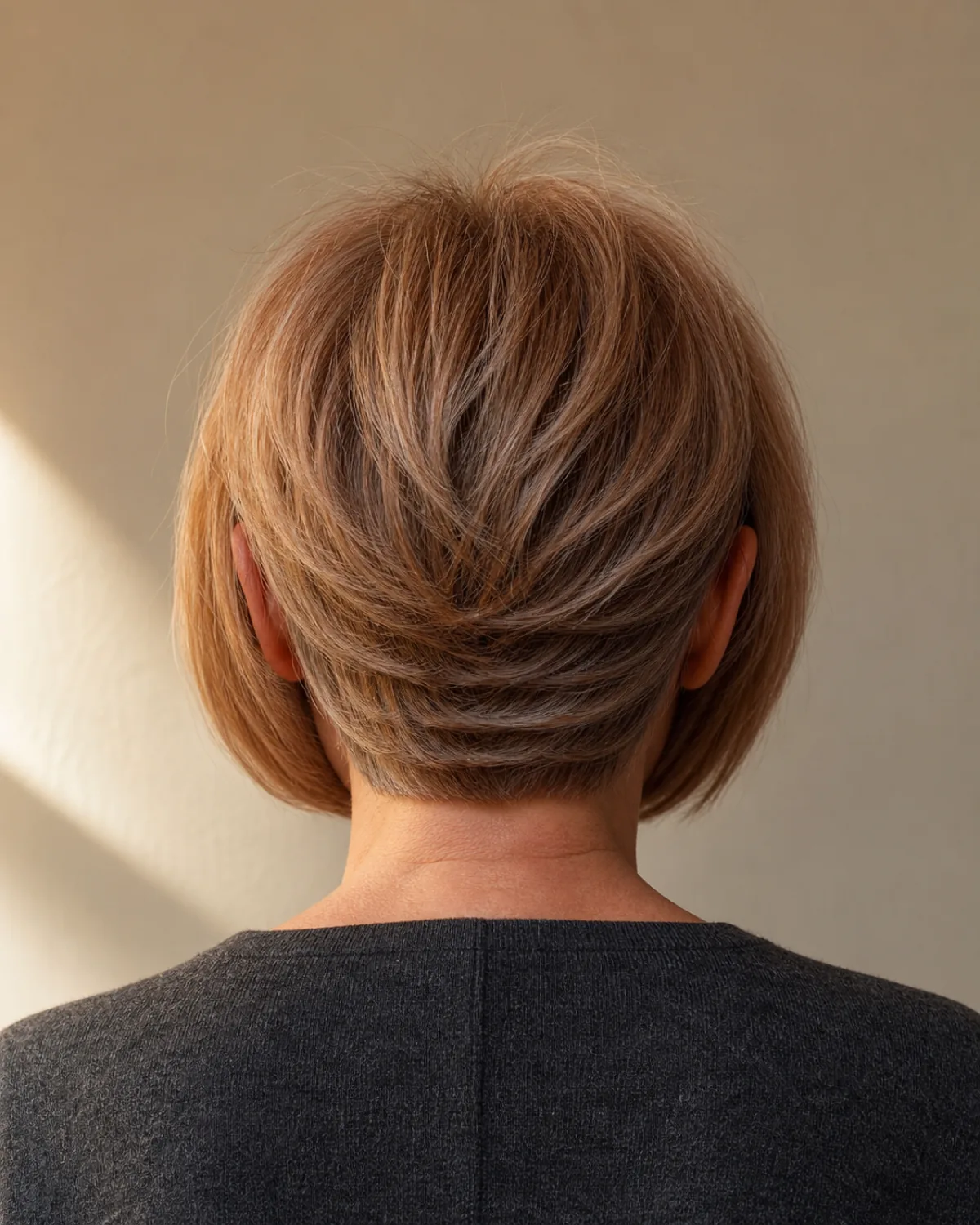
Graduation at the nape means each layer is slightly longer than the one below it. The stacking builds a visible shelf of volume that pushes the crown upward, and on fine hair that upward push is the difference between flat and full. The front stays longer and heavier, creating a weight line that reads as thickness.
This cut suits straight or slightly wavy fine hair that tends to lie flat at the back. If your hair has natural curl, stacked graduation can bunch rather than stack, and the volume reads as bulk rather than lift. A stylist who understands elevation versus graduation will know the difference.
- Graduation at the nape builds an upward shelf of volume
- The front stays longer and heavier, creating a visible weight line
- Suits straight or slightly wavy fine hair that lies flat at the back
4. A Textured Bob with Razored Ends
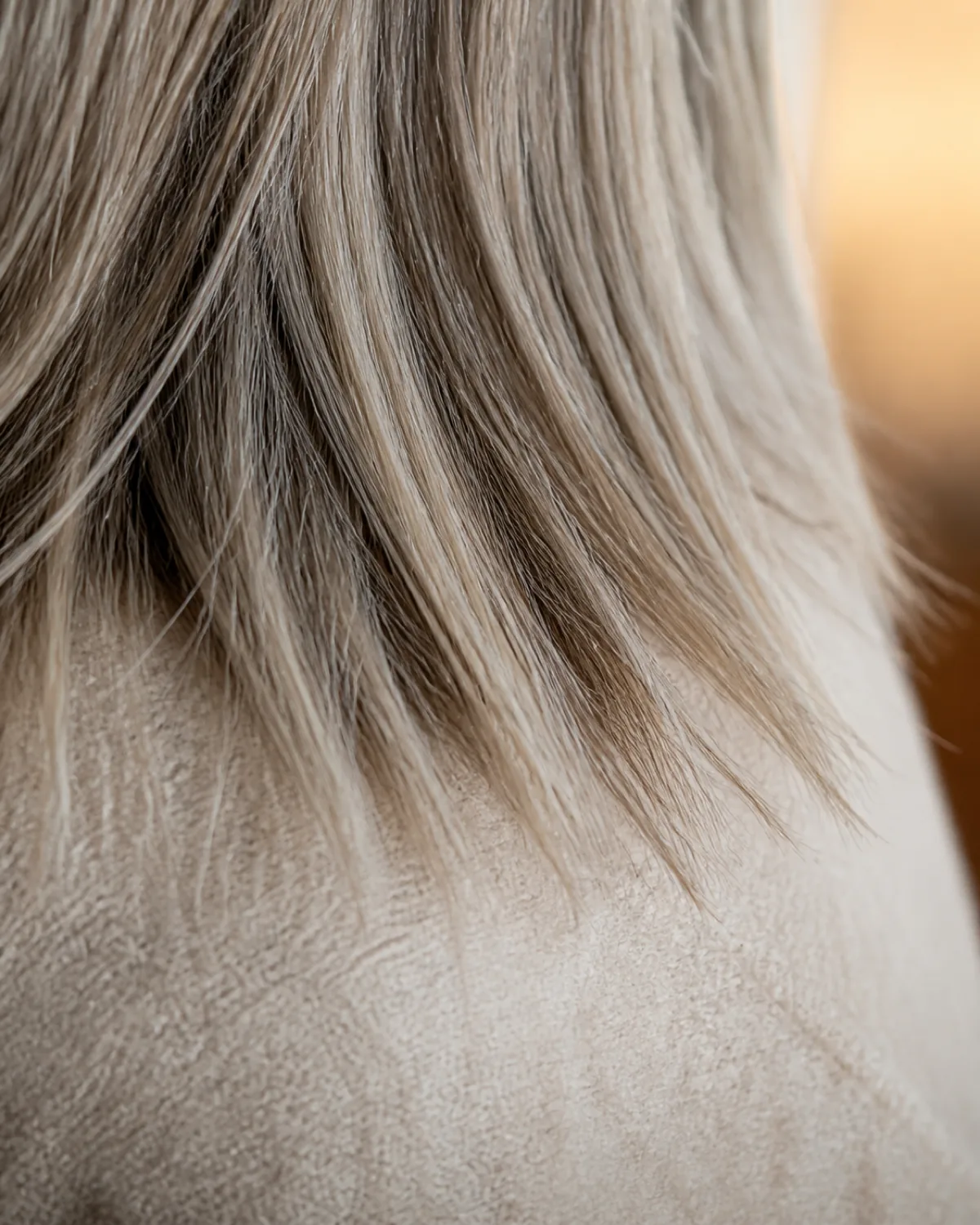
Razor-cutting removes weight from the last inch of each strand, tapering it to a fine point. On medium-density fine hair the result is soft, feathery movement at the hemline. On low-density fine hair the hemline dissolves and the ends look sparse rather than textured.
This is a density-dependent cut. The same technique reads completely differently depending on how many strands you have at the bottom. Hold your ponytail at the ends and look at its circumference. If it feels solid, razoring will add texture. If it already feels thin, razoring will make it thinner. A stylist can also point-cut instead of razor-cut for a similar effect with less density loss.
- Razoring removes weight from the last inch of each strand
- On medium-density fine hair the result is soft feathery movement
- On low-density fine hair the hemline disappears; point-cutting is a safer alternative
5. A Side-Parted Layered Bob with a Deep Side Sweep

A deep side part displaces root volume from the flat side to the full side. Combined with two or three long layers, it creates the illusion of more hair without actually removing any bulk. The heavier side reads as full coverage, and the lighter side reads as deliberate rather than thin.
This is one of the lowest-commitment options because you can try it tonight without booking a cut. Move your part to a deep side and see how the volume shifts. If you like the trade-off, two or three long layers will reinforce the shape.
For more on how a simple part change affects perceived volume, see the easy hairstyles guide.
- A deep side part shifts root volume to one side without removing any hair
- Two or three long layers add shape without thinning the ends
- Try it tonight before booking: move your part and see the volume shift
6. A Layered Bob with a Soft Curtain Fringe
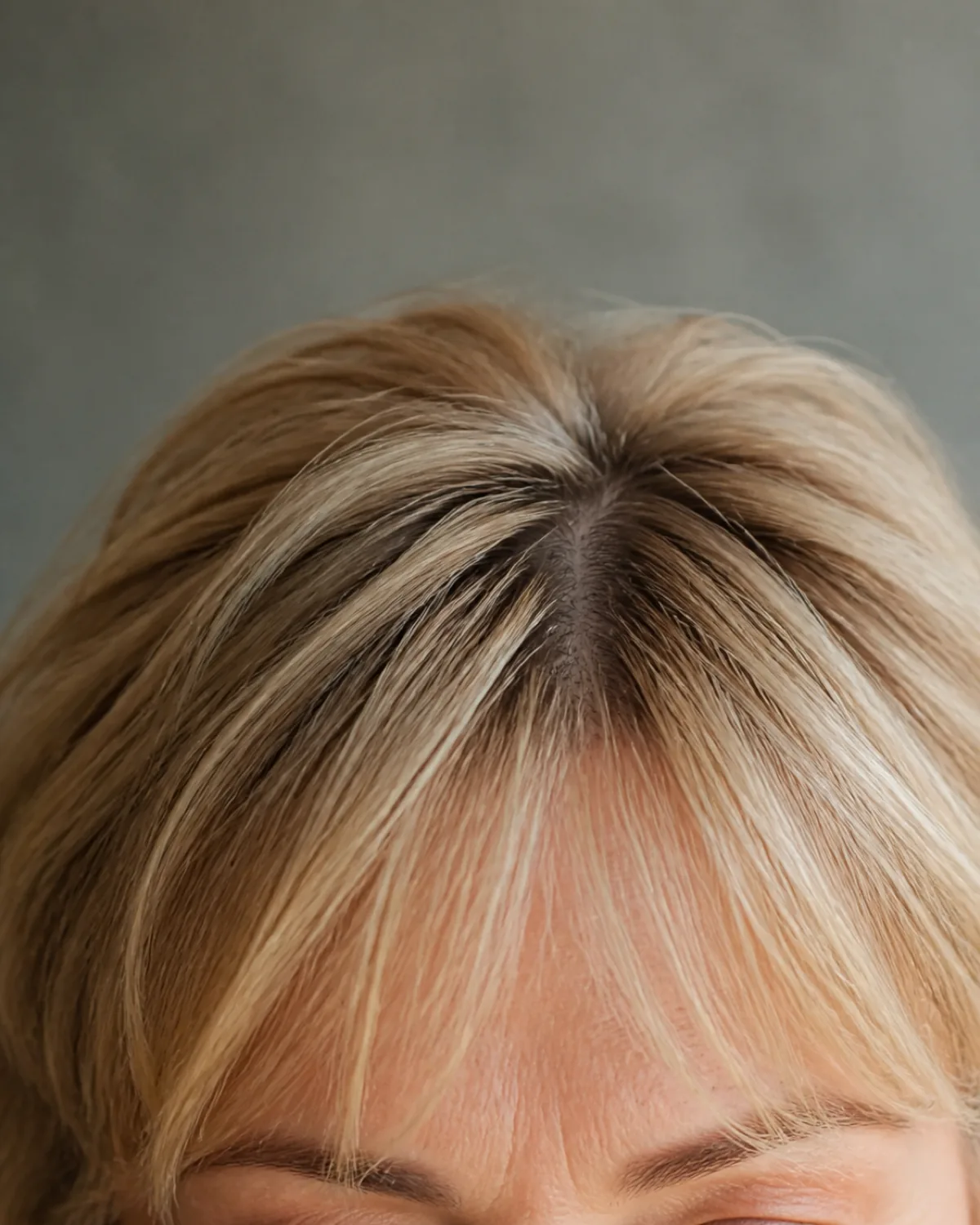
A curtain fringe parts at the center and falls to both sides of the face. The strands come from the crown-to-forehead zone, which is typically the densest area on a head where the rest of the hair is thinning. The fringe gives the face a frame while the layers behind it do the shaping.
On fine hair, keep the fringe wispy rather than blunt. A heavy blunt fringe borrows too many strands from a zone that may already be thinning at the temples, and the result is a visible gap where the fringe meets the sides. A soft, wispy curtain fringe takes fewer strands and blends more naturally into the layered bob behind it.
- Curtain fringe parts at the center and falls to both sides of the face
- The strands come from the crown-to-forehead zone, typically the densest area on fine hair
- Keep the fringe wispy rather than blunt to avoid a visible gap at the temples
7. A Jaw-Length Layered Bob Left Slightly Longer on One Side

Asymmetry creates visual interest with one length difference rather than multiple layer lines. The longer side sits about an inch below the shorter side at the jaw, and that single angle does the work that several layers would in a symmetric cut. Fine hair only needs one well-placed angle to read as styled.
The advantage for fine hair is density preservation. Instead of distributing layers throughout the cut, you keep maximum density everywhere and rely on one angle to create shape. The heavier side reads as full, the shorter side reads as intentional, and neither side looks thin.
- The longer side sits about an inch below the shorter side at the jaw
- One angle does the work of multiple layers in a symmetric cut
- Fine hair keeps maximum density because no bulk is removed through layering
A stylist who can see your hair in person outranks anything written here. Bring two photos showing the angle you want, and ask where the weight line will sit on your specific hair.
Where the checkable claims come from
- Bob cut — Wikipedia
- Graduation vs. Elevation: The Subtle Distinction That Impacts Every Cut — Above Shears
- Hair diameter and aging — Birch, Messenger & Messenger, Journal of Investigative Dermatology (2001)
- Bangs (hair) — Wikipedia
Keep this one
Save it for the appointment
Pin the image above to the board you actually open before a salon visit. This guide is written to be re-read, not read once.
Tonight, before you close this tab
- Hold your ends up to natural daylight and photograph them to see how dense or sparse they read
- Count the layers in your current cut by running your fingers through the ends and feeling where the lengths change
- Part your hair on the opposite side from usual and see whether the volume shift suits you
- Write down two questions about layer placement to ask your stylist before your next appointment