18 Low-Maintenance Haircuts for Fine Hair That Hold Their Shape Between Visits
Eighteen haircuts for fine hair judged on one question: does the shape survive between salon visits, or does it fall apart by week three?

Booking an appointment soon? Save this page. It is easier to skim in the chair than to remember.
At a glance
Works
- Cuts that grow out in a readable direction rather than splaying or going flat
- A chin-length bob when your ends still hold a clean edge in daylight
- A pixie with crown weight that goes six to eight weeks between trims
- Disconnected layers that turn grow-out into texture instead of neglect
Depends
- A shag, which needs some natural wave to separate the disconnected pieces
- A blunt perimeter, which costs almost nothing to maintain unless your ends are sparse
- A curtain fringe, which is the one piece that needs trimming even when the rest holds
Skip
- Steep graduation on fine straight hair, where the stack collapses without volume underneath
- A micro-fringe if you will not trim it at home every two weeks
- A geometric lob with a centre parting if grow-out frustrates you before it softens
Low-maintenance is not a property of a haircut. It is a relationship between a cut and the hair it sits on.
A bob that holds itself for six weeks on thick hair can lose its line in two on fine strands. The question is not which cuts are easy in general but which ones stay readable on fine hair without daily intervention.
Every cut below is judged on the same axis: how long does the shape survive between visits, and what does the grow-out cost you?
1. A blunt chin-length bob with a single-length perimeter

A bob cut to one length at the chin collects all its weight at the perimeter. That single line is the whole shape, which means gravity does almost all the work. On fine hair with good end density, this is one of the most hands-off cuts you can own.
The condition is the ends. Fine strands that have thinned at the tips show every gap in a one-length line, and no amount of product closes those gaps for long. If your ends are sparse in natural light, the blunt edge is the first thing to reconsider.
- Look at your ends in daylight before committing to a blunt perimeter
- Ask the stylist to hold the hair at the proposed length so you can see the edge before cutting
- If the ends are sparse, a bevelled or textured perimeter hides the gaps without changing the length
- The grow-out on a blunt bob is forgiving because the line simply moves down
2. A textured pixie with weight at the crown
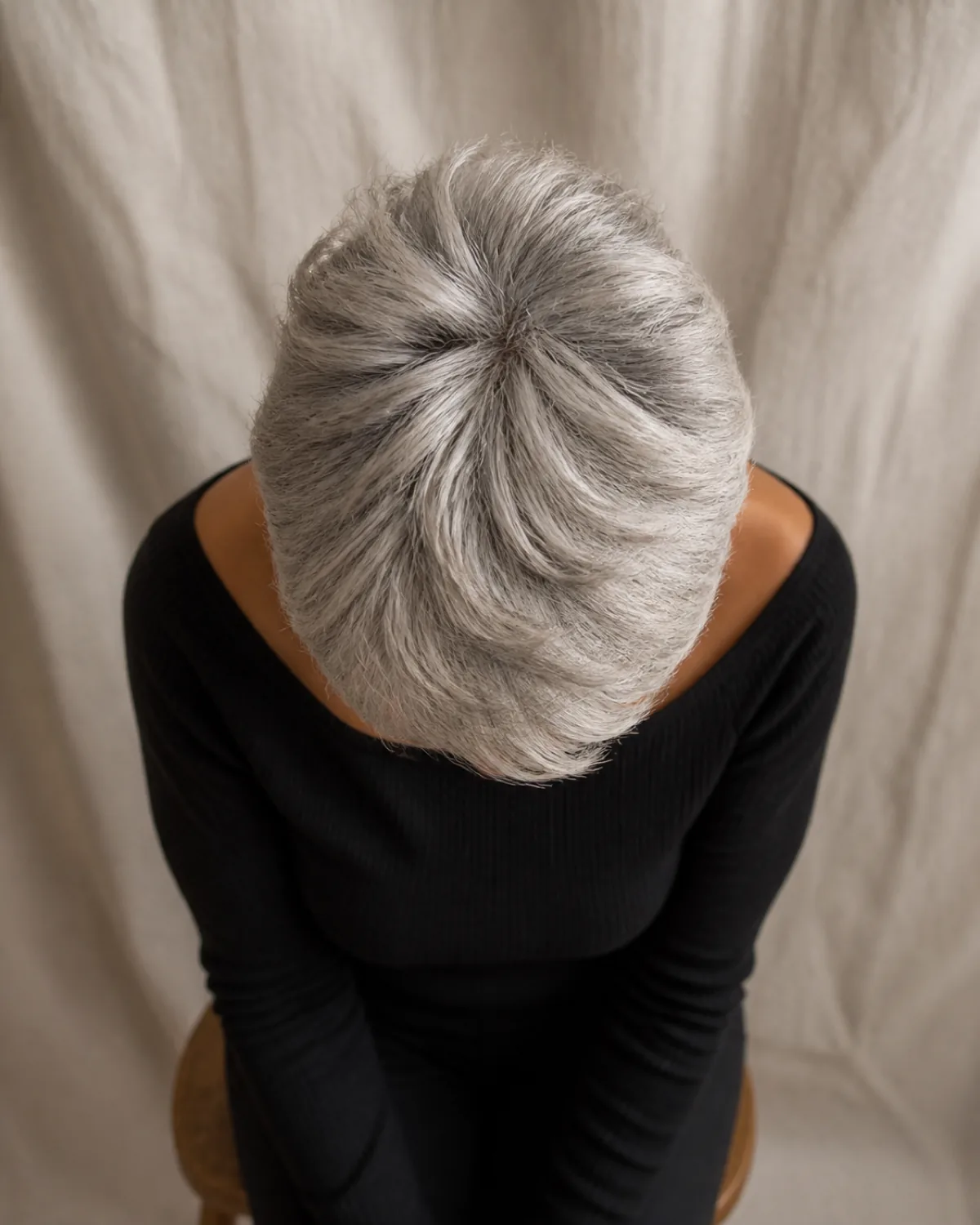
A pixie that keeps the crown long can go six to eight weeks between trims without losing its proportions. The crown length gives fine hair enough height to read as deliberate even when the cut is overdue. The sides, cropped close, grow slower and stay clean longer.
The maintenance is almost nothing. Towel-dry, run your fingers through the crown, and leave it. The structure is in the cut, not in what you do with a dryer.
- Ask for the crown to stay at least two inches while the sides taper close
- The grow-out reads as intentional because the proportions shift slowly
- Fine hair benefits here because the crown does not need density to stand up
- If the sides start to look heavy before the top, one clipper pass at home buys another two weeks
3. A long layered lob that falls past the collarbone

Length is the lowest-maintenance variable on fine hair. Shorter cuts need more frequent shaping because an eighth of an inch changes the proportions. A lob past the collarbone can go months between cuts because the length absorbs new growth.
The risk is a flat, featureless curtain. Long layers underneath prevent that without removing density from the perimeter. The layers are invisible from outside but keep the ends from lying in a single lifeless plane.
- Ask for internal layers only, so the perimeter stays one-length
- The layers should start below the chin to preserve the weight where fine hair needs it
- Skip surface layers on fine hair because they thin the visible outline
- Grow-out is almost invisible because the length absorbs each millimetre of new growth
4. A side-swept pixie with a deep side parting

The deep side parting displaces volume to one side without a single product. Fine hair looks thicker on the heavy side and the thin side reads as a deliberate close crop. The asymmetry is the shape, so when it grows out unevenly, it still reads like a choice.
Two months is a reasonable interval before the proportions blur. The swept-over side gains length and starts to read less pixie and more bob, which is not a problem unless you mind the drift.
- Move your parting an inch further to the side than feels natural and see if you prefer the result
- The grow-out is asymmetric by design, so it reads as intentional longer than a symmetric pixie
- Ask the stylist to keep the short side close enough that the grow-out stays tidy for at least six weeks
- Fine hair benefits from the displacement because the volume is concentrated, not spread thin
5. A one-length bob at jaw level with bevelled ends
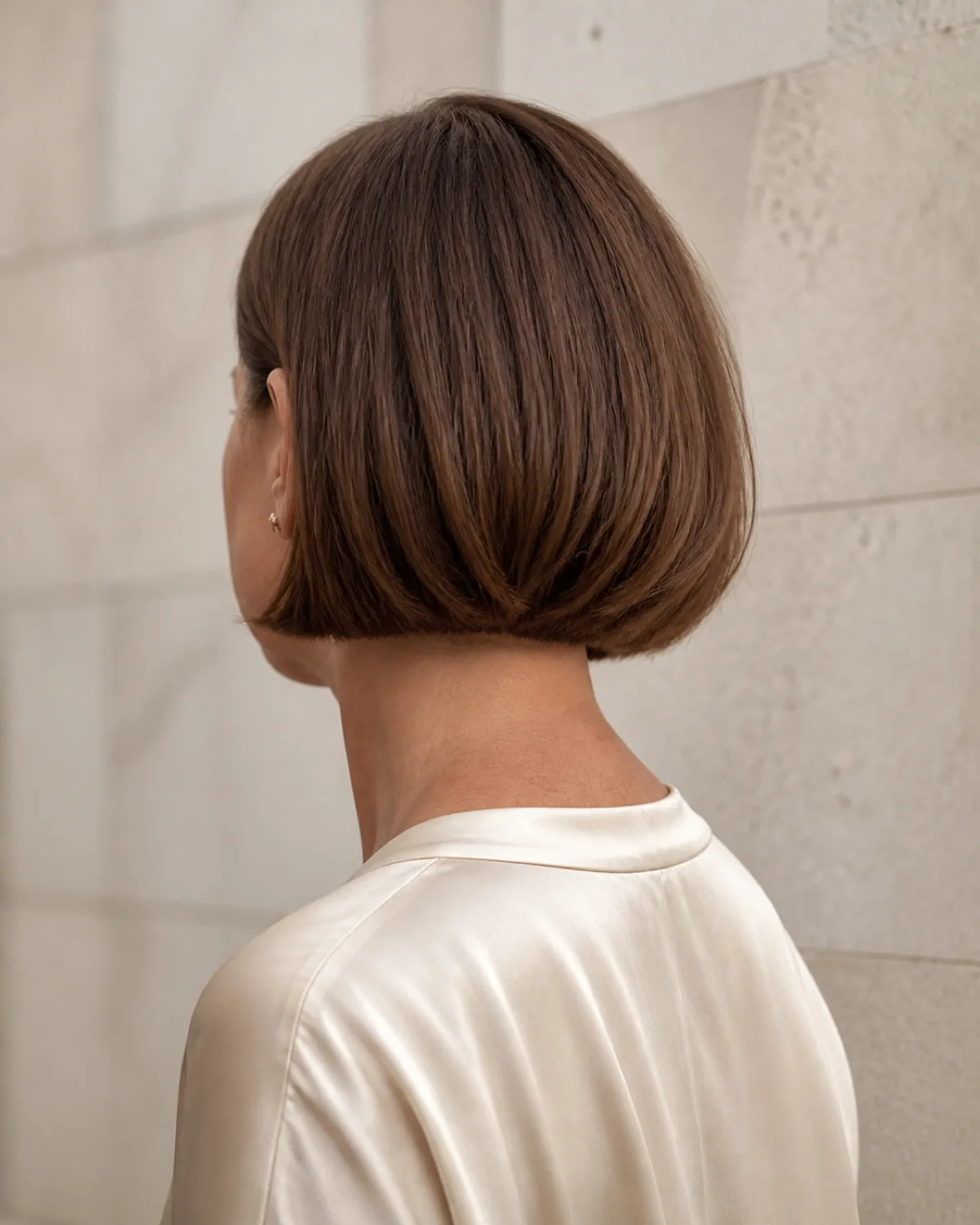
The bevel is a small inward angle at the cutting edge. It removes the blunt line that exposes gaps on fine ends and replaces it with a softer boundary that hides imperfection by design. The maintenance is lower than a blunt bob because the perimeter was never meant to be precise.
Bevelled ends also curl slightly inward, which makes fine hair read thicker at the bottom. The effect holds without a round brush. On hair that lies flat, the bevel does what product tries to do and lasts longer.
- Tell the stylist you want the perimeter bevelled inward, not blunt
- The difference is subtle but the grow-out is significantly more forgiving
- Bevelled ends read clean even when they are three weeks overdue
- This is the bob to choose if you like the shape but your ends are not dense enough for a sharp line
Where to start
Find your situation, skip ahead
Your hair is fine and you want to stretch salon visits to every eight weeks
Look at the pixie and bixie options first. Their proportions hold longest because the shape is in the cut, not the styling.
02 A textured pixie with weight at the crown10 A cropped pixie with tapered sides and length on top15 A layered pixie bob (bixie) that bridges pixie and bob
Your hair is fine and you refuse to give up length
A collarbone lob or razored cut keeps length while the texture does the work product would do on a plain one-length style.
03 A long layered lob that falls past the collarbone11 A razored collarbone cut with invisible layers08 A curtain fringe paired with a collarbone lob
Your hair is fine and you have less than three minutes in the morning
The ear-tuck bob and the towel-dry pixie are the two cuts where the daily styling is one gesture.
13 An ear-tuck bob with the sides pushed behind the ears10 A cropped pixie with tapered sides and length on top12 A wispy bob with piece-y ends and no bangs
6. A soft shag with disconnected layers

Disconnected layers grow at different rates, which means the grow-out reads as texture rather than neglect. On fine hair with some natural wave, the pieces separate on their own and the shag's chaos becomes the point. A missed appointment looks like styling.
The condition is wave. On poker-straight fine hair, disconnected layers lie flat and read as thinned-out gaps instead of intentional separation. If your hair has any bend at all, even a slight curve after air-drying, the shag will work.
- Ask for disconnected layers, not blended ones, so the pieces fall at different lengths
- The shortest layer should sit where your hair has the most natural movement
- Straight fine hair needs a different cut because the disconnection reads as thinning
- This is the most forgiving cut on the list for skipping the salon
7. A chin-length graduated bob, stacked at the nape
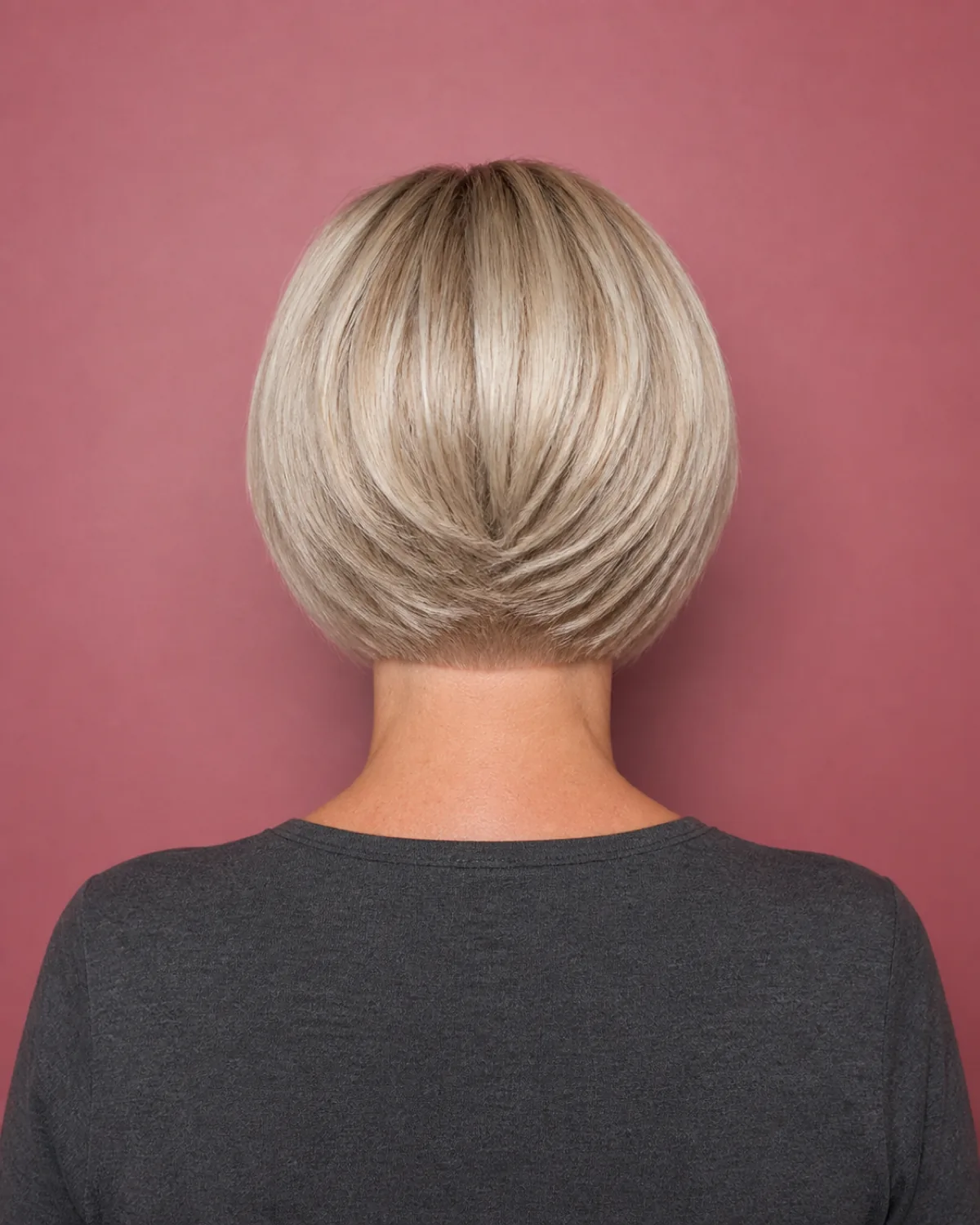
Graduation lifts weight into the back of the head. Each layer is slightly shorter than the one above it, creating a wedge that compresses inward. On fine hair, the stack makes the back read thicker because the layers push against each other instead of lying flat.
The grow-out is neat because the stack compresses rather than splays. The layers grow down and in, maintaining the wedge until the nape starts to look heavy. That usually takes six to eight weeks on fine hair.
- Ask for the graduation to start at the occipital bone and stack down to the nape
- The front should stay longer than the back to frame the face
- Fine straight hair benefits most because the graduation creates volume the texture cannot
- If the nape starts to feel heavy, one quick trim at the back buys another month
8. A curtain fringe paired with a collarbone lob
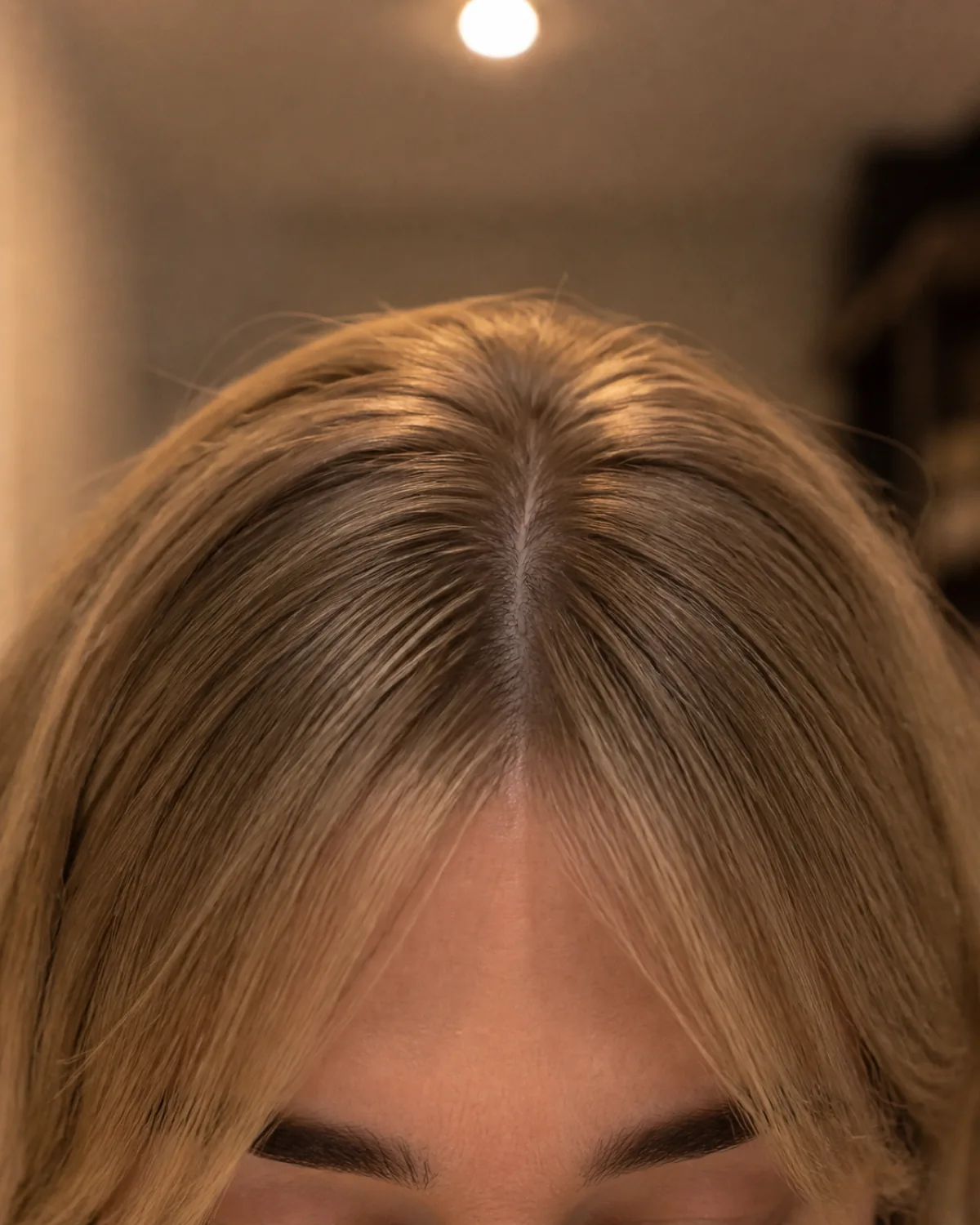
The curtain fringe is the only high-maintenance piece in this cut. The rest is a collarbone lob held by gravity. The fringe needs trimming every three to four weeks to stay above the eyes. Everything else can go two months.
On fine hair, the fringe must be cut narrow. A wide curtain fringe pulls density away from the sides and makes the hair look thinner overall. Narrow means the curtain uses only the hair directly above the forehead, leaving the sides full.
- Tell the stylist to keep the curtain narrow, no wider than the outer edges of your eyebrows
- A wide curtain on fine hair thins the sides visibly
- Decide upfront whether you will trim the fringe at home or accept the salon schedule
- The lob itself is one of the least demanding shapes because length absorbs new growth
9. A French bob with ear-length sides and a micro-fringe

The French bob is short enough that the geometry holds for weeks. Ear-length sides do not splay because there is not enough length to lose shape. The structure is in the cut, not in what you do after washing.
The micro-fringe is the trade-off. Cut well above the eyebrows, it grows out visibly fast. You will need to trim it at home every two weeks or accept that it becomes a regular fringe within a month. If you are willing to do that, the rest of the cut is nearly zero-effort.
- The French bob works on fine hair because the short length concentrates what density you have
- Ear-length sides hold their geometry longer than chin-length ones
- The micro-fringe is the price of admission, so decide whether you will maintain it before committing
- A salon visit every six to eight weeks keeps the bob shape; the fringe is the only piece that needs more
10. A cropped pixie with tapered sides and length on top
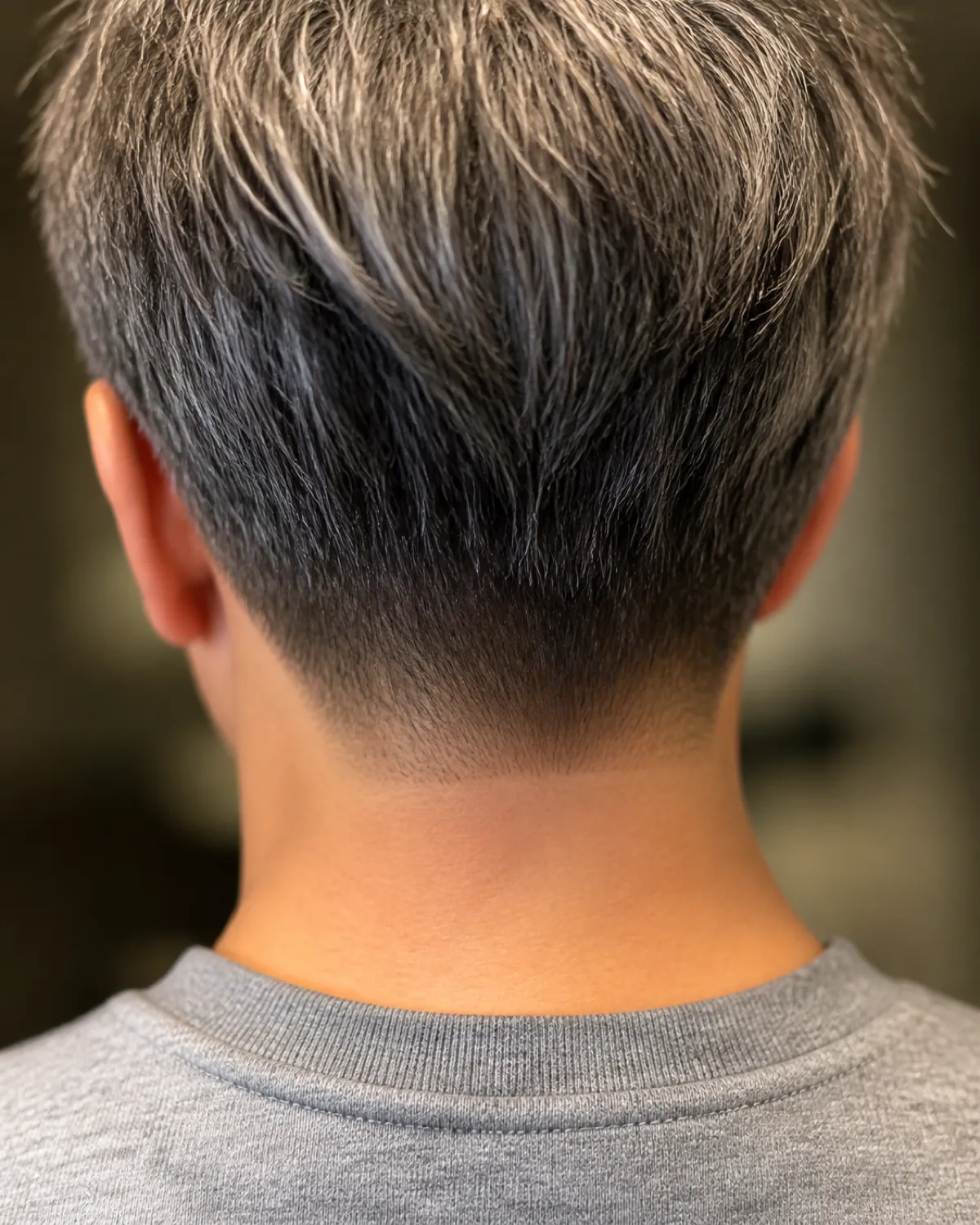
The taper at the sides grows slower than the top, so the proportions hold longer than a uniform crop. Fine hair on top stands up when it is short enough, which means the cut looks styled even when you have done nothing.
This is the towel-dry-and-go cut. No product, no dryer, no mirror time. The shape holds for about six weeks before the top starts to flop and the sides need cleaning up. For fine hair, this is the ceiling of low-maintenance.
- Ask for the sides to taper to about half an inch, with the top left at one to two inches
- The top should have enough length to show texture but not enough to lie flat
- Fine hair stands up naturally at this length, which is why the cut works without product
- One home clipper pass on the sides extends the interval by two to three weeks
11. A razored collarbone cut with invisible layers

Razor-cut ends separate on fine hair and create the illusion of more strands without removing density from higher up. The texture at the tips does the work that a round brush would do on a plain one-length style. An imperfect blowout is hidden by the texture, not exposed by it.
The layers are invisible from outside. The perimeter looks mostly one-length, but the internal structure keeps the ends from clumping into a single flat sheet. The grow-out is gentle because the razored tips soften naturally.
- Ask for razor-cut ends specifically, not scissor-point cutting
- The internal layers should not be visible at the perimeter
- Razored ends work best on fine hair that is not also extremely sparse at the tips
- The texture hides a bad hair day better than any smooth one-length cut
12. A wispy bob with piece-y ends and no bangs

No fringe means nothing to maintain between visits. The piece-y texture at the ends is the shape, so day-three hair reads the same as day-one hair. The wispy quality is built into the cut, not achieved with product or heat.
On fine hair, piece-y ends are a deliberate trade: you give up the clean line of a blunt bob and gain a shape that forgives imperfect drying. The ends separate on their own and the separation is the style.
- Ask for the ends to be point-cut or slide-cut to create natural separation
- Skip bangs entirely to eliminate the one piece that would need regular trimming
- This bob reads right on air-dried hair, which is the whole point for fine-hair maintenance
- The grow-out is gradual because piece-y ends do not show a distinct grow-out line
13. An ear-tuck bob with the sides pushed behind the ears
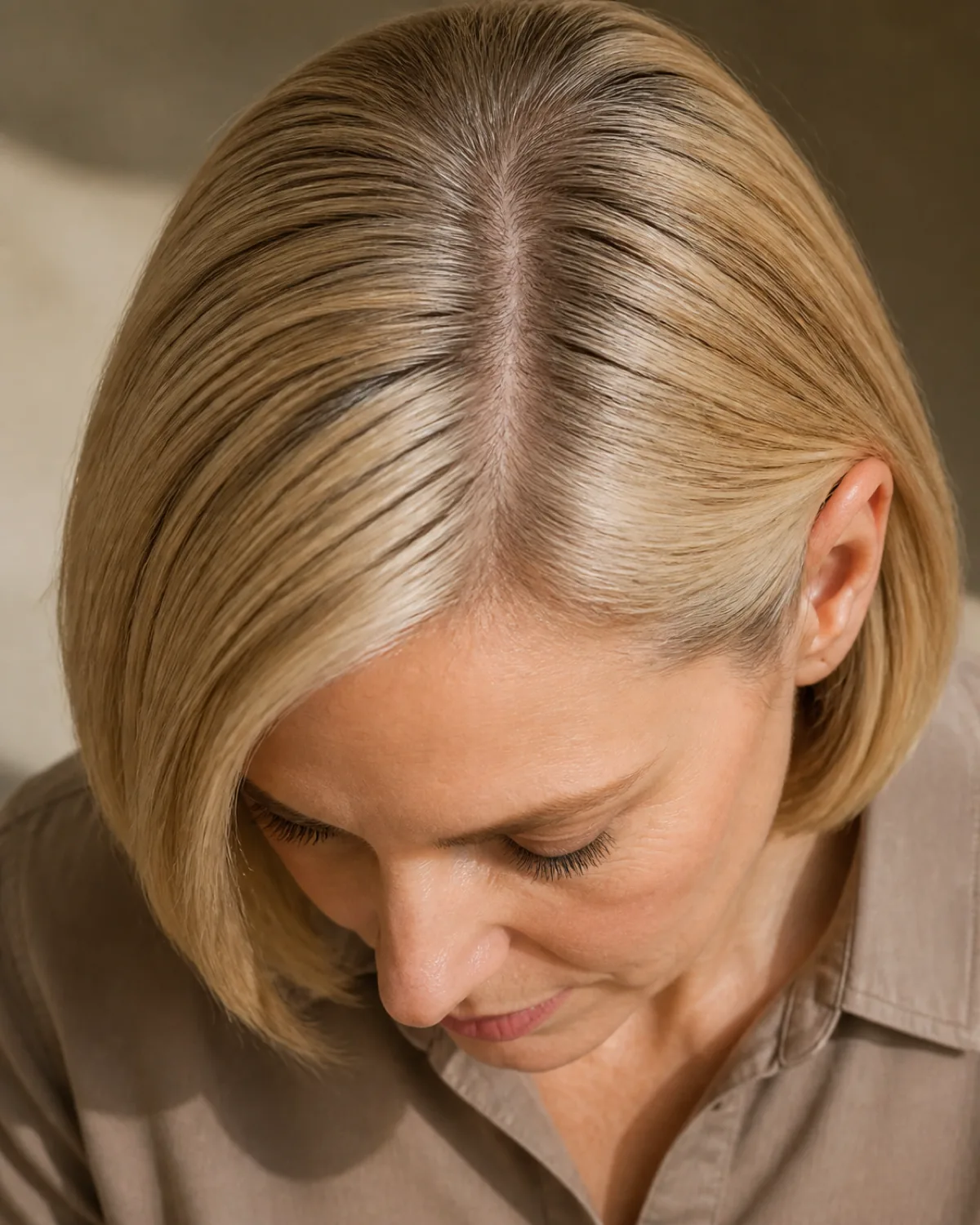
The ear-tuck is a styling gesture, not a cut. The cut itself is a plain bob at jaw level. Tucking one or both sides behind the ears visually shortens the perimeter, lifts weight away from the jaw, and takes about two seconds.
That two-second gesture is the entire daily effort. No product, no tool, no technique. The bob underneath grows out at its own pace and the tuck adjusts automatically because the ear stays in the same place.
- The cut is a standard jaw-length bob with no layers and no fringe
- Tuck one side for asymmetry or both sides for a cleaner look
- The ear-tuck works on fine hair because it concentrates volume behind the ear instead of spreading it along the jaw
- Grow-out does not change the styling gesture, so the interval between cuts is flexible
14. A blunt lob with a centre parting

This is the most geometric option on the list, which means it has the most unforgiving grow-out. The centre part and the blunt edge are both precision elements. Any softening is visible.
The question is whether you can accept the softening as a feature rather than a flaw. The blunt lob at the collarbone gradually turns into a slightly longer, slightly softer version of itself. If you see that as a gradual relaxation, it is low-maintenance. If you see it as losing control, it is not.
- The centre parting works best on hair with even density on both sides
- Fine hair lies flat from the part, which makes the geometric line easier to hold than on thicker hair
- The grow-out softens the line rather than breaking it, which can read as an intentional relaxation
- If precision matters to you, this cut needs trimming every six weeks; if not, it can stretch to ten
15. A layered pixie bob (bixie) that bridges pixie and bob
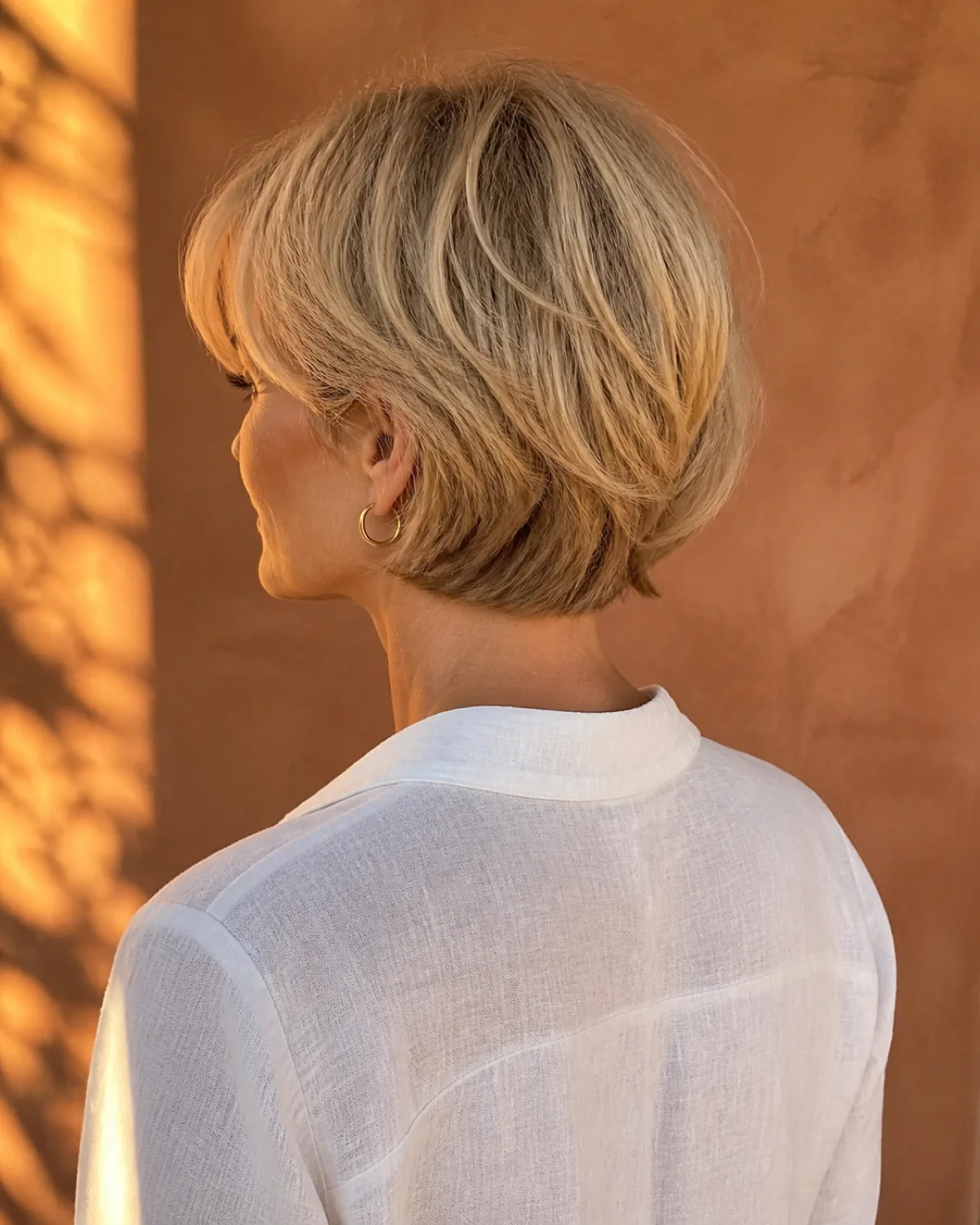
The bixie sits between a pixie and a bob, which means you can let it grow from one toward the other without an awkward stage. Fine hair benefits because the transitional length never looks unfinished. The layers create soft movement at a length where fine hair usually just lies flat.
The grow-out is the entire design. A bixie that was cut at the earlobe becomes a short bob at the jaw over two months. If you liked the bob length, you keep it. If you preferred the pixie, you cut back. Either way, the in-between phase is the style, not a problem.
- Ask for the length between the earlobe and the bottom of the ear
- The layers should create movement, not remove density
- Fine hair reads well at bixie length because the weight is concentrated
- The grow-out is the most graceful on this list because the destination is just another good cut
16. A soft wedge at the nape with volume through the crown
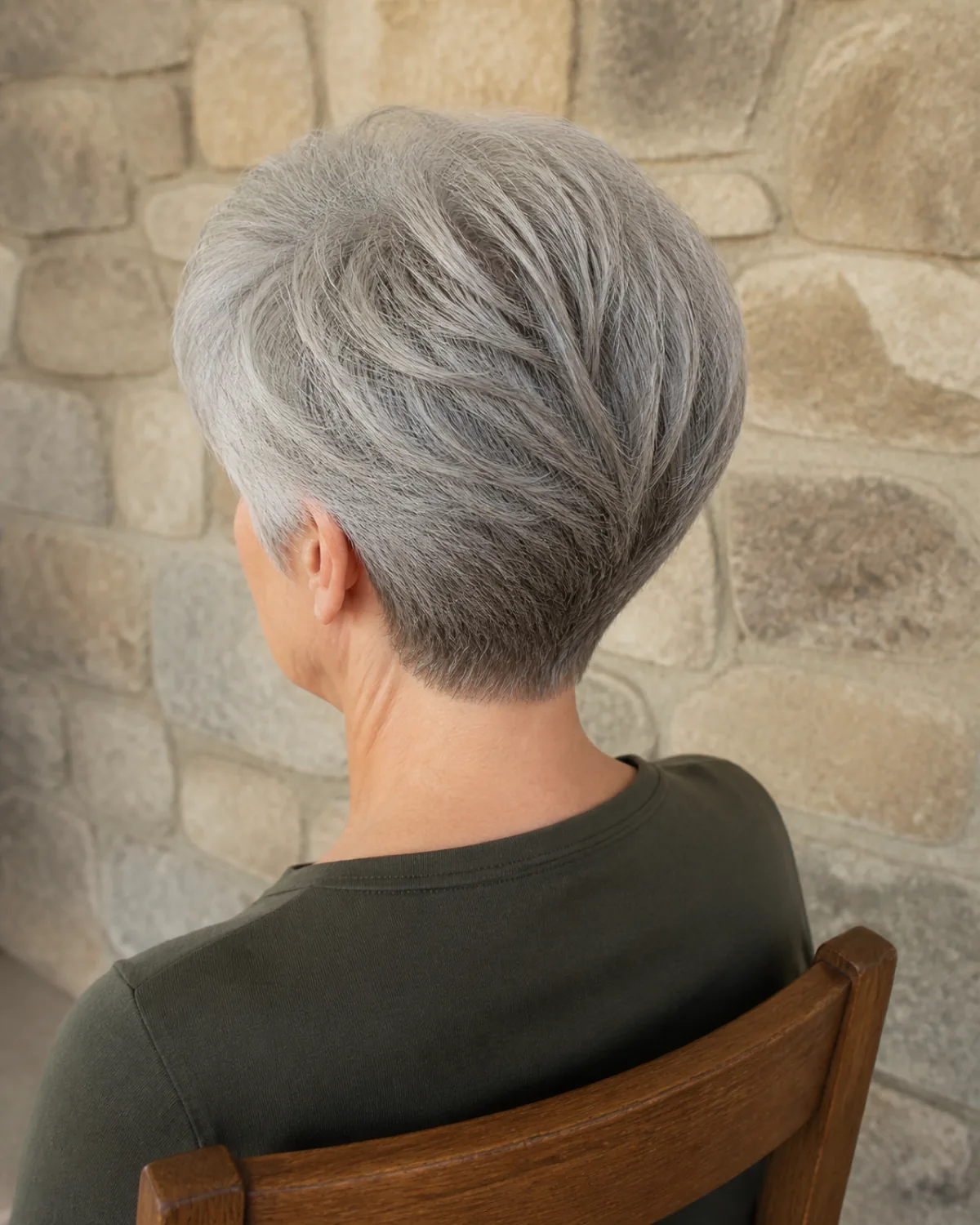
The wedge is the original low-maintenance short cut for fine hair. One shape, no layers to separate, no pieces to arrange. The volume comes from the crown length, and the close nape keeps the back tidy. The whole thing grows out as a unit.
On fine hair, the wedge creates the illusion of density because the crown pushes up and the nape compresses down. The contrast reads as thickness even when the total density is modest. The grow-out is uniform, so the proportions hold until the nape feels heavy.
- Ask for the crown to keep enough length to lift, and the nape to taper close
- The wedge shape does not require layers, which preserves every strand of density
- Fine straight hair benefits the most because the geometry creates volume the texture cannot
- Trim the nape when it starts to feel thick, and the crown takes care of itself
17. A collar-length shag with face-framing pieces

The face-framing pieces do the work that product would do on a plain cut. They fall shorter than the back, frame the cheekbones, and move with every head turn. The shag behind them is deliberate disorder, which means it always looks like it was meant to look that way.
On fine hair, the face-framing pieces are the critical detail. Without them, a collar-length cut lies flat against the face and reads as curtain-like. With them, the shorter pieces create the only movement the cut needs.
- Ask for face-framing pieces that start at the cheekbone and blend into the shag
- The back should be collar-length with loose disconnected layers
- Fine hair with any wave benefits most because the pieces separate naturally
- The grow-out is slow to show because the shag absorbs new length and the face-framing pieces grow into the next length down
18. A long pixie with a side-swept fringe and textured back
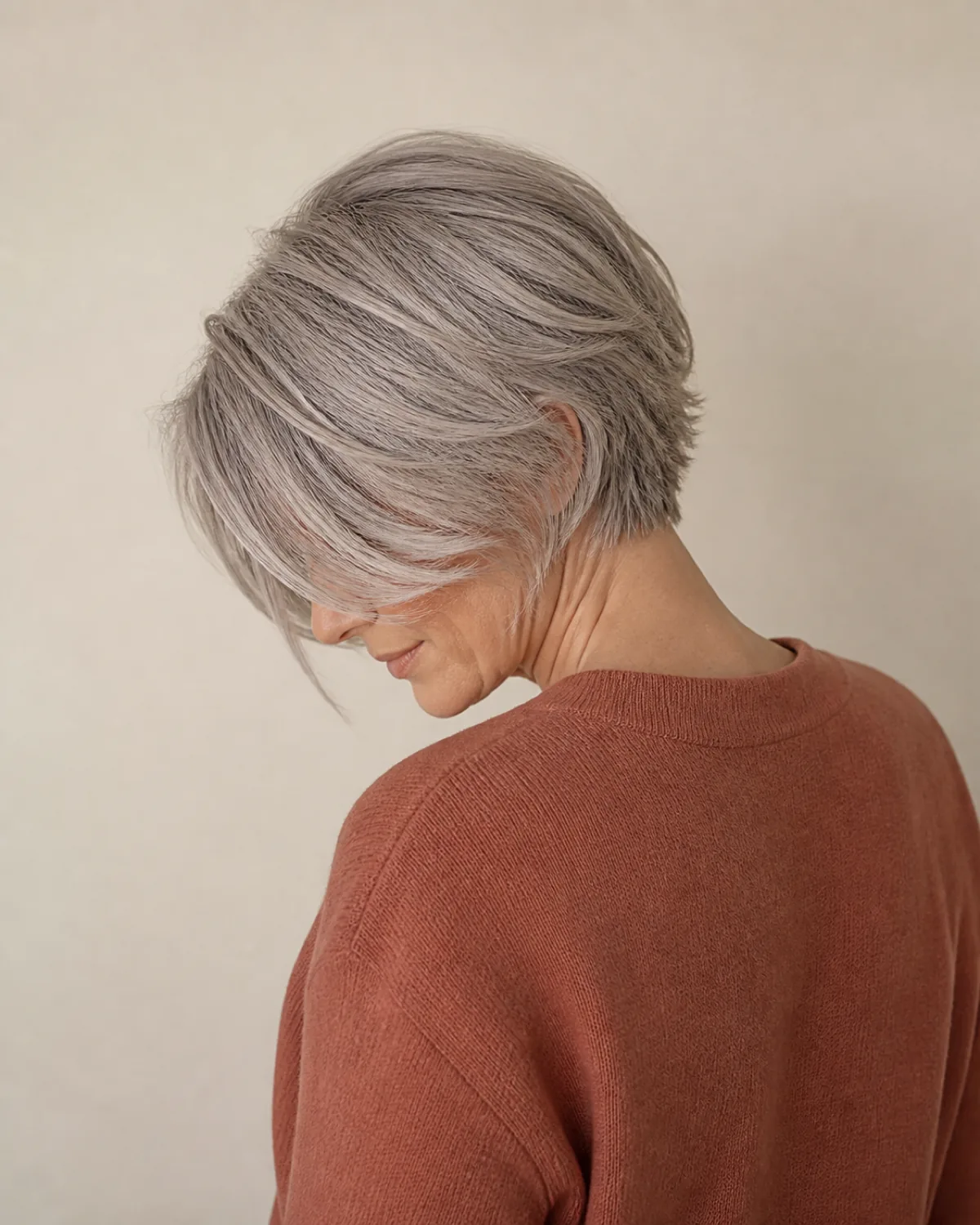
Longer than a crop, shorter than a bob. The textured back hides the neckline grow-out that makes short cuts look abandoned on fine hair. Instead of a clean nape that grows into a messy one, the texture was there from the start.
The side-swept fringe adds length at the front that balances the short back. On fine hair, the fringe lies flat naturally, which is exactly what you want. No round brush, no product, no directing it into position every morning.
- Ask for the back to be textured rather than blunt, so new growth blends in
- The fringe should sweep to the side and fall to about the cheekbone
- The textured back is what makes this cut lower-maintenance than a standard pixie
- Grow-out at the nape is hidden by the texture for about two months before a trim is needed
The cut that costs you the least time is the one that still looks like a cut when you have done nothing to it. That is a question about your hair specifically, not about haircuts in general. A stylist who can see your hair in person outranks anything written here.
Where the checkable claims come from
- Bob cut — Wikipedia
- Pixie cut — Wikipedia
- Graduation vs. Elevation: The Subtle Distinction That Impacts Every Cut — Above Shears
- Hair diameter and aging — Birch, Messenger & Messenger, Journal of Investigative Dermatology (2001)
- Bangs (hair) — Wikipedia
Keep this one
Save it for the appointment
Pin the image above to the board you actually open before a salon visit. This guide is written to be re-read, not read once.
Tonight, before you close this tab
- Look at your hair on day three after washing and note whether the shape still reads
- Check your ends in natural light to see whether a blunt edge or textured edge suits your density
- Time your morning routine from towel to door and write down the number
- Photograph your current cut at week four and week eight to see where it loses its shape