19 Hairstyles for Women Over 50 With Dark Hair That Show Every Cut Line
Nineteen hairstyles for women over 50 with dark hair, each judged by how the cut reads against a shade that hides nothing and flatters precision.
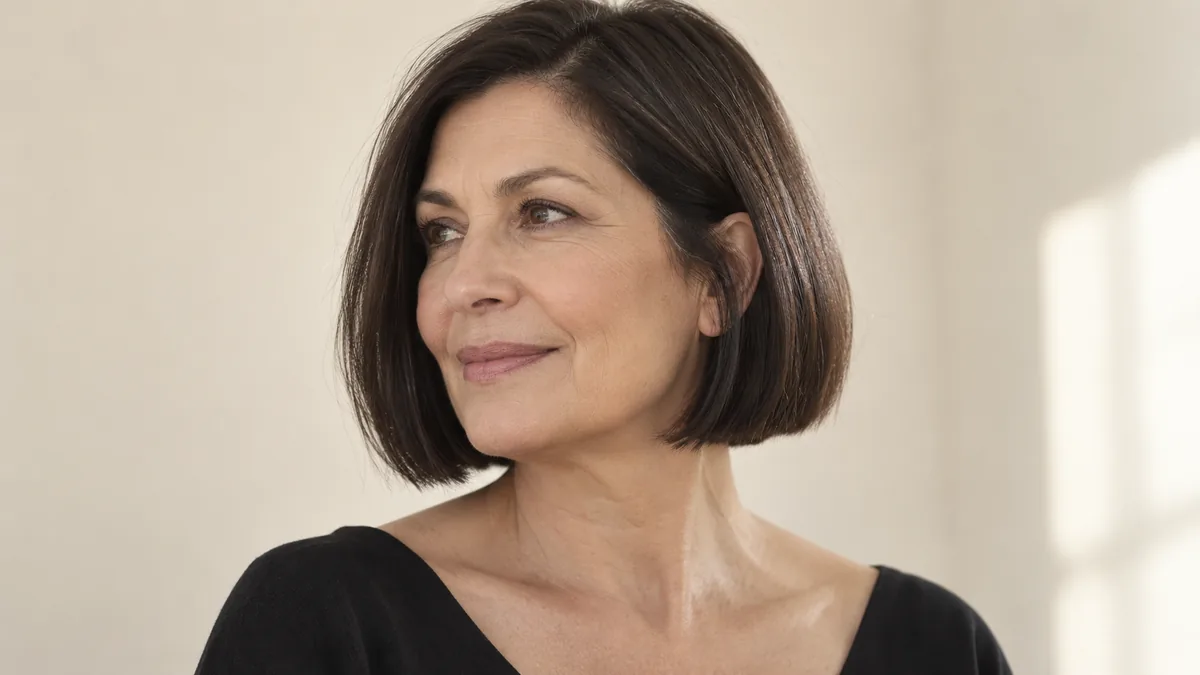
Booking an appointment soon? Save this page. It is easier to skim in the chair than to remember.
At a glance
Works
- Blunt cuts at jaw or chin height — dark hair holds a clean edge better than any other shade
- Textured pixies that break up the solid-block look of dark hair without exposing the scalp
- Interior-only layers that add movement while keeping the dark perimeter line unbroken
Depends
- A one-length lob — looks polished on hair that is even from root to tip, but draws attention to thin ends
- Curtain bangs — frame the face well on dense hair, expose thinning temples on fine hair
- Razored ends — soften blocky dark ends on thick hair, but make fine dark hair look wispy
Skip
- Short crops when the crown is thinning — dark hair against pale scalp magnifies the contrast
- Heavy graduation on very curly dark hair — curls obscure the line and the shape reads as accidental
- Keeping one length past the collarbone when the last three inches are visibly thinner
Dark hair is the most unforgiving shade for structure. Every gap shows. Every thinning spot reads. Every blunt end registers as either a deliberate line or a mistake. There is no blending into the light the way blonde and silver do.
That visibility works both ways. A well-chosen cut on dark hair looks sharper than the same cut on any other shade. The question is which cuts exploit that property and which ones get exposed by it.
These nineteen hairstyles are judged by one question: does this cut use what dark hair shows, or does it get punished by it?
1. Blunt Bob at Jaw Length
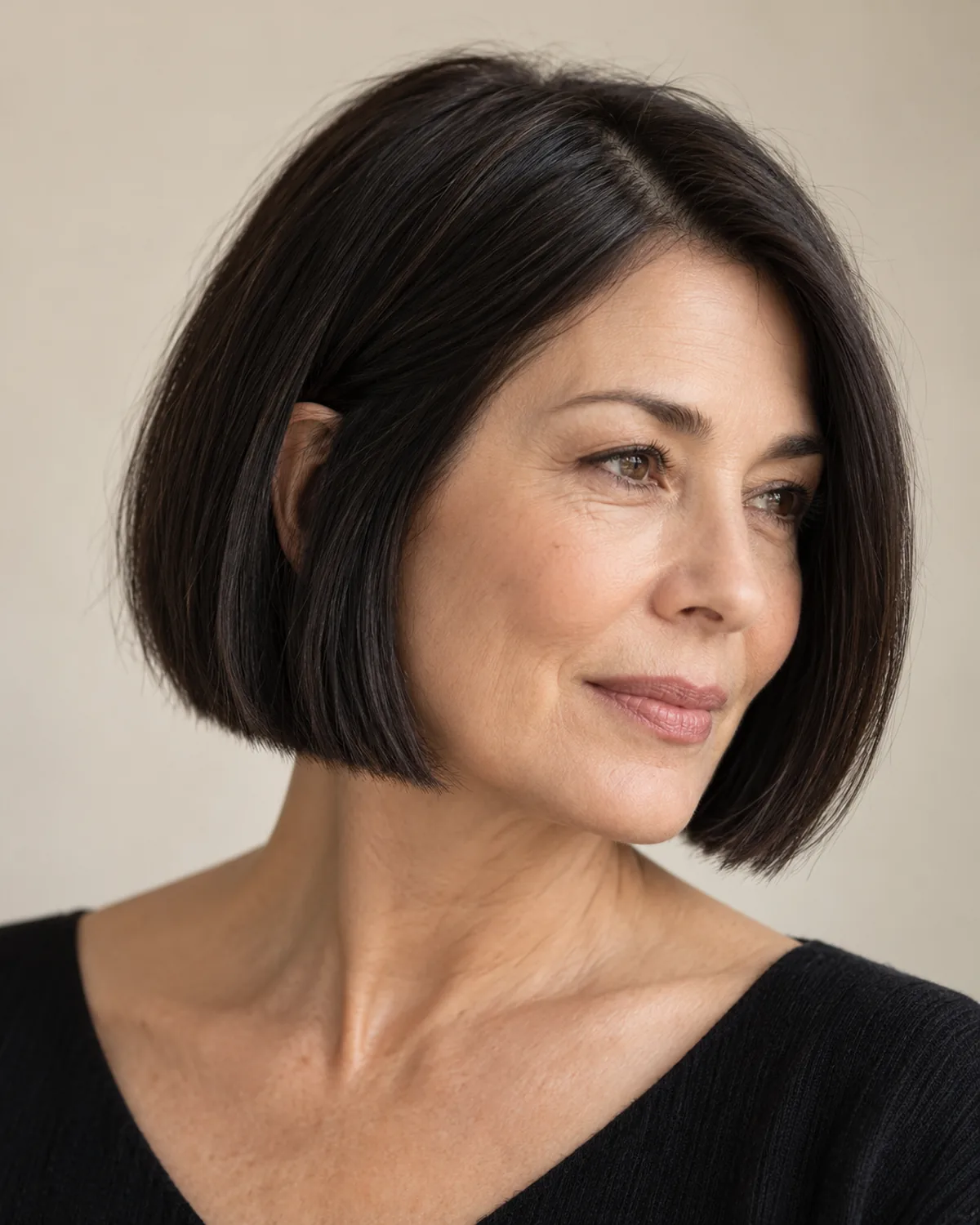
Dark hair holds a blunt hemline better than any other shade because every strand reads as part of the same edge. At jaw length the line sits at the widest point of the face and frames it with a single unbroken border. This three-quarter view shows how cleanly the dark line terminates against the neck.
- Works on straight to slightly wavy hair with moderate to thick density. The more strands at the hemline, the sharper the edge reads
- The blunt cut at jaw length is one of the most self-maintaining shapes on dark hair. The line stays visible between salon visits
- Skip on very fine dark hair where the hemline thins out — the blunt line exposes exactly how few strands reach the end
- Ask the stylist to cut dry so the hemline reads true without blow-drying, and to leave the perimeter untexturized
2. Textured Pixie With Piece-y Top
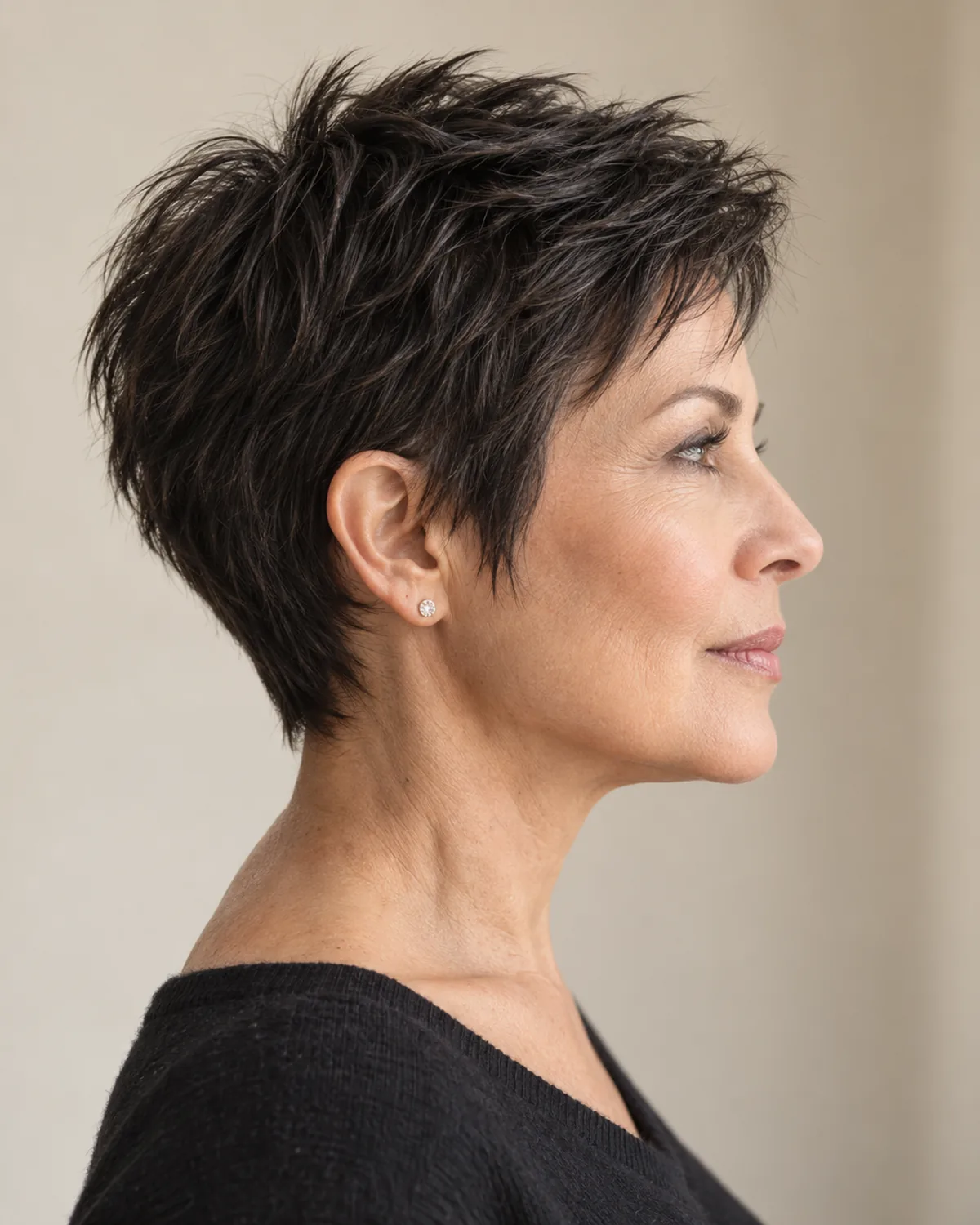
A short pixie where the top is point-cut into separated pieces. On dark hair the individual pieces stand out against the scalp, giving the illusion of density even on medium-thick hair. This full profile shows how each piece separates and casts its own shadow.
- Works on straight to wavy hair with enough density that the scalp does not show through the separated pieces
- Point-cutting the top creates texture that dark hair would not otherwise have. Without it, a dark pixie can read as a solid helmet
- Skip if the scalp is visible through the top — dark hair next to pale scalp creates a high-contrast gap that the pixie magnifies rather than disguises
- Tell the stylist to point-cut rather than blunt-cut the top, and to leave enough length for each piece to fall independently
3. Long Layers Starting Below the Chin
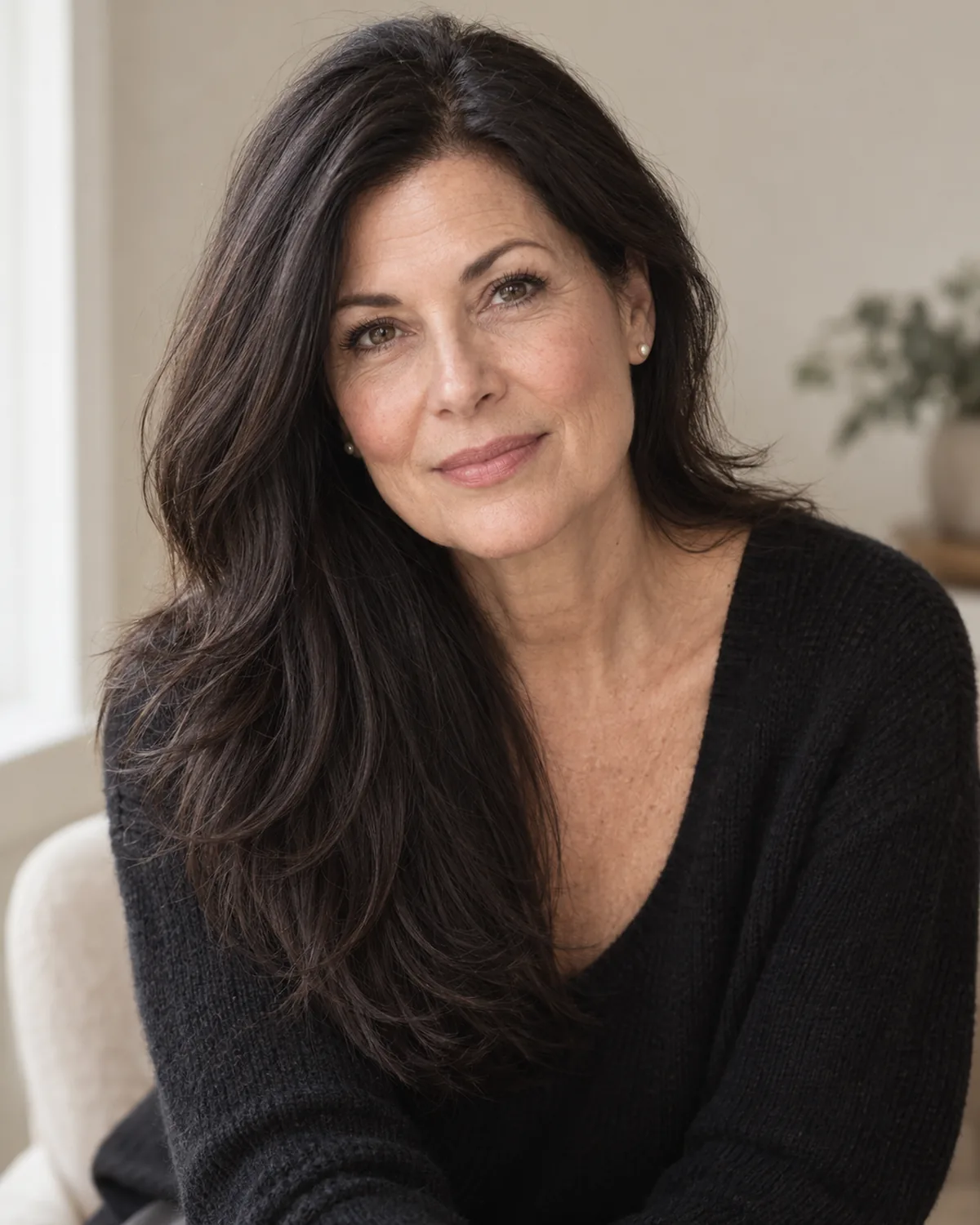
Layers that begin below the chin keep the top section solid and unbroken. On dark hair an unbroken top section reads as thick because there are no gaps for light to pass through. Starting the layers low means the movement happens at the ends where the hair is already thinner, not through the crown where density matters most.
- Works on wavy or slightly curly dark hair past the shoulders — the wave holds the low layers and prevents them from hanging flat
- The solid top section is the structural advantage here. On dark hair, any break in the upper canopy reads as a thin spot
- Skip on very straight dark hair that lies flat — without wave, the layers separate into visible channels that dark hair makes prominent
- Ask the stylist where the first layer begins and make sure it is below the chin — higher layers on dark hair create visible breaks
4. Side-Parted Lob at One Length
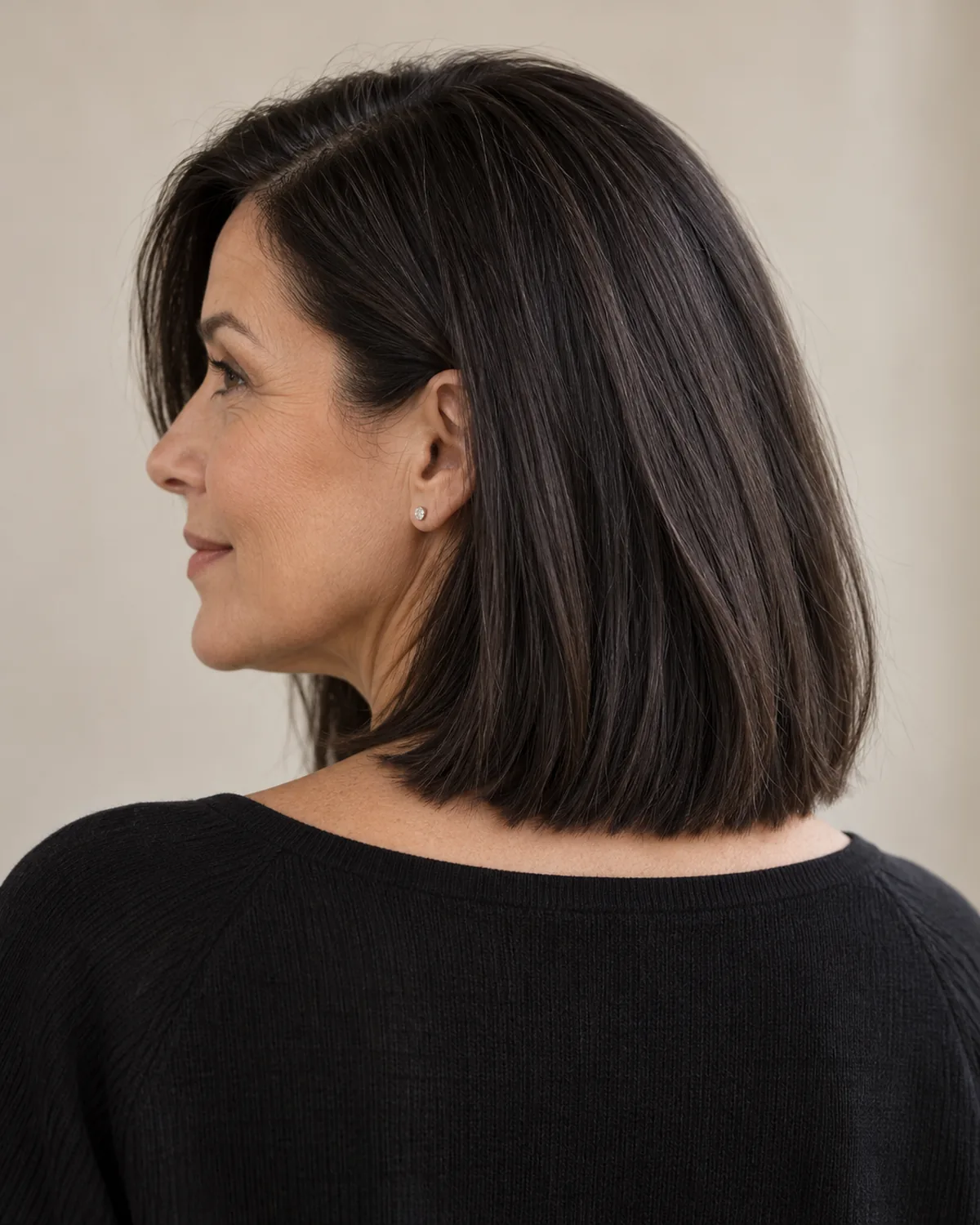
A lob at collarbone length, one length throughout, parted to the side. The side part lifts the root on one side, and the single length means no interior gaps. Dark hair at one length catches light on the surface and looks polished without effort. This rear view shows how the single blunt hemline reads from behind.
- Works on straight to wavy hair where the strands are consistent from root to tip — the one-length approach requires that the hemline look as dense as the mid-shaft
- The side part adds asymmetry without any cutting. It is free movement that a centre part does not provide
- Skip if the ends are visibly thinner than the mid-shaft — a one-length lob draws the eye straight to the hemline, and on dark hair thin ends are unmistakable
- Ask the stylist whether the ends can support a one-length cut, and whether a light dusting at the perimeter would clean up any see-through strands
5. Graduated Bob With Stacked Back
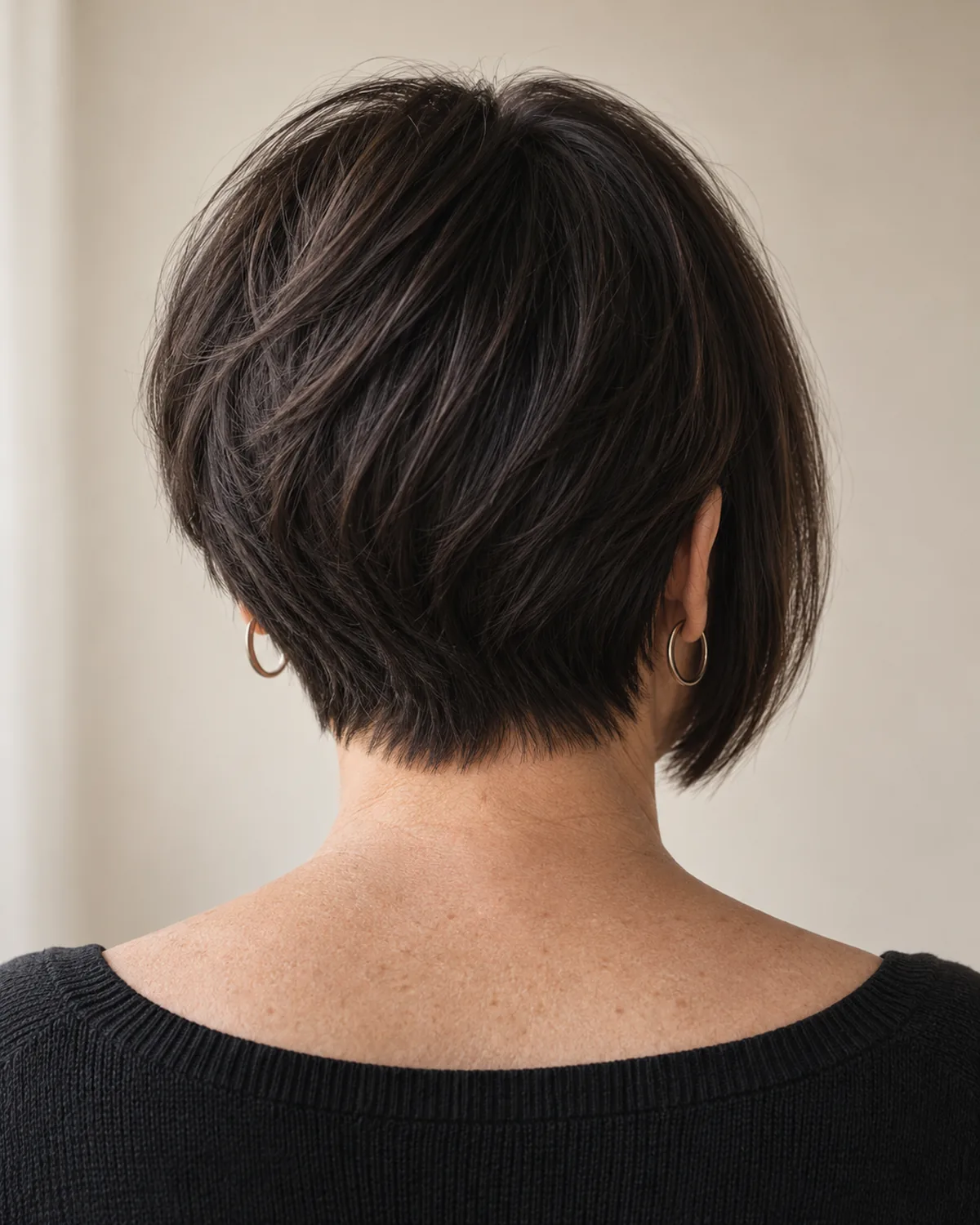
Short and stacked in the back, angling longer toward the chin. On dark hair the graduation creates a visible weight line — a graphic horizontal that reads like an architectural detail rather than just a haircut. This rear view shows how the stacked layers build up from the nape.
- Works on straight to slightly wavy dark hair with medium to thick density. The stacking requires enough hair to create the layered effect at the nape
- The graduation is more visible on dark hair than on any lighter shade because each layer casts a shadow on the one below it
- Skip on very curly dark hair — curls obscure the graduation and the stacked back poofs outward rather than lying flat
- Tell the stylist you want the graduation tight and graphic — on dark hair a soft graduation reads as ambiguous rather than shaped
Where to start
Find your situation, skip ahead
Your dark hair is thick and straight and you want the cut to look sharp without daily styling
A blunt bob or chin-length micro-bob uses dark hair's edge visibility — the line does the work.
01 Blunt Bob at Jaw Length05 Graduated Bob With Stacked Back13 Blunt Micro-Bob at Chin Height
Your dark hair is starting to thin and you need a cut that hides the scalp contrast
Cuts that keep the top section unbroken work best — long layers starting below the chin or a lob at one length.
03 Long Layers Starting Below the Chin04 Side-Parted Lob at One Length11 Shoulder-Length With a Single Long Layer
Your dark hair is wavy or curly and you want a shape that works with the texture
A textured shag or layered collarbone cut follows the wave rather than fighting it.
07 Collarbone Cut With Interior Layers Only10 Soft Shag With Face-Framing Wisps17 Mid-Length With Disconnected Front Pieces
6. Curtain Bangs Framing a Centre Part
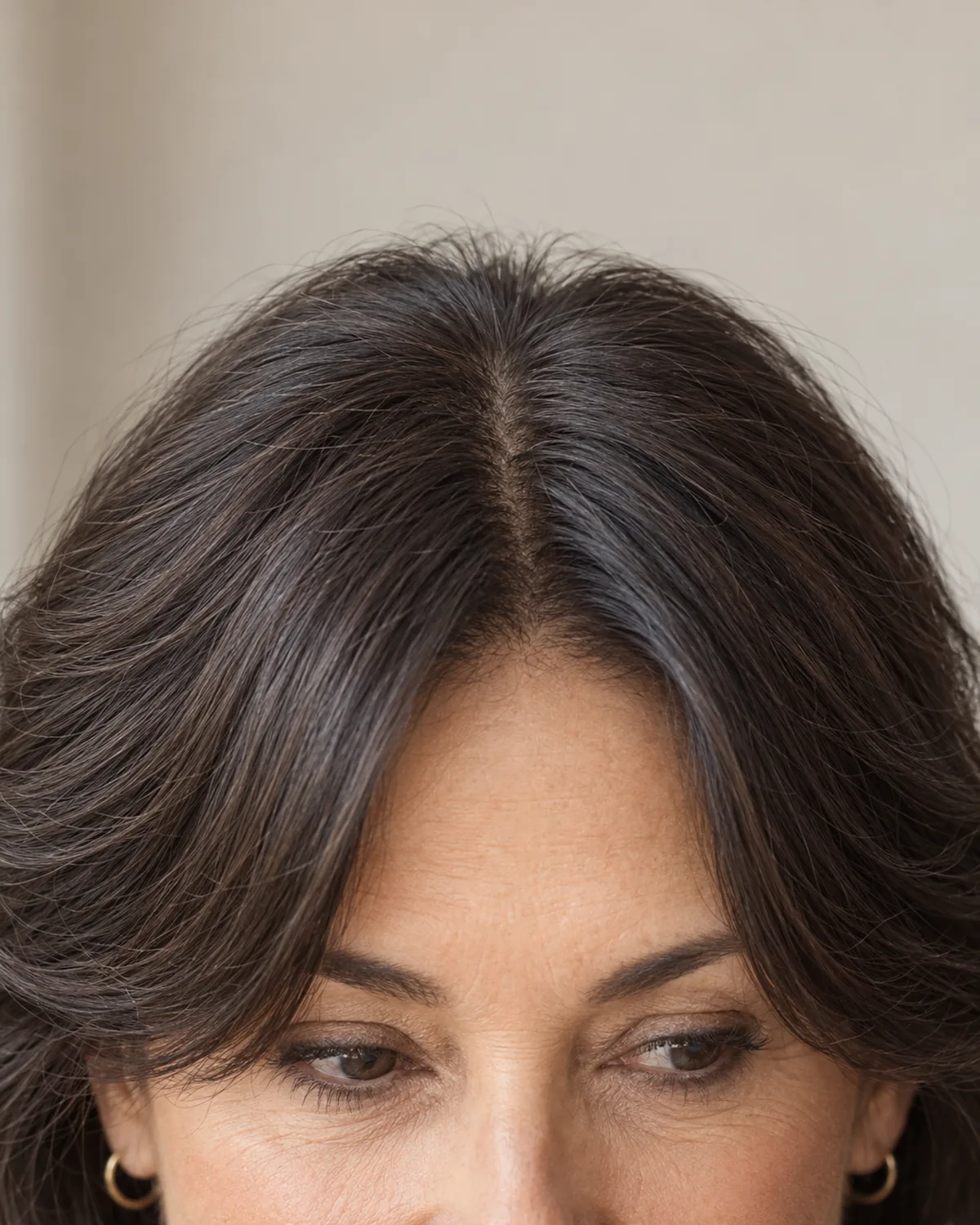
Face-framing layers that part in the middle and sweep to either side. On dark hair the bangs create a dark frame around the face that draws the eye inward. This close crop shows how the curtain bangs fall from the centre part and define the forehead border.
- Works on straight to wavy hair with enough density at the temples that each side of the curtain looks full rather than sparse
- The dark frame effect is unique to dark hair — lighter shades produce curtain bangs that soften, but dark bangs define and border
- Skip if the hairline at the temples is thinning — curtain bangs that show scalp at the part defeat the framing effect
- Ask the stylist to cut the bangs dry so you can see exactly where the frame falls — on dark hair the placement is precise or it is wrong
7. Collarbone Cut With Interior Layers Only
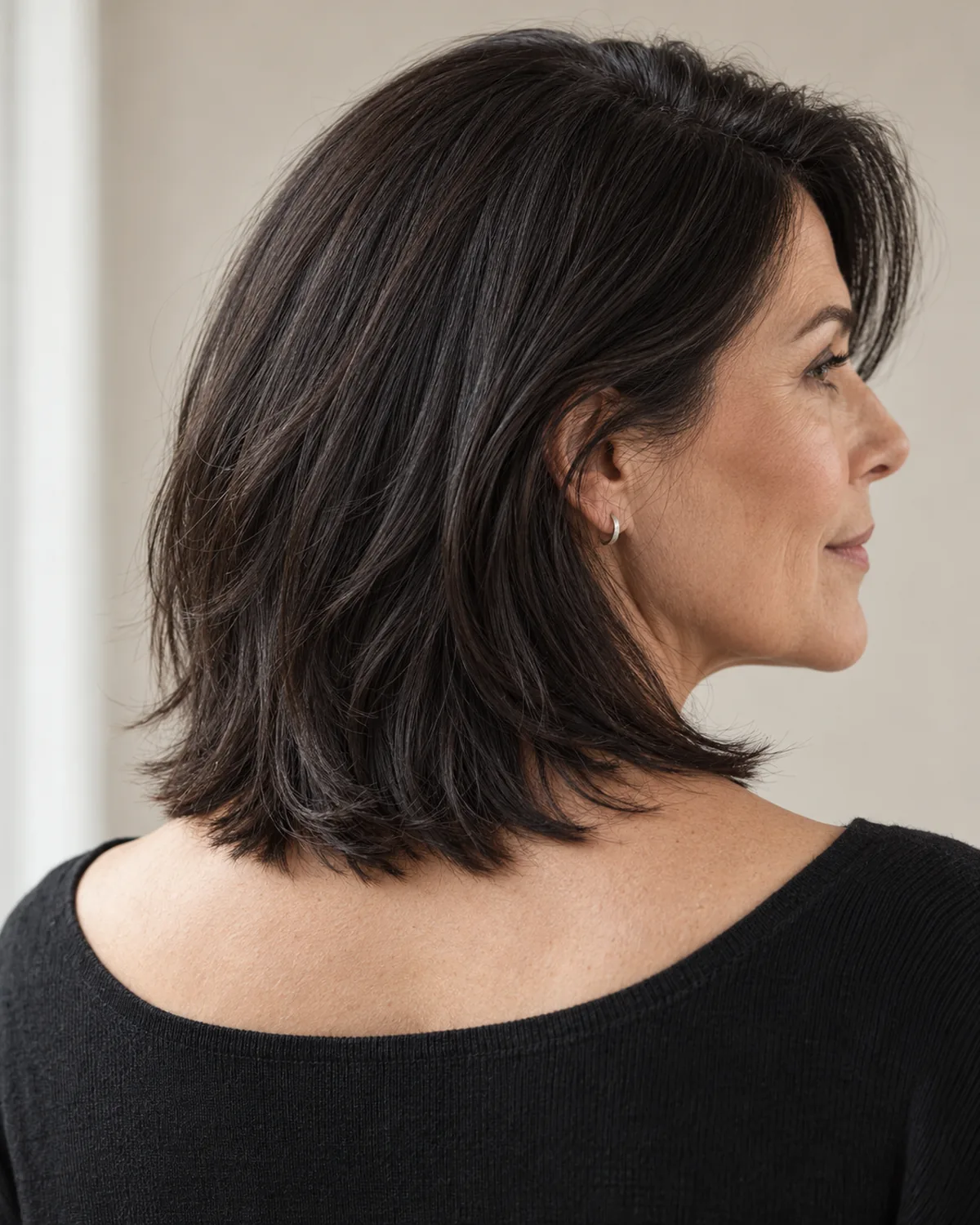
Length at the collarbone, but with layers only on the interior — the outermost layer stays one length. The interior layers add movement without breaking the perimeter line. On dark hair the perimeter reads as a clean edge while the interior creates depth underneath.
- Works on thick dark hair that needs weight removal without sacrificing the perimeter shape. Interior layers do the work invisibly
- The solid edge is what makes this cut work on dark hair — any break in the perimeter line shows more on dark hair than on lighter shades
- Skip on thin dark hair — interior layers on thin hair create visible holes when the hair moves, and dark hair makes those holes prominent
- Ask the stylist to keep the outermost layer one length and to do the layering underneath where it cannot be seen when the hair hangs still
8. Cropped Ear-Length Cut With Sideburns Left Long
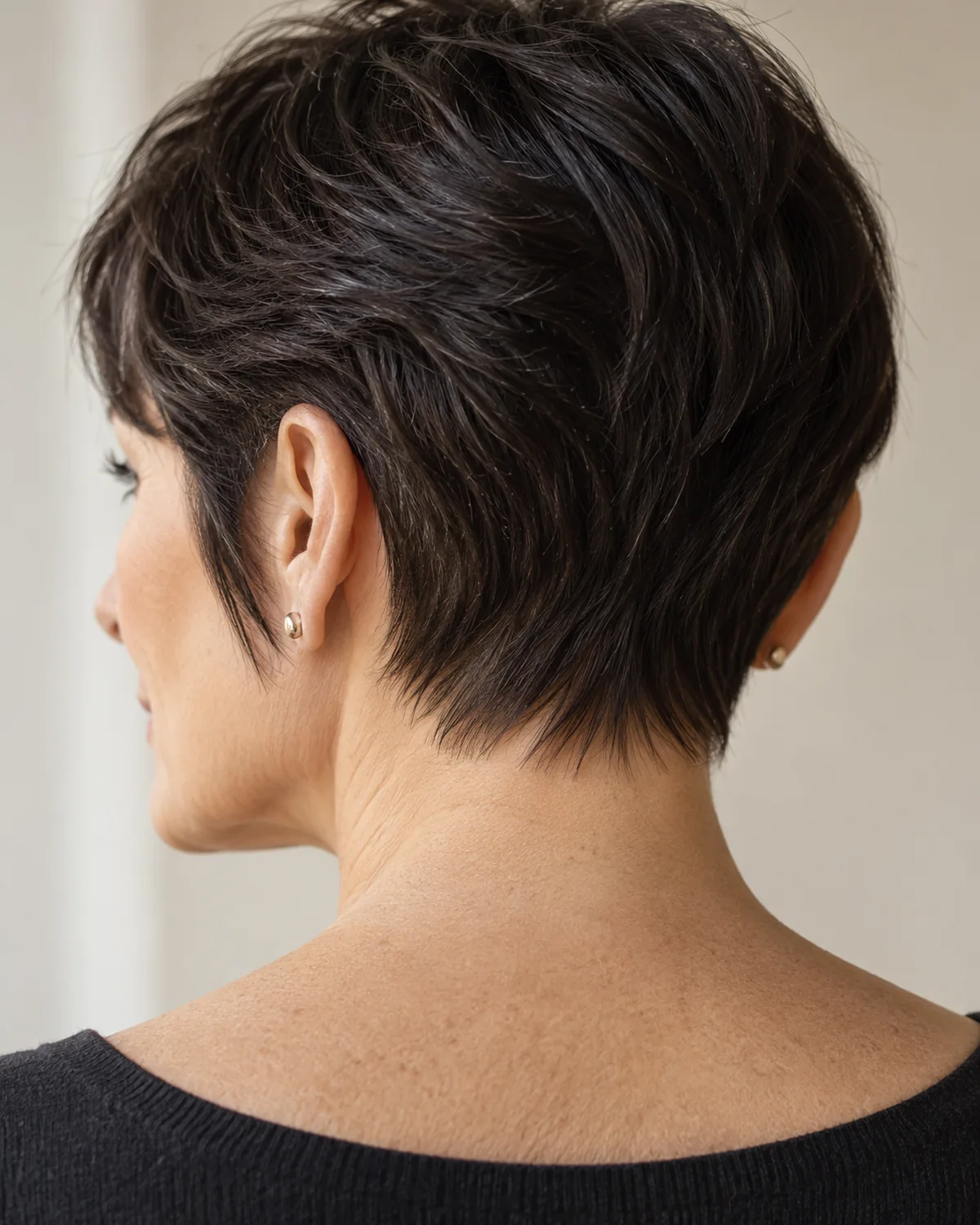
A short cut at ear length with the sideburns left slightly longer and tapered to a point. On dark hair the long sideburns create a graphic line along the jaw that lighter hair cannot deliver. This nape-level close crop shows the tapered sideburn trailing down past the ear.
- Works on straight to wavy dark hair with any density. The sideburn detail is a line, and dark hair draws lines better than any other shade
- The long sideburns add length to the face without adding volume. They work the same way a vertical stripe does on a garment
- Skip if the sideburns are sparse or significantly grayer than the rest — the contrast breaks the graphic line
- Tell the stylist to taper the sideburns to a point rather than cutting them blunt — the taper gives the line direction
9. Chin-Length A-Line With Longer Front Pieces
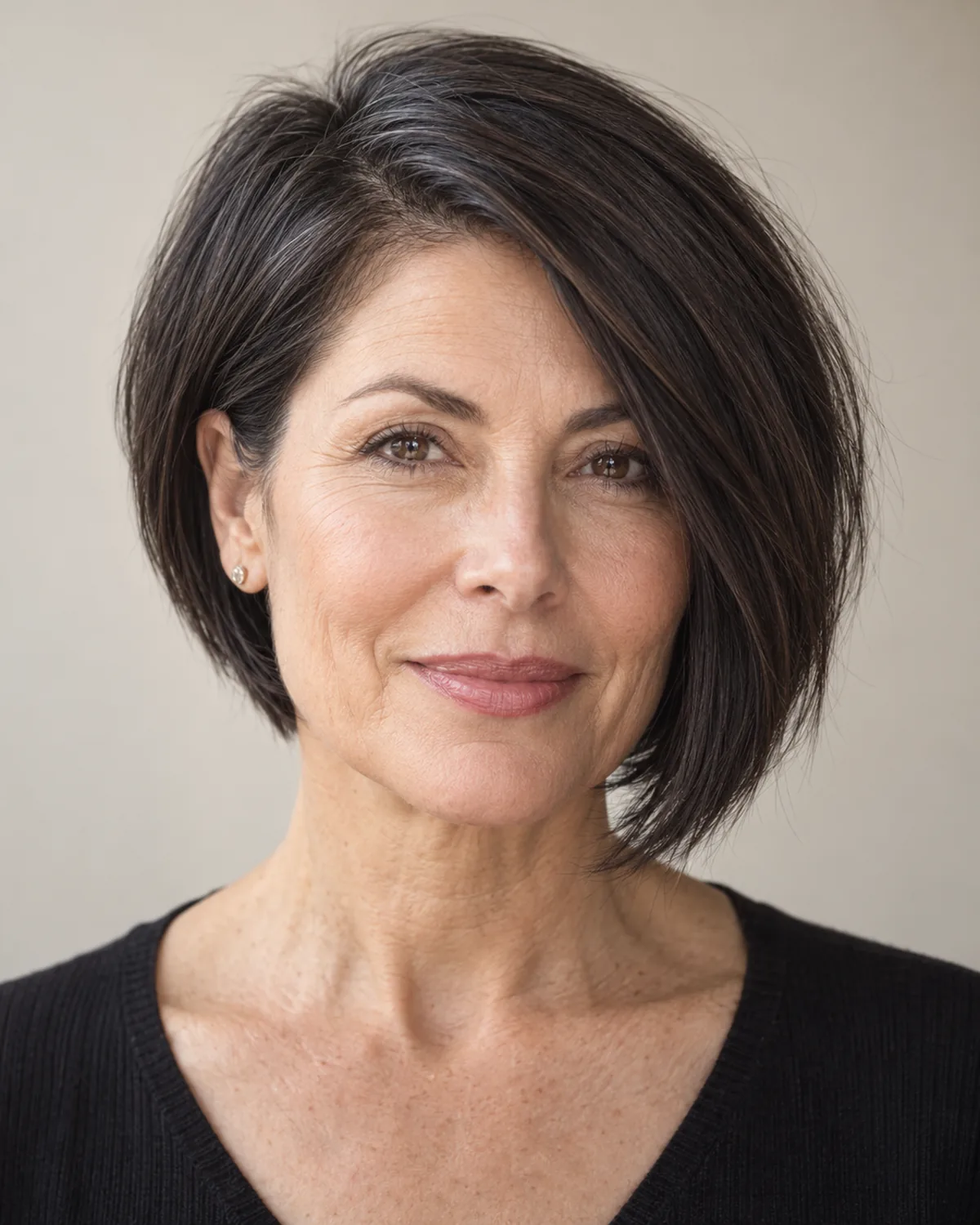
Shorter in the back, gradually longer toward the chin. On dark hair the diagonal from back to front reads as a clear graphic shape — you can follow the angle line from nape to jaw as a single unbroken trajectory. This front view shows the A-line's diagonal from its most visible angle.
- Works on straight dark hair where the angle line stays crisp — waviness softens the diagonal and reduces the graphic effect
- The A-line is one of the most architecture-forward cuts on dark hair because the angle is fully visible against the neck and jaw
- Skip on very curly hair — curls scramble the diagonal and the A-line reads as uneven rather than intentional
- Ask the stylist to keep the back short enough that the angle is obvious — a subtle A-line on dark hair looks like a bad bob rather than a design choice
10. Soft Shag With Face-Framing Wisps
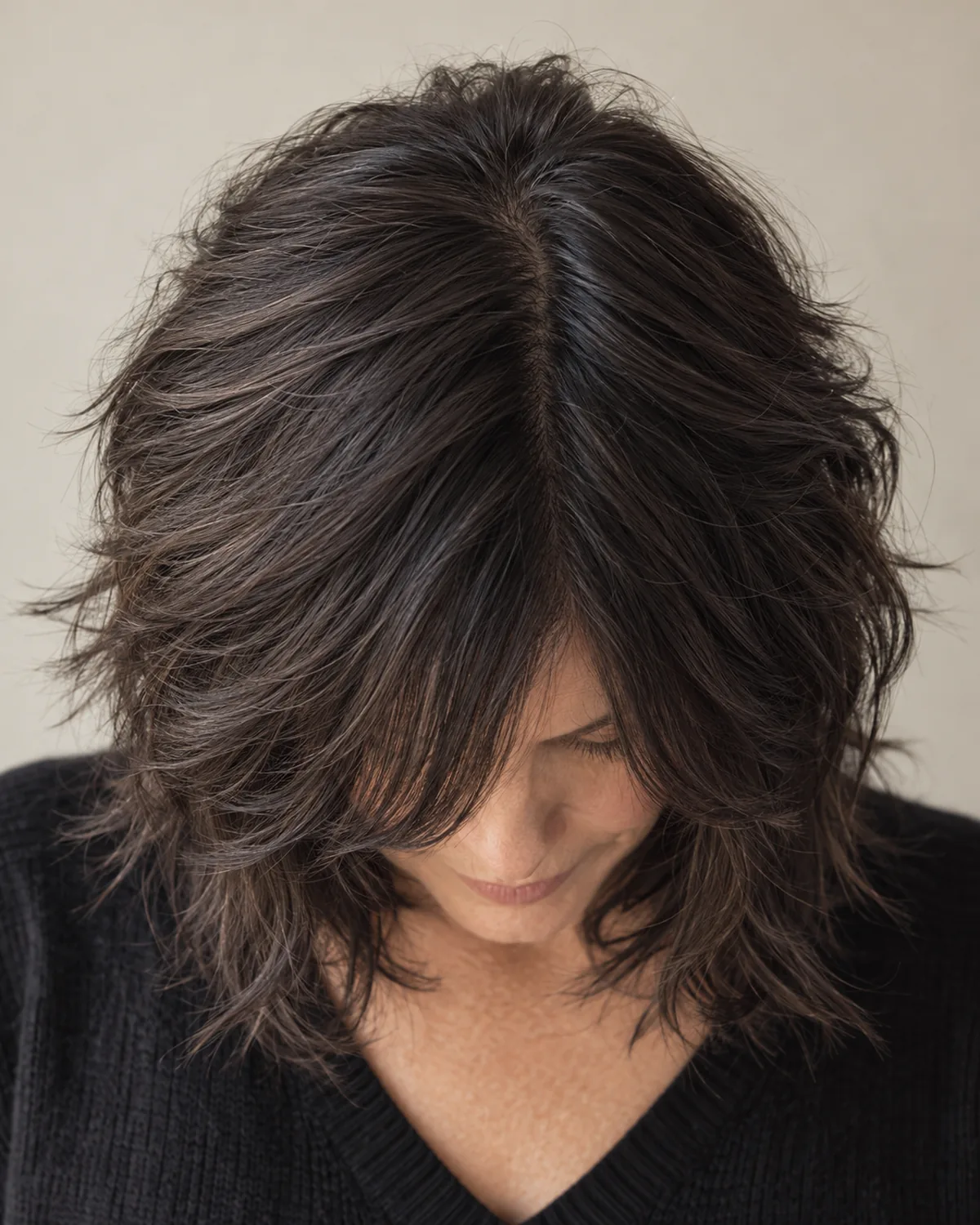
A shag with layers throughout and shorter pieces framing the face. On dark hair the shag's texture prevents the solid-block look that one-length dark hair can fall into. This crown-level view shows how the layers separate and create movement across the entire head.
- Works on wavy to curly dark hair with moderate density — the wave holds the layers and the density fills the shape
- The shag breaks up the visual weight of dark hair without removing the actual weight — it is a redistribution, not a reduction
- Skip on very straight fine dark hair — the layers hang flat and expose thin areas rather than creating the tousled movement the shag needs
- Ask the stylist for a soft shag rather than a choppy one — on dark hair a choppy shag can read as damaged rather than textured
11. Shoulder-Length With a Single Long Layer

Hair at shoulder length with one interior layer starting at the jawline. The single layer lifts the ends slightly without breaking the perimeter. On dark hair this creates a subtle curve at the hem rather than a flat curtain. This movement shot shows the single layer working underneath.
- Works on straight to slightly wavy hair with medium density — the single layer is a fine-tuning adjustment, not a structural overhaul
- The curve at the hemline is visible on dark hair because the single layer redirects the fall without breaking the outer edge
- Skip on thick dark hair that already has natural volume — the single layer is too subtle to remove enough weight, and the hair will overwhelm it
- This cut is ideal when the hair is already close to the right shape and needs only one adjustment to finish it
12. Tapered Nape Pixie With Volume Kept Through the Crown
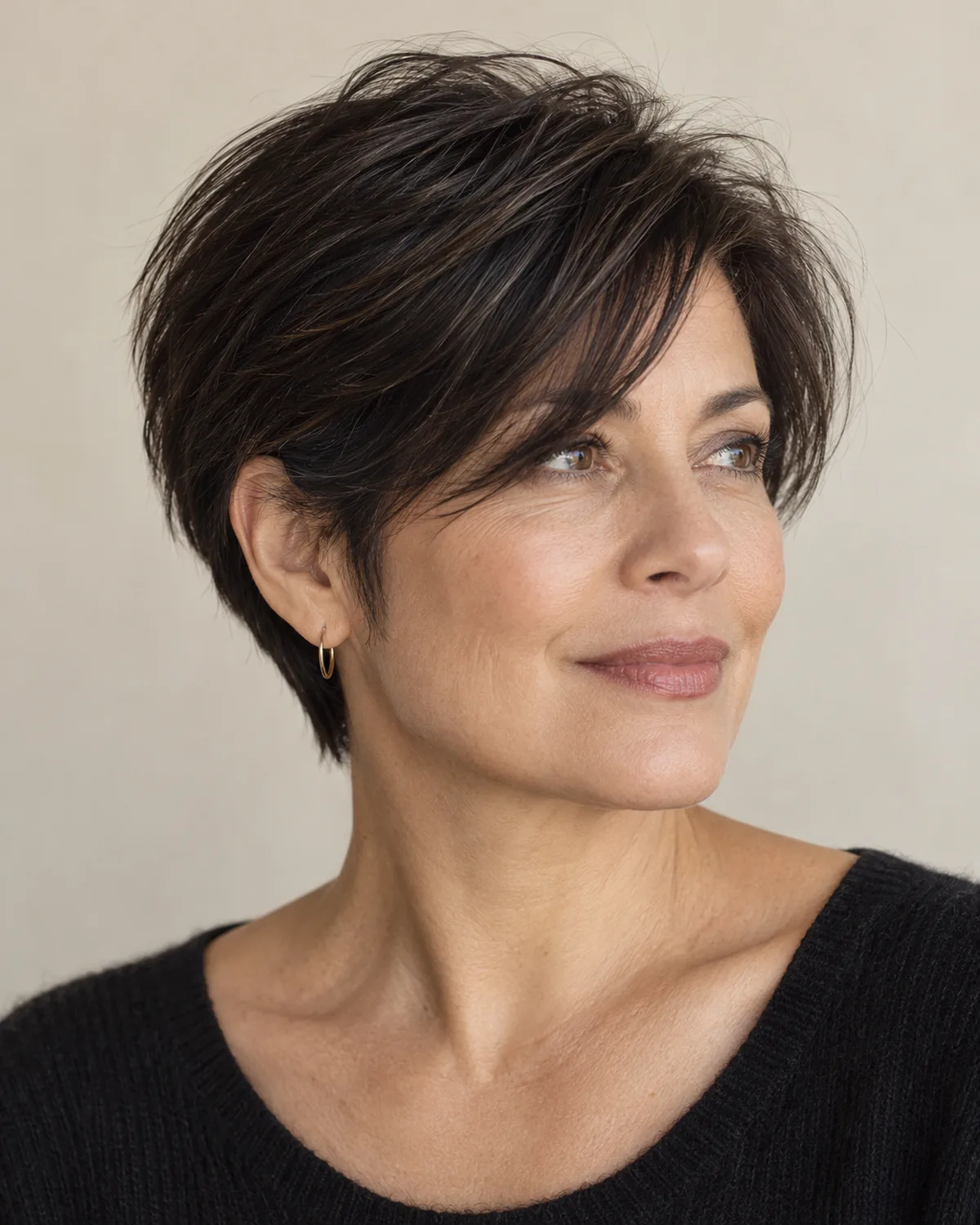
Short and tapered at the nape, longer through the crown and top. On dark hair the contrast between the close nape and the fuller crown is more dramatic than on lighter shades — the shape reads with more visual weight. This three-quarter view shows the taper-to-crown volume shift.
- Works on thick coarse dark hair where the crown has enough density to carry the volume difference
- The dark background amplifies the nape-to-crown contrast — the shape is a statement in a way that the same cut on blonde hair is not
- Skip if the crown is thinning — on dark hair the thin patch against pale scalp is more visible from above, not less
- Tell the stylist to keep the nape tight but to leave the crown with enough length that it holds its shape by weight alone
13. Blunt Micro-Bob at Chin Height
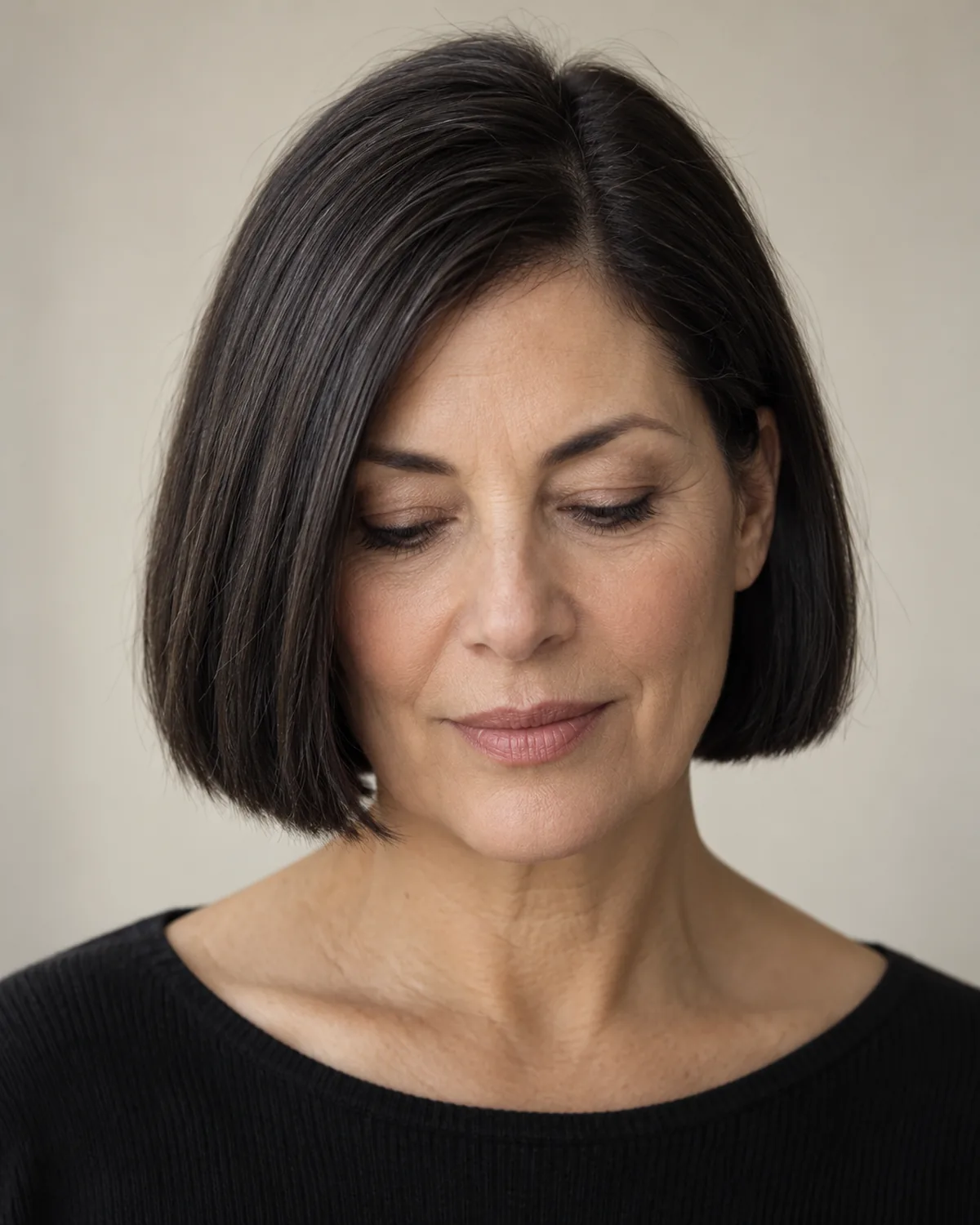
A very short bob that ends exactly at the chin, cut blunt. On dark hair this is one of the sharpest silhouettes available — the dark line against the neck creates a clean border that no lighter shade can match. This front view shows the hemline sitting right at the chin break.
- Works on straight dark hair with moderate to thick density — the micro-bob requires that every strand reach the same point
- The blunt hemline at chin height is the sharpest line dark hair can draw — it works as a frame for the face rather than just a haircut
- Skip on wavy dark hair that flips outward at the chin — the flip breaks the blunt line and fights the entire geometry of the cut
- Ask the stylist to check the hemline at the chin from both sides — even half an inch of unevenness on dark hair is visible
14. Long Side Bangs Sweeping Across the Forehead
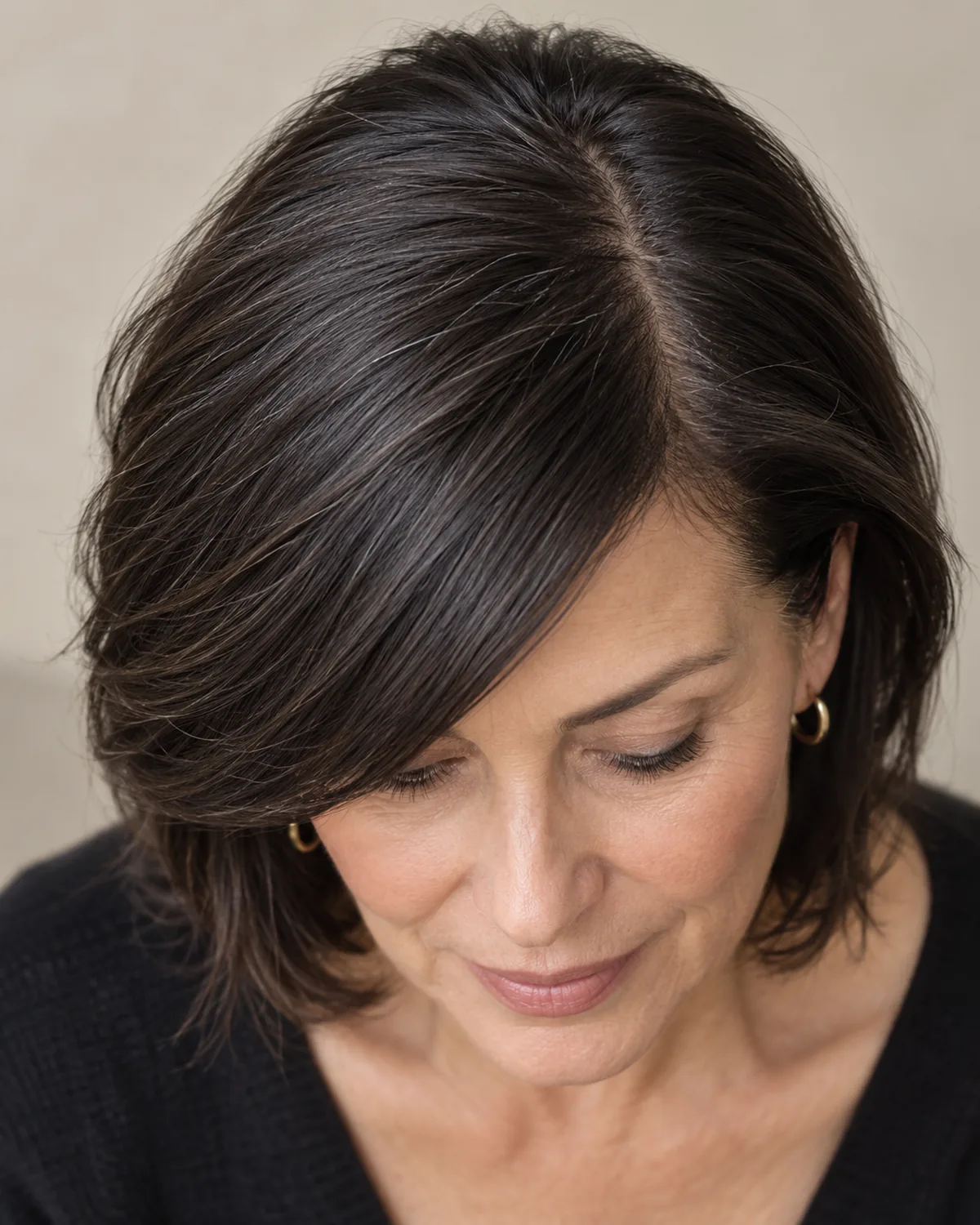
A single piece of hair swept from a deep side part across the forehead. On dark hair the sweep creates a strong diagonal that lighter hair delivers only with product. This overhead angle shows how the dark bang crosses the forehead as a continuous line.
- Works on straight to slightly wavy dark hair with enough density that the bang reads as a piece rather than a few strands
- The dark sweep adds a graphic element to any cut — it works with bobs, lobs, and shoulder-length hair
- Skip if the hair has a cowlick at the part — a cowlick lifts the sweep and creates a gap, and on dark hair that gap is a visible break
- Ask the stylist to cut the bang piece heavier than you think you need — dark hair reads as thinner at the fringe because the forehead shows through
15. Shoulder-Length Textured Cut With Razored Ends
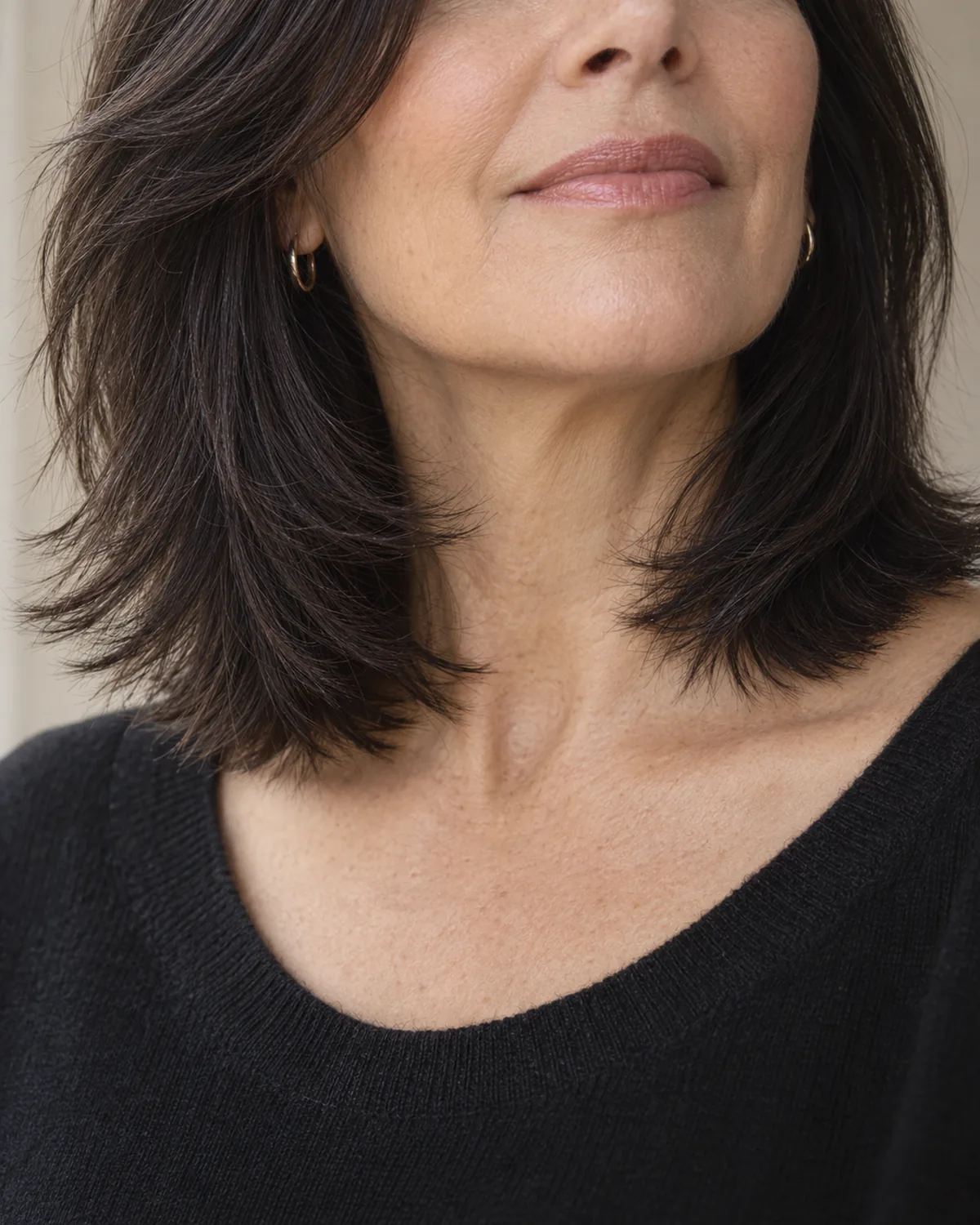
Shoulder length with the ends razored rather than blunt-cut. Razoring dark hair creates a soft, feathered hemline that breaks up the heaviness of one-colour ends. This close-up shows the razored tips creating a diffused edge rather than a hard line.
- Works on thick straight dark hair that tends to look blocky at the ends — razoring is the tool that softens the perimeter without layers
- On dark hair the razored edge reads as intentionally soft rather than messy — the dark colour keeps it from looking wispy
- Skip on fine dark hair — razoring fine strands makes them thinner, and on dark hair the thinned tips become see-through against the skin
- Ask the stylist to razor only the last inch of the hemline — going further up thins the mid-shaft, and dark hair exposes that loss
16. Chin-Length Bob With Side-Swept Fringe
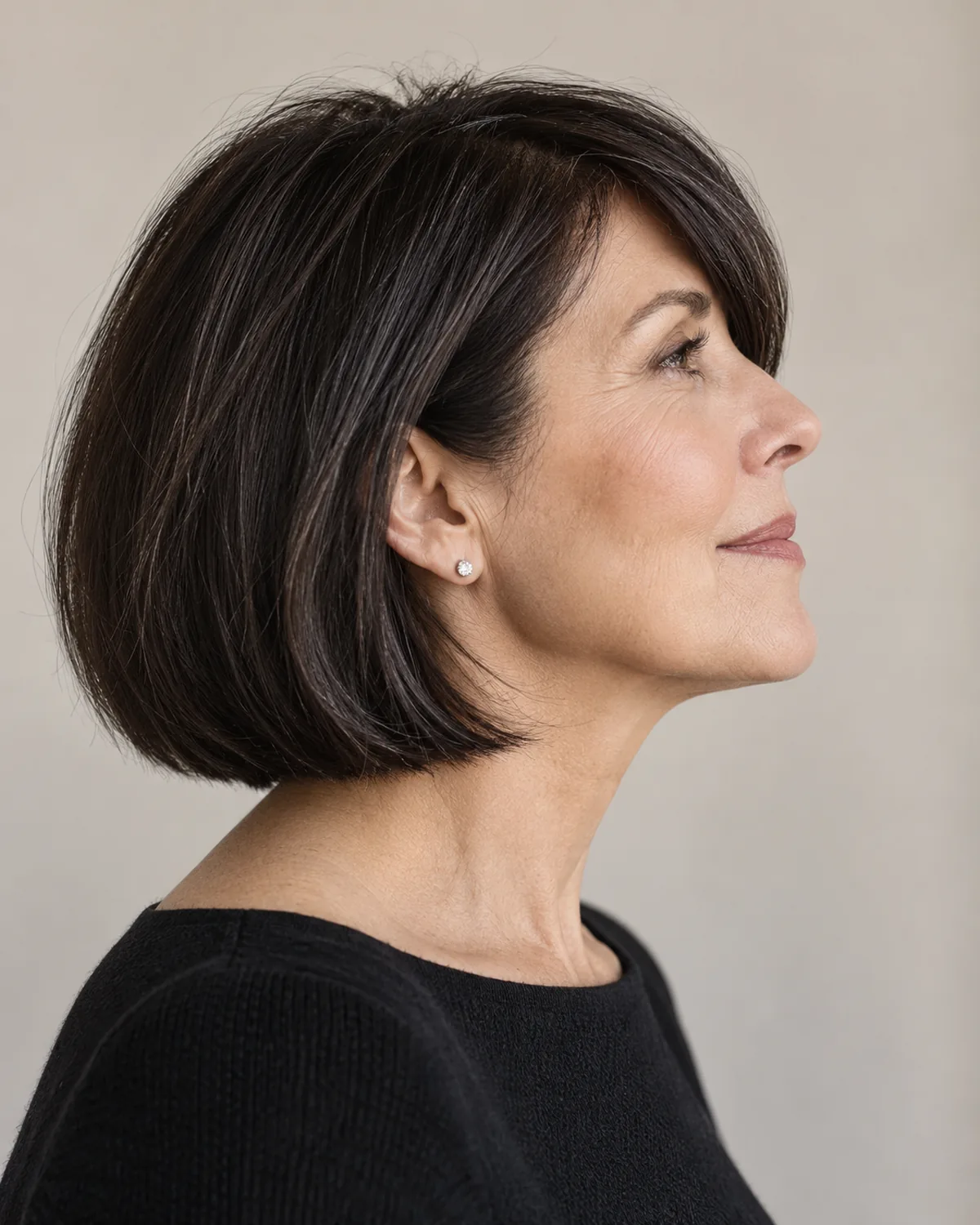
A classic bob at chin length with a fringe swept to one side rather than cut straight across. The fringe adds a diagonal to the front silhouette while the bob provides the horizontal at the chin. This profile shows both lines intersecting — the sweep across the forehead meeting the bob line at the jaw.
- Works on straight to wavy hair with consistent colour from root to tip — the fringe-to-jaw line is a shape, and it works when the shade is uniform
- The side-swept fringe softens the bob without eliminating its graphic quality — it gives the face an entrance point
- Skip if the fringe section is significantly grayer than the rest — the colour break across the forehead draws attention away from the cut shape
- Ask the stylist to cut the fringe heavy enough that it sweeps as a piece — thin dark bangs separate and show the forehead in stripes
17. Mid-Length With Disconnected Front Pieces
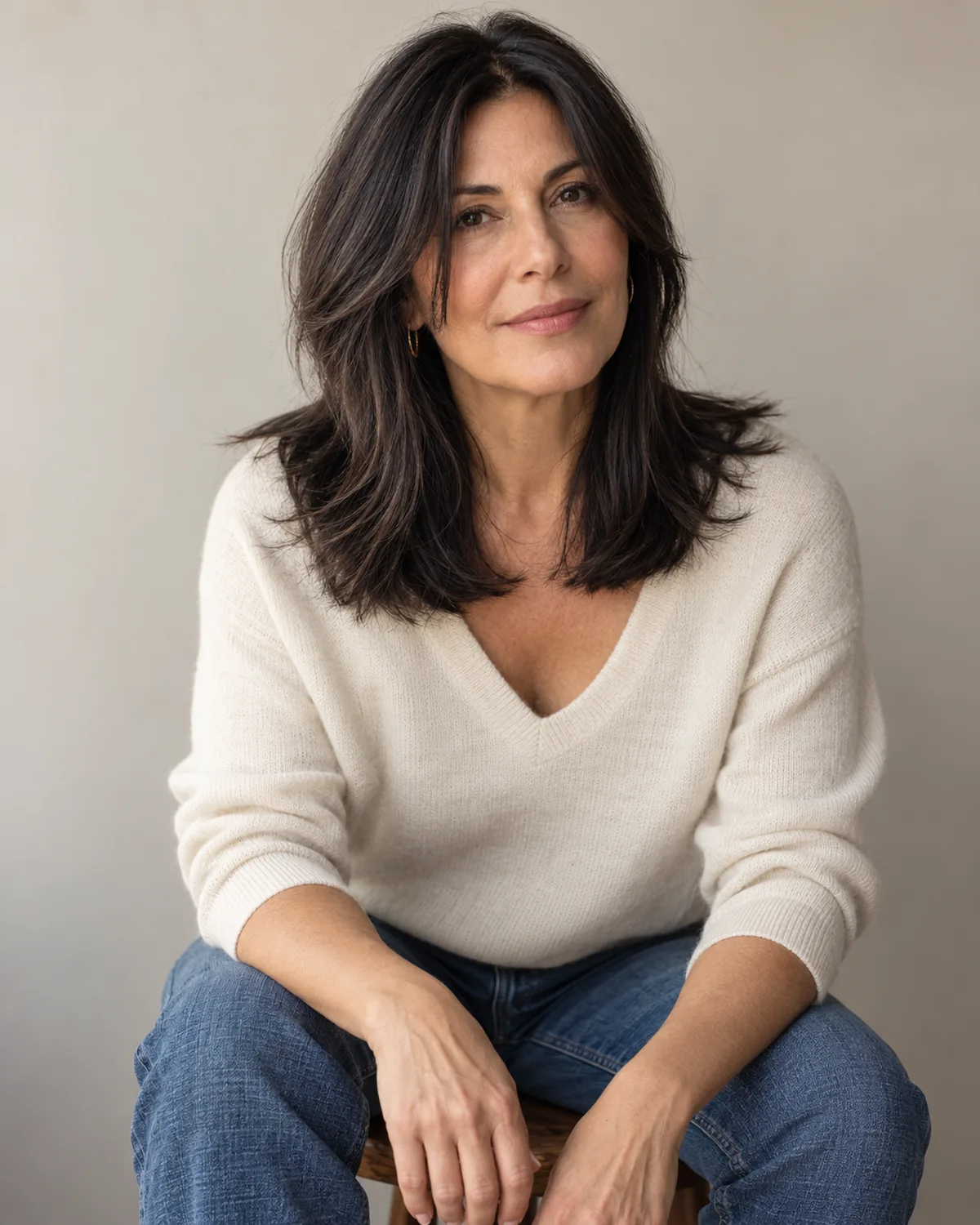
Hair at mid-length with two front pieces cut shorter and left disconnected from the main body. On dark hair the disconnected pieces cast visible shadows on the face — they function as a built-in frame that moves independently. This seated view shows the shorter front pieces falling separately from the rest.
- Works on wavy dark hair with enough density that the two front pieces read as intentional features rather than accidental strands
- The shadow-casting effect is specific to dark hair — lighter shades produce disconnected pieces that blend rather than contrast
- Skip on very straight fine dark hair — without wave, the disconnect looks accidental and the pieces just hang
- Ask the stylist to cut the front pieces at least two inches shorter than the main length — on dark hair a subtle disconnect is invisible
18. Short Crop With Forward-Directed Top
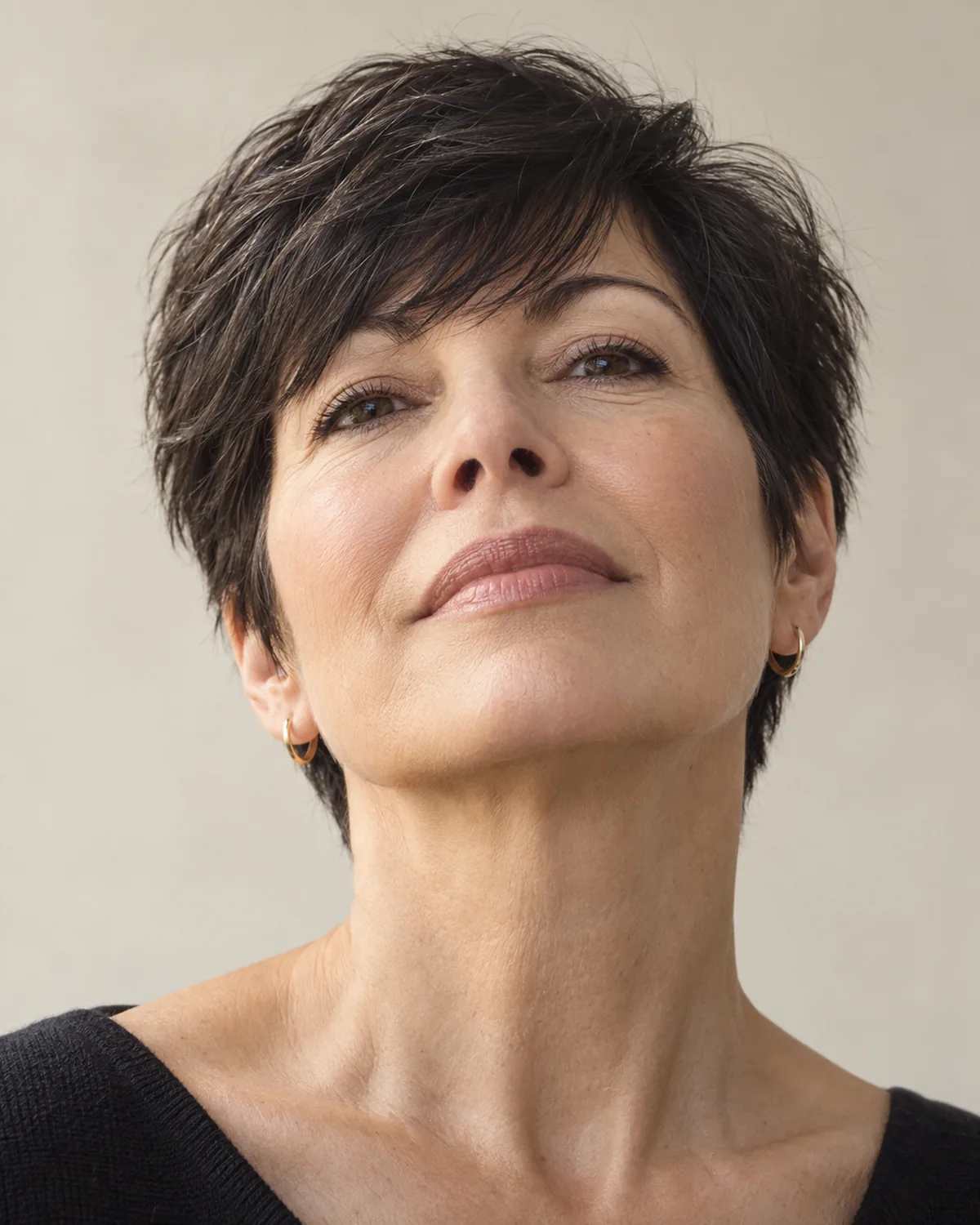
A short crop where the top is directed forward over the forehead rather than swept back. On dark hair the forward direction covers the front hairline and eliminates the gap between forehead and hair that backward styling exposes. This front view shows the dark hair falling forward as a continuous canopy.
- Works on straight to wavy dark hair with moderate density — the forward direction requires enough hair to cover the front without separating
- Directing the hair forward hides the front hairline, which on dark hair is the highest-contrast area where recession or thinning shows first
- Skip on curly dark hair — curls refuse to lie forward and spring upward, defeating the coverage
- Ask the stylist to keep the top long enough to reach the mid-forehead when directed forward — too short and it stands up rather than lying down
19. Low Chignon-Friendly Length With Blunt Ends
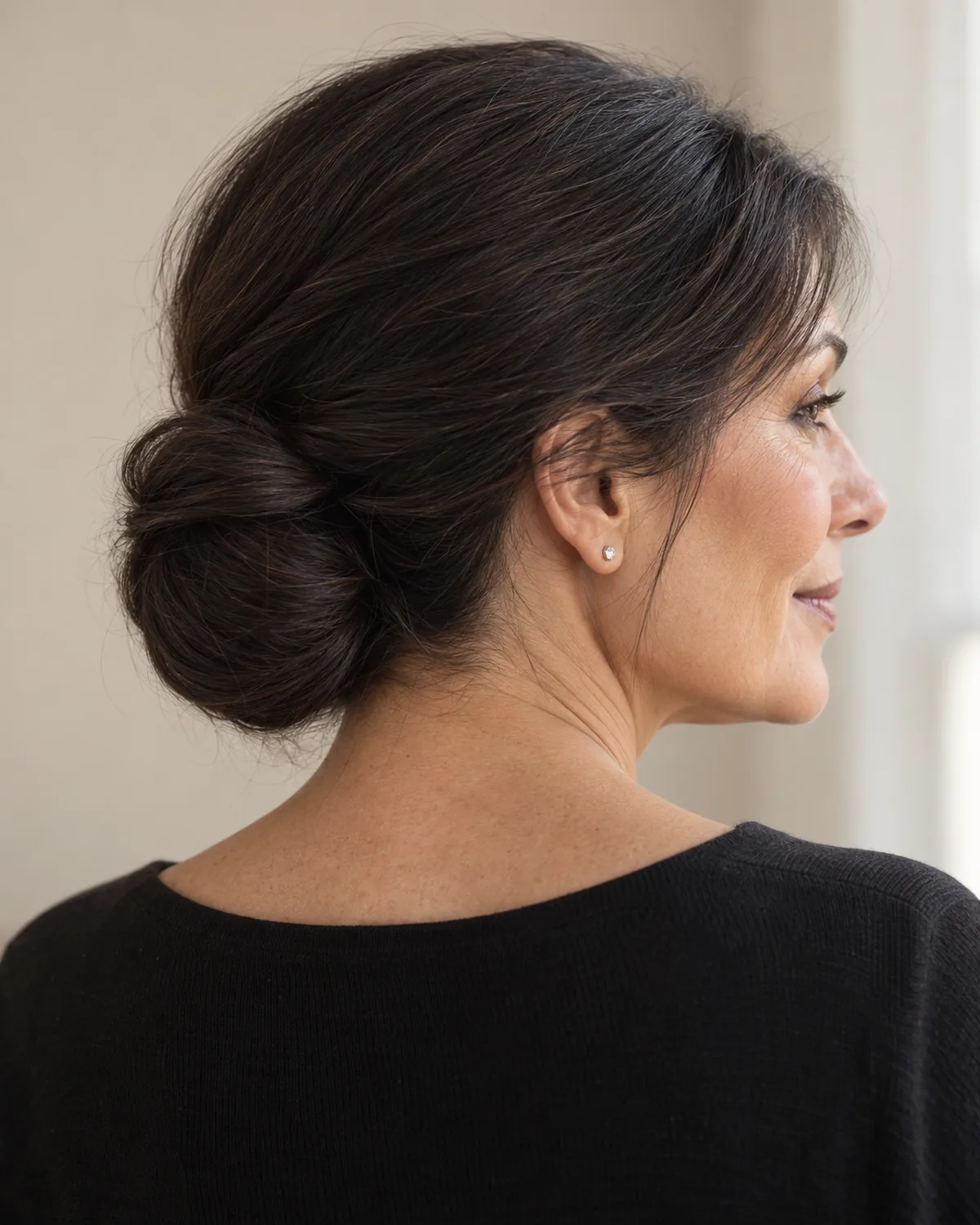
Hair long enough to gather at the nape in a low chignon, cut blunt at the ends so the gathered shape holds a clean edge. On dark hair the chignon reads as a solid mass rather than a flyaway cluster — the colour unifies the knot. This back view shows the low chignon sitting at the nape with the blunt ends tucked cleanly.
- Works on straight to wavy dark hair at collarbone length or longer — the blunt ends stack in the chignon rather than escaping
- The solid dark mass of a well-gathered chignon is a shape that lighter hair produces only with product — dark hair delivers it by default
- Skip if the ends are damaged or split — gathering damaged dark hair magnifies the frizz halo around the knot, and the dark colour makes every flyaway visible
- Ask the stylist to cut the ends blunt specifically so they behave in an updo — layers at the ends escape the chignon and create a halo of loose pieces
Where the checkable claims come from
- Milady Standard Cosmetology — Cengage Learning
- The Science of Hair Care — Springer
- Understanding Hair Density and Cutting Decisions — Society of Beauty Professionals
Keep this one
Save it for the appointment
Pin the image above to the board you actually open before a salon visit. This guide is written to be re-read, not read once.
Tonight, before you close this tab
- Stand in front of a mirror with a white towel behind your hair — this is how the stylist sees your cut line, and what the camera sees in every photo
- Part your hair where you normally part it and check whether the scalp shows through — on dark hair any visible scalp reads as a gap
- Look at the last two inches of your length — if the ends are thinner than the mid-shaft, that is the first structural decision to make with the stylist
- Bring one photo of a dark-haired woman with a cut you like — not a blonde or silver reference that will not translate the same way
- Ask the stylist to cut dry if you want a blunt line — wet-cutting dark hair can shift the hemline by half an inch when it dries