17 Bangs After 50: Curtain, Side, or None
Seventeen bang styles for women over 50, each judged by face shape and hair density. Curtain, side-swept, blunt, arched, and two no-bang alternatives.

Booking an appointment soon? Save this page. It is easier to skim in the chair than to remember.
At a glance
Works
- Curtain bangs parted at the center on an oval or oblong face when your hair has enough weight to fall evenly on both sides
- Side-swept bangs on a round face because the diagonal line counters the roundness of the cheek and jaw
- Feathered point-cut ends on thinning front hair because the broken texture hides the gaps a blunt cut would expose
Depends
- A wispy micro-fringe only works if your forehead is short and you commit to trimming every three weeks
- Thick blunt bangs require thick hair to fill a solid horizontal line from temple to temple without going see-through at the edges
- Bottleneck bangs that widen at the jaw flatter a narrow chin but double the width of an already wide jaw
Skip
- Blunt bangs on fine or thinning hair over 50 because the front section cannot fill a solid horizontal line from temple to temple
- A wispy micro-fringe on a high forehead because the gap between the short fringe and the brow line cuts the face with two parallel lines
- Curtain bangs longer than the bob they sit with because the framing pieces outgrow the shape and create a visible ledge
A bang changes the proportions of your face. The right kind depends on two things: how tall your forehead is and how much hair your front section can deliver. The wrong kind advertises the gap between what the fringe needs and what your hair has.
The seventeen ideas below cover curtain, side-swept, blunt, arched, feathered, and two deliberate no-bang alternatives. Every one is judged on who it suits and who it disappoints.
1. Curtain Bangs That Part at the Center

The center-parted curtain drapes on both sides of the forehead and tapers toward the cheekbones. The version here shows the part line from above, where the symmetry is clearest. Both curtain pieces carry enough weight to fall evenly rather than floating up at the roots.
This is a weight test. Hair that parts cleanly and lies flat on both sides is the right candidate. Fine hair that lifts at the crown pulls the center part open and exposes the forehead the curtain was supposed to soften. Oval and oblong faces benefit most because the curtain breaks a tall forehead without covering it entirely.
- Ask whether your hair falls evenly on both sides of a center part or one side always swings heavier
- If the part opens up within an hour, the curtain will look gapped rather than framing
- Shoulder-length or longer gives the curtain enough material to taper past the cheekbones
- The curtain works as a face frame, not a forehead cover, so it should show some skin at the center
2. Curtain Bangs Swept to One Side

One side of the curtain hangs longer, sweeping past the cheekbone. The other side tucks behind the ear. The asymmetry draws the eye on a diagonal across the face, which benefits a round face by adding an angle the circle lacks.
The image shows how the longer piece creates a visual line from the part to the cheekbone on one side while the shorter side stays clean behind the ear. The sweep direction matters more than the length. Sweeping away from the fuller cheek draws attention toward the narrower side.
- Check whether your front hair stays directed to one side or springs back to center within an hour
- Curly or coily hair at the hairline resists a one-sided sweep and needs a different approach
- The swept side should hit between the brow and the cheekbone to do its structural work
- This is the lower-commitment version of a full curtain because only one side needs to cooperate
3. Wispy Micro-Fringe Above the Eyebrows
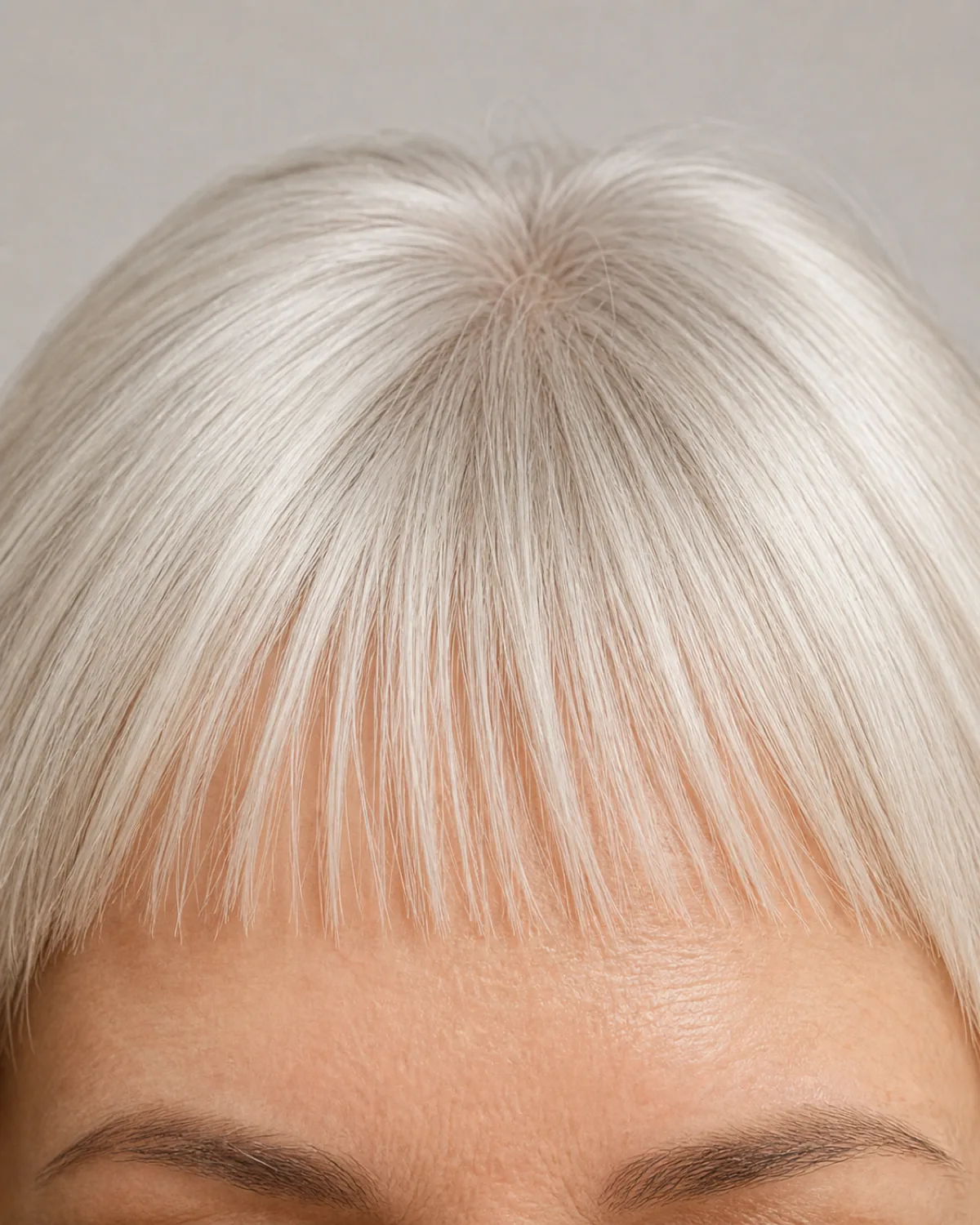
The fringe here is cut short and deliberately thin. Individual strands fall across the forehead with visible gaps between them, and the skin shows through. The brow line sits clearly below the fringe ends, creating a clean separation between hair and brow.
This is a high-risk choice. The short length opens the eye area and highlights the brow bone, but it demands trimming every three weeks. One extra millimeter of growth flattens the effect into a straight line. It works on small features and a short forehead. A high forehead leaves too much gap between the fringe and the brow, creating two horizontal lines that cut the face.
- Measure your forehead with three fingers from hairline to brow bone
- If all three fingers fit, your forehead is tall and a micro-fringe may leave too wide a gap
- The trimming commitment is real and non-negotiable for this length
- Ask your stylist to point-cut the fringe so the ends break into pieces rather than forming a blunt shelf
4. Thick Blunt Bangs Straight Across
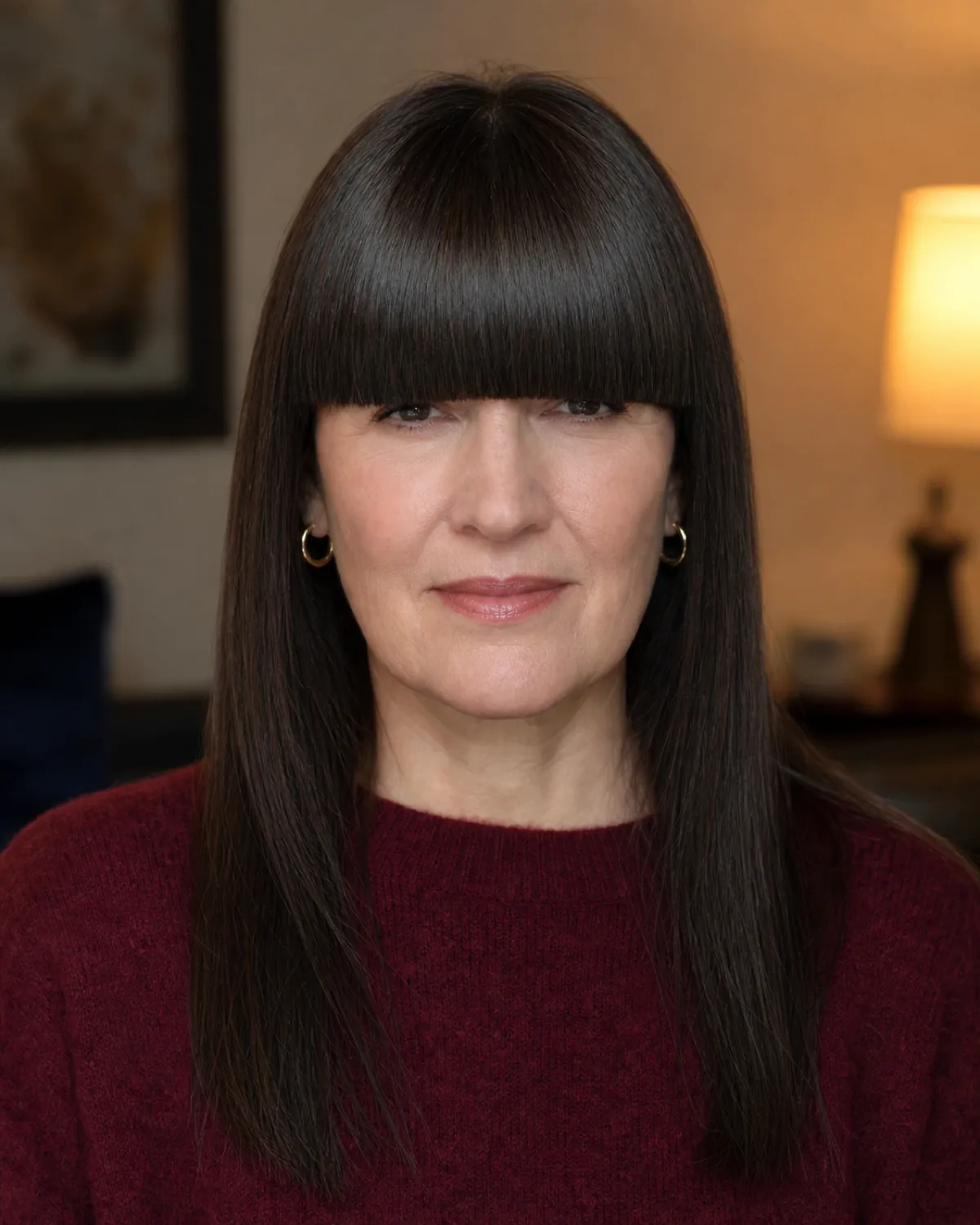
A solid shelf of hair from temple to temple, cut precisely at the brow line. The version here shows the fringe as a complete curtain with no gaps, no see-through areas, and no daylight between the strands. The hair is thick enough to maintain the horizontal line without thinning at the edges.
This is a density requirement, not a preference. Thick hair fills the horizontal span. Fine hair over 50 cannot. When the front section has thinned, the blunt line becomes transparent at the temples, and that transparency advertises the very problem the bang was meant to solve. The style flatters square and oblong faces by shortening the visual height of the face.
- Test by gathering your front hair across your forehead to see if it covers the skin completely
- If you see scalp through the gathered section, blunt is not the right cut for your current density
- The brow line is the only correct landing point for this fringe
- Square and oblong faces gain the most because the horizontal line shortens the visual face height
Where to start
Find your situation, skip ahead
Your front hair has thinned and you can see scalp through a blunt fringe
Feathered point-cut bangs or a side sweep hide the gaps that a blunt cut exposes. Ideas 6, 10, and 14.
06 Side-Swept Bangs on Fine or Thinning Hair10 Feathered Bangs with Texture at the Ends14 No Bangs, Deep Side Part
You have a round face and want bangs that make it read less circular
A side-swept bang creates a diagonal that breaks the roundness. Idea 5.
You already have bangs and you are tired of the trimming but scared of the grow-out
The transition takes four to six months and side-sweeping manages the middle stage. Idea 17.
5. Side-Swept Bangs on a Round Face
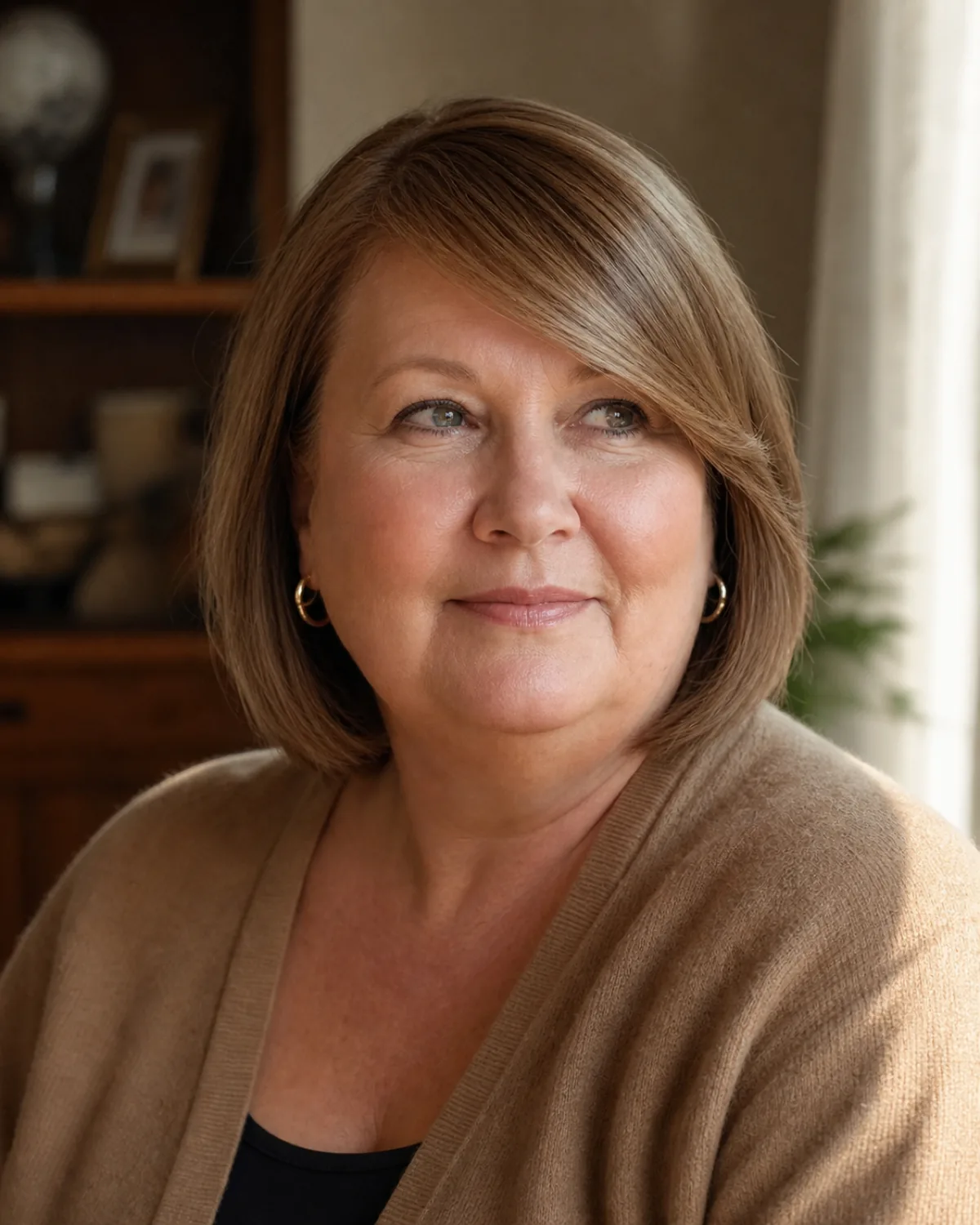
The diagonal line of a side-swept bang creates an angle that counters the roundness of the cheek and jaw. The woman here has a visibly round face, roughly equal in width and length, and the swept fringe introduces an angle the circle does not have on its own.
The sweep direction matters. Sweeping away from the fuller cheek draws the eye toward the narrower side. The bang should hit somewhere between the brow and the cheekbone. Too short and it reads as a failed blunt cut; too long and it falls in the eyes.
- Sweep your front hair to one side in a mirror and check whether your face reads less circular
- The diagonal is the structural element that does the work, not the fringe length alone
- Round faces benefit from the angle because a circle has no diagonal of its own
- A bob with side-swept bangs compounds the effect by keeping the overall silhouette compact
6. Side-Swept Bangs on Fine or Thinning Hair
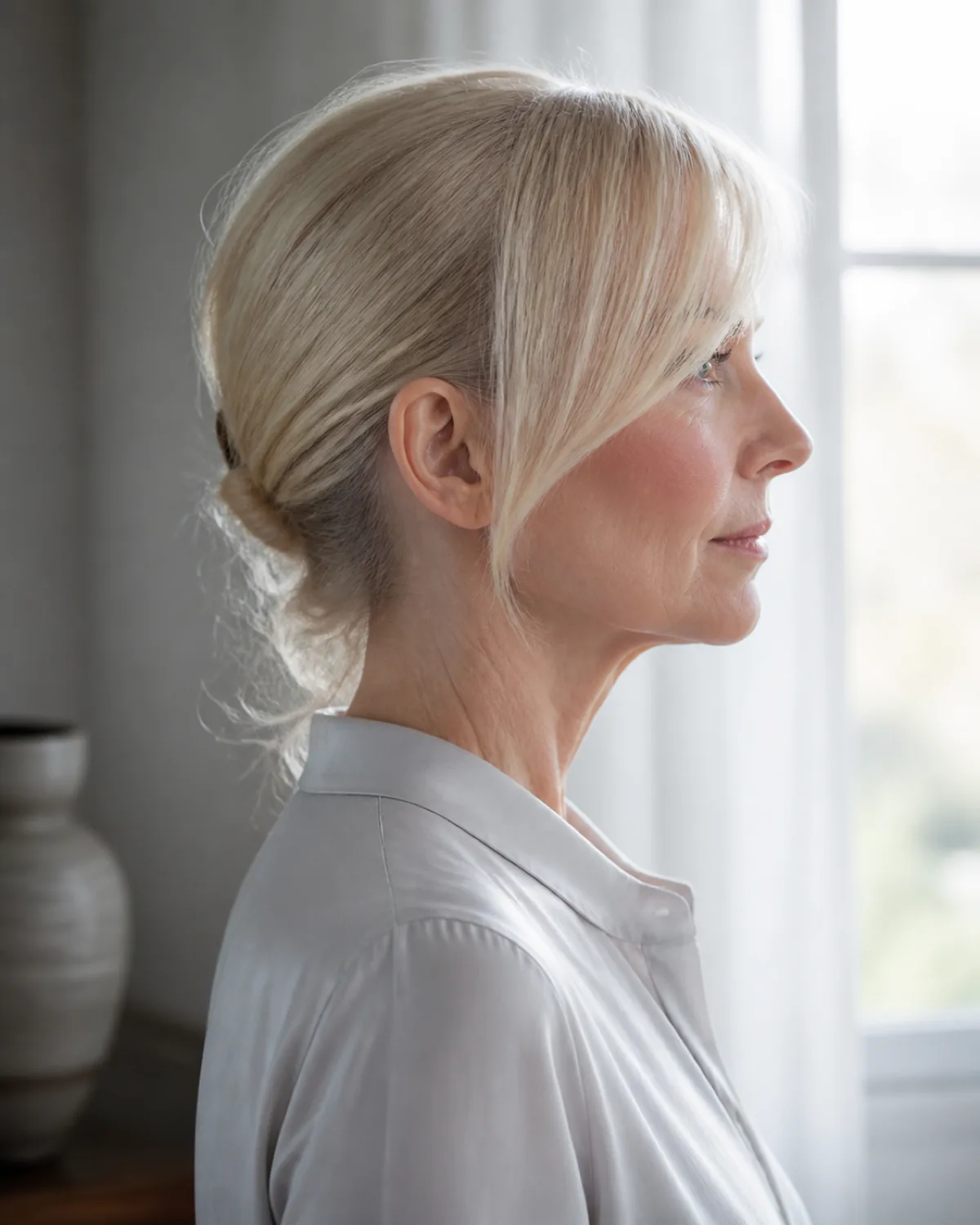
The side sweep works with less density than a blunt bang because it spreads the hair on a diagonal instead of asking it to cover a horizontal span. The profile here shows how fine strands can still create a sweep when directed to one side and anchored where the hair tucks behind the ear.
The requirement is enough length that the sweep holds its direction. Too short and the fine hair floats upward. Too long and it separates into see-through strands that fall in the eyes. The diagonal placement is forgiving because it does not demand a solid wall of hair the way a blunt cut does.
- Check whether your front section is thick enough to stay swept to one side or separates into gaps within an hour
- The side sweep asks for direction, not density, which is why it works where blunt fails
- Anchoring behind the ear on one side keeps the sweep in place through the day
- If your hair is both fine and short at the front, a deep side part without bangs may be the simpler route
7. Curtain Bangs with a Bob
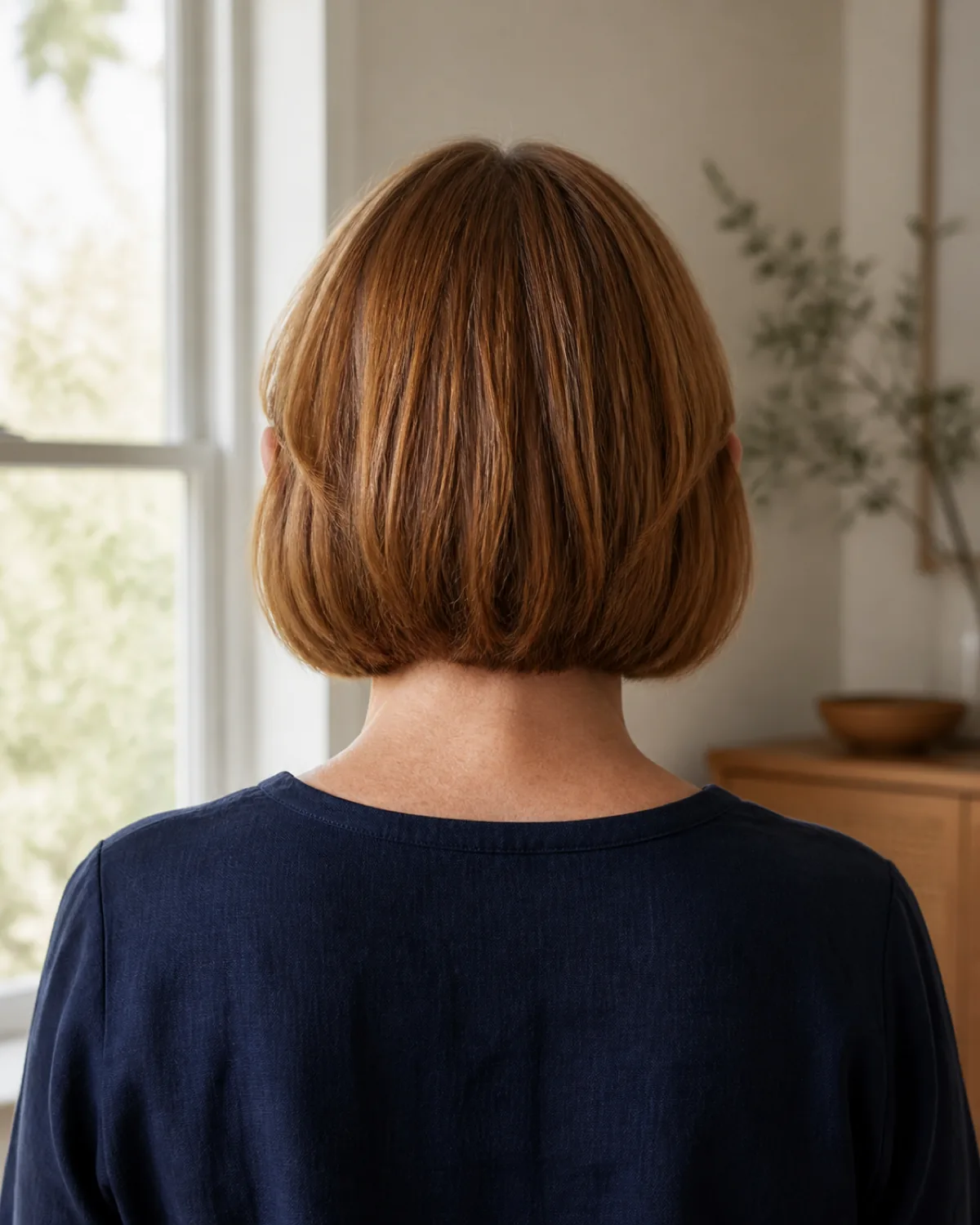
The curtain frames the face while the bob keeps the silhouette compact. The view from behind shows the bob hemline sitting cleanly at chin level, with the curtain framing pieces wrapping around on both sides without hanging longer than the bob itself.
The risk is a curtain that outgrows the bob. When the framing pieces are longer than the shortest layer, they create a ledge where two lengths collide. The curtain should blend into the bob, not extend past it. This matters more with a bob than with longer hair because the bob hemline is precise and any overhang is visible.
- Check whether your curtain length stops at or above the chin when the bob hemline sits at the chin
- A curtain longer than the bob creates a visible ledge that reads as two separate cuts
- The inverted bob adds graduation at the back, which gives the curtain more room to blend
- Ask your stylist to connect the curtain to the shortest layer of the bob so the transition is seamless
8. Curtain Bangs with Long Layers
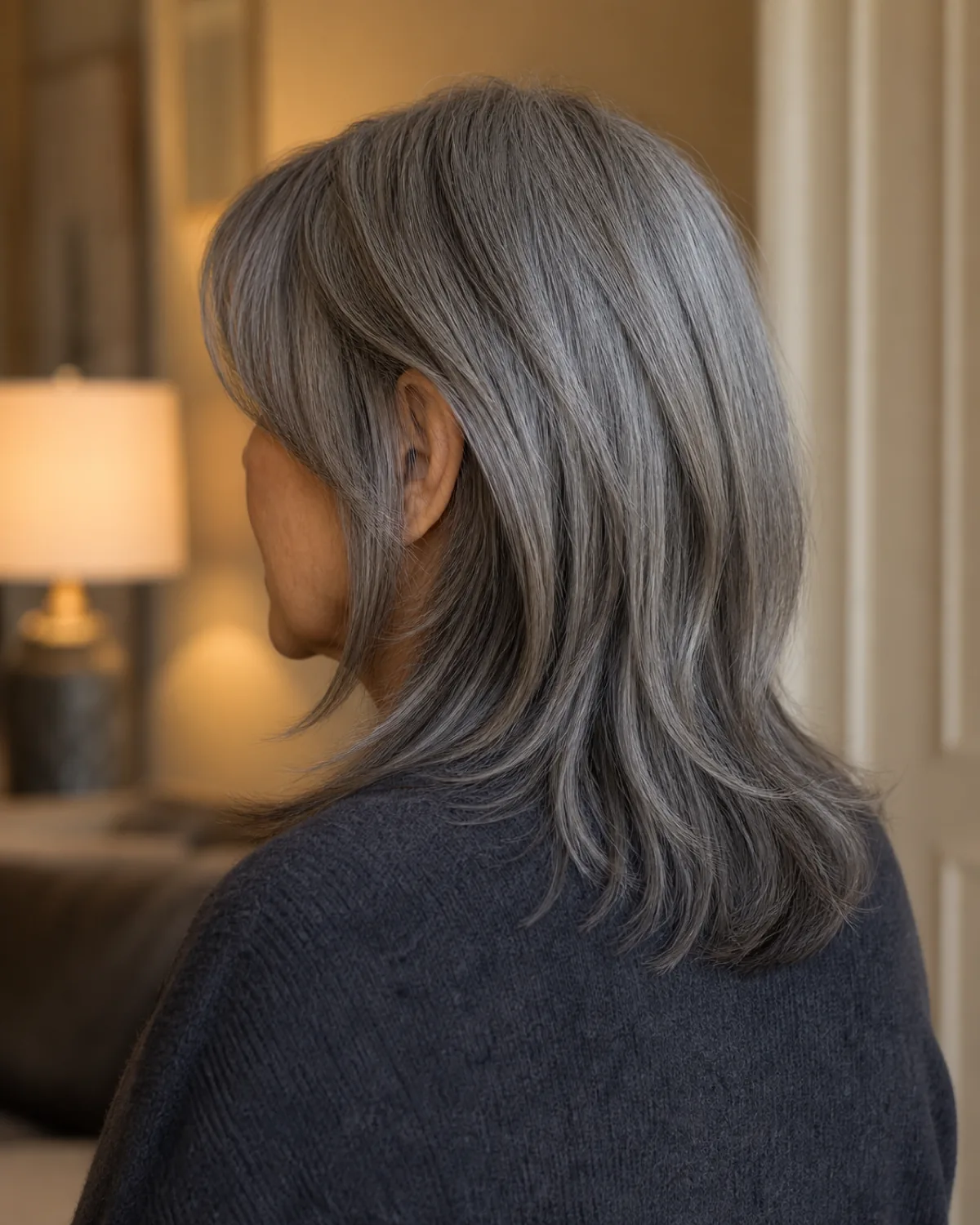
On shoulder-length or longer hair, curtain bangs serve as the shortest layer in a graduated frame. The back-three-quarter view here shows the graduated structure: the curtain pieces at chin level taper smoothly into mid-lengths and then into the longest pieces at the collarbone.
The transition is what makes or breaks this combination. If the curtain stops sharply at the chin while the rest falls to the collarbone, the gap creates a visual break that reads as two different haircuts stacked on one head. The curtain must connect to the next layer without a ledge. This is a conversation to have with your stylist before the scissors start.
- Ask whether your curtain pieces connect to your longest layer or whether there is a length gap between them
- A smooth taper from chin to collarbone means the layers were cut as a system, not added separately
- Long layered hair with thick hair shows how the graduated frame works when density is not an issue
- The more layers between the curtain and the longest piece, the smoother the graduation reads
9. Arched Bangs That Follow the Brow Curve
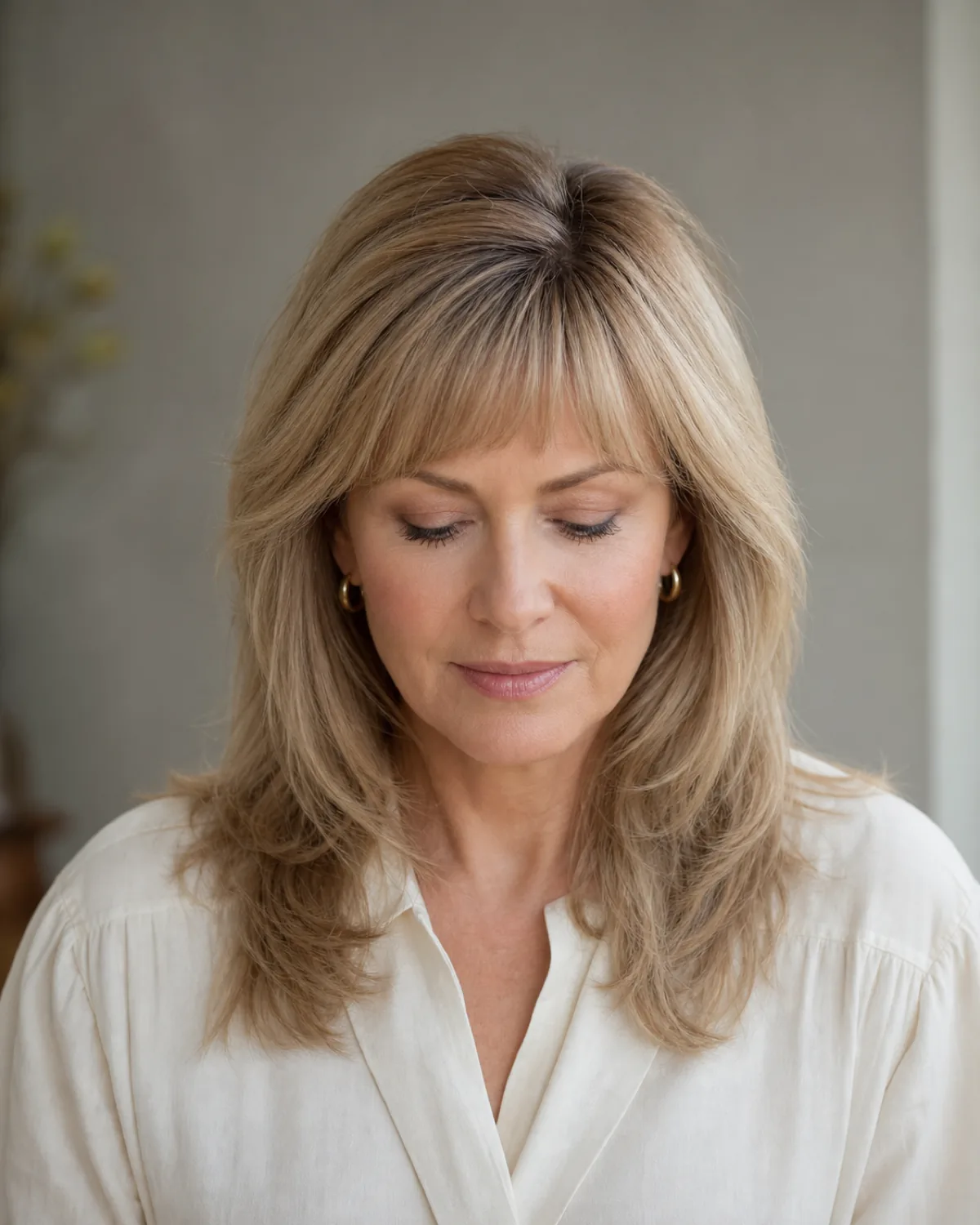
The fringe here mirrors the curve of the eyebrow. It is shortest at the center of the forehead and gradually lengthens toward the temples, creating a gentle arch. The shape is the most face-shape-specific bang in this guide.
An arched fringe shortens a long face because the curve creates a horizontal boundary that closes the vertical distance between hairline and chin. On a short face, the same arch compresses the proportions further. Regular trimming is essential because one or two millimeters of growth flattens the arch into a straight line that loses the curved effect entirely.
- Ask whether your face is longer than it is wide, because the arch works by shortening the vertical
- The trimming interval is every two to three weeks to maintain the curve
- A flat line where the arch used to be signals that the fringe has grown past its intended shape
- This is one of the few bangs where the center is shorter than the sides, so the stylist needs to cut it that way deliberately
10. Feathered Bangs with Texture at the Ends
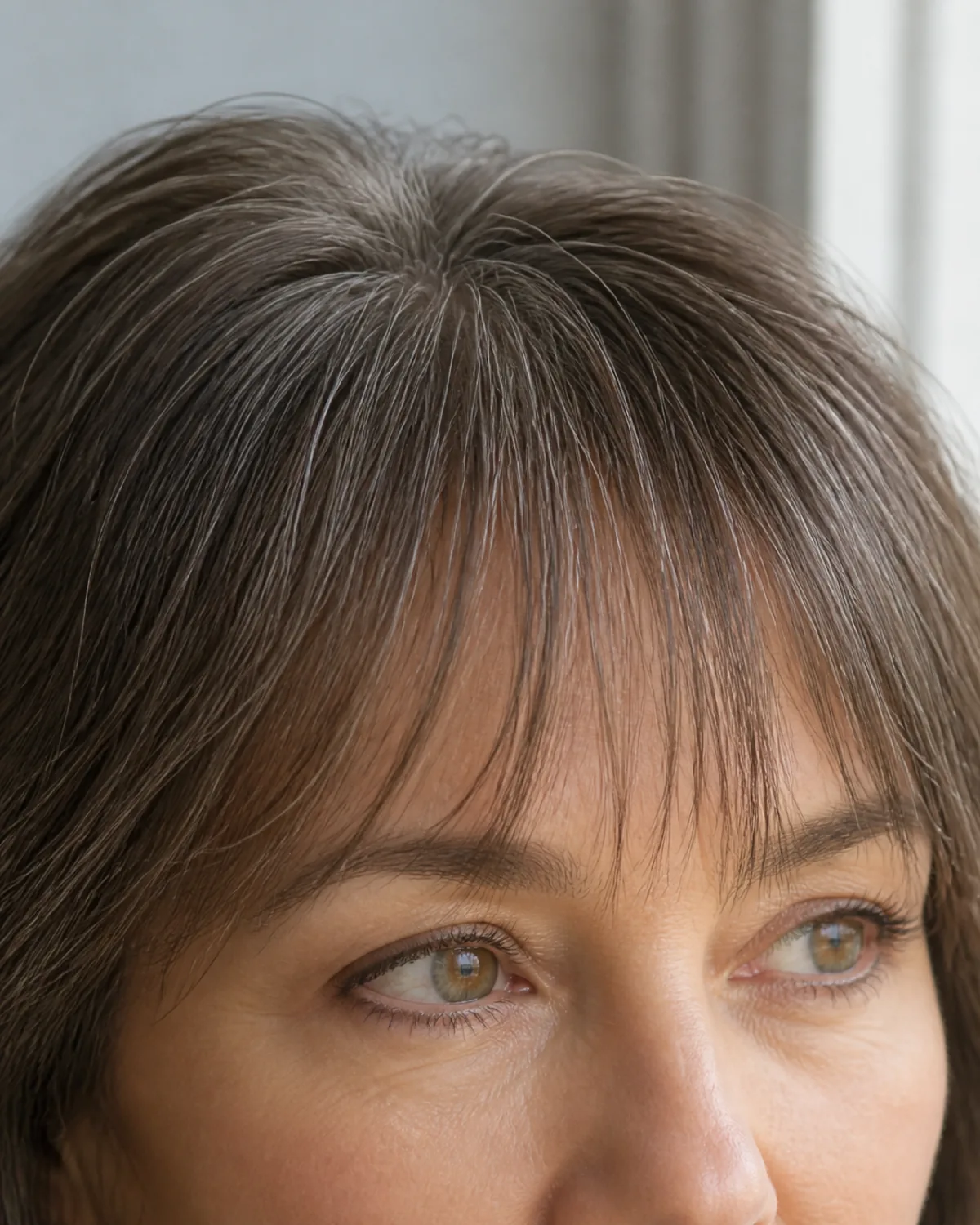
The ends are point-cut so they break into soft individual pieces instead of forming a solid line. The close-up here shows the strand separation at the fringe tips, where each piece falls separately rather than merging into a wall.
This is the density rescue for women whose front section has thinned. The broken texture hides the gaps that a blunt cut would expose because the eye reads irregularity as intentional rather than sparse. It works on straight to wavy hair. Tight curls override the feathering and create unpredictable shapes that the point-cutting cannot control.
- Look at whether your front hair appears thin when cut blunt and whether broken ends would disguise that
- Point-cutting is a specific technique your stylist needs to use, not just regular scissors
- The feathered effect only works on hair that falls with some weight and direction
- Straight to wavy textures cooperate with the point-cut; curly textures rearrange the pieces on their own
11. Bottleneck Bangs That Widen at the Jaw

The fringe starts narrow at the forehead and fans out along the jawline, widening as it goes. The shape resembles a bottle neck. The three-quarter view here shows the pieces getting progressively wider from the temples down to jaw level.
This is a newer cut that functions like a curtain bang with extra jaw-level volume. It flatters a narrow chin by adding width where the face tapers. On a wide jaw, the extra material at jaw level doubles down on the width, which is not what most women with a wide jaw want.
- Ask whether your jaw is narrower than your cheekbones, because the bottleneck adds width at the chin
- The widening shape is deliberate and structural, not just hair that grew out unevenly
- A narrow chin gains balance from the jaw-level pieces
- A wide jaw gains more width, which is usually the opposite of the goal
12. Birkin Bangs: Long and Undone

These sit just past the eyebrows and are intentionally imperfect. The overhead view shows the fringe falling forward in irregular, slightly separated pieces. The texture is undone rather than precise.
The requirement is hair that reads casual when slightly unkempt. Thick or medium-density hair with some natural texture carries the undone look. Fine hair that separates reads sparse rather than relaxed, and the distinction between those two impressions is the entire judgment. This fringe suits women who want a fringe without the precision commitment of blunt bangs.
- Ask whether your hair looks relaxed when slightly messy or whether it looks neglected
- The difference between undone and unkempt depends on the strand diameter
- Fine hair separating at the fringe reads as thinning, not as style
- This is the lowest-maintenance fringe in this guide because imperfection is the point
13. No Bangs, Center Part

The absence of a fringe is a valid decision, not a default. The view from behind shows hair falling cleanly away from a center part with no short pieces at the front. The full forehead is exposed.
A center part without bangs reads balanced on an oval or heart-shaped face where the forehead width is already proportional. On a long or oblong face, the unbroken vertical line from hairline to chin can elongate further. The judgment is whether your forehead is something you want to show and whether the full vertical of your face reads proportional without a horizontal break.
- Look at your face with all your hair pulled back and decide whether the full forehead reads proportional
- An oval face rarely needs a fringe because the proportions are already balanced
- A long face may benefit from a horizontal break, which means bangs might serve you better than this option
- Choosing no bangs eliminates the trimming commitment entirely
14. No Bangs, Deep Side Part
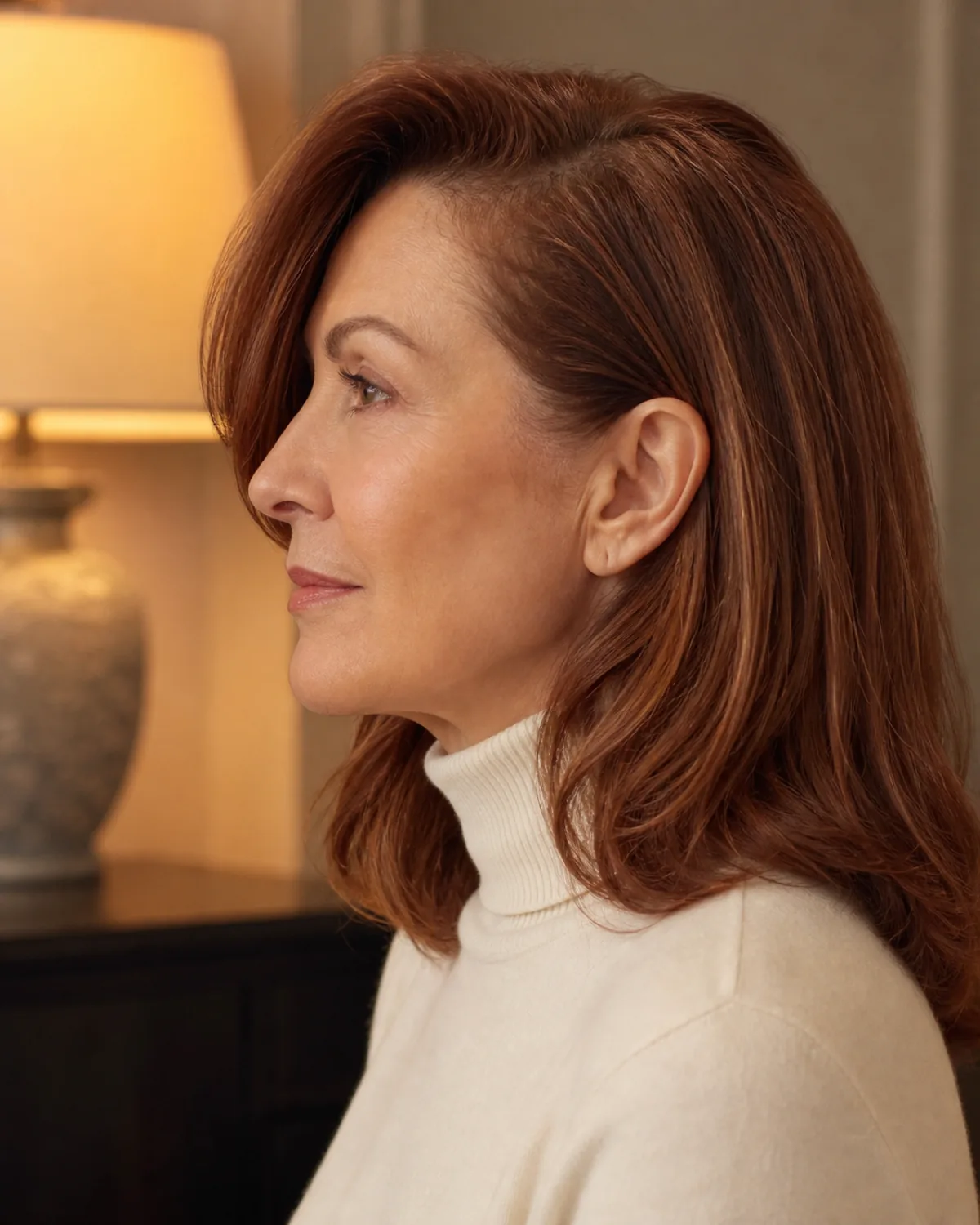
Moving the part to one side without adding a fringe creates a sweep of hair that covers part of the forehead. The profile here shows how the heavy side of the deep part drapes across approximately half the forehead while the lighter side falls behind the ear.
This is the low-commitment alternative for women who want forehead coverage without the trimming schedule of a true fringe. The hair does the work that bangs would do, but it can be reparted to center or the other side at any time. The coverage depends on the hair having enough weight on the heavy side to stay in place.
- Try a deep side part and check in a mirror whether the heavy side covers enough forehead to satisfy you
- If the heavy side swings forward within an hour, the hair may not have enough weight to hold the part
- This gives you forehead coverage without committing to a cut you cannot reverse
- Shoulder-length hair carries a deep part well because the length adds enough weight to keep the sweep in place
15. Bangs on a Heart-Shaped Face
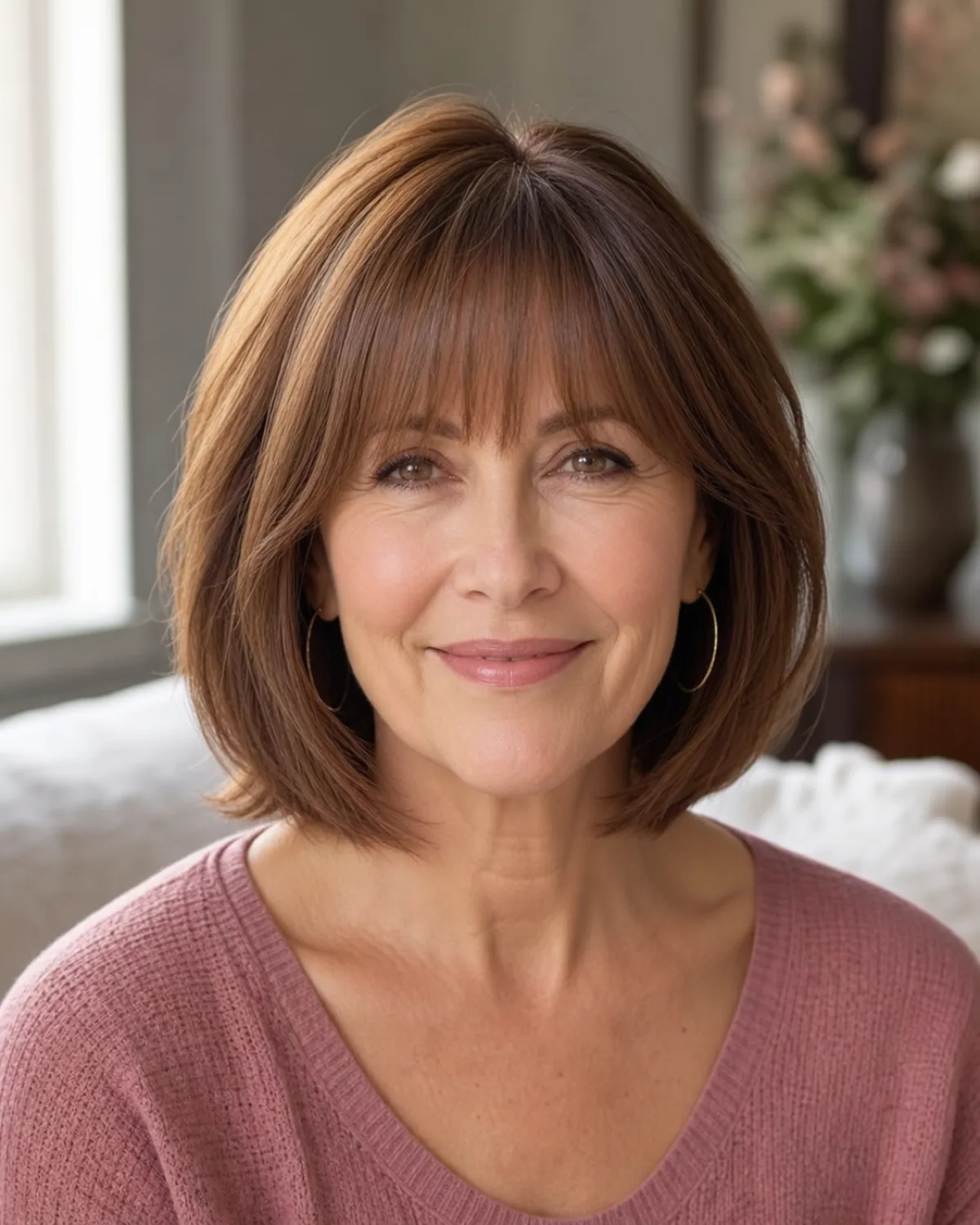
The wider forehead and narrow chin of a heart-shaped face benefit from a fringe that covers the top and lets the chin speak. The image shows curtain bangs sitting across the forehead, softening the width at the top while the narrower chin below is fully exposed.
Curtain bangs and side-swept bangs both work on this face shape. Blunt bangs risk making the forehead look wider because the solid horizontal line draws attention to the widest point of the face. The goal is to reduce the visual contrast between the wide forehead and the narrow chin, and a fringe that hides some of the forehead width does that.
- Decide whether you want to soften your forehead width or emphasize it, because the fringe direction determines which
- Curtain bangs reduce the visible width of the forehead by covering the edges
- Blunt bangs create a horizontal line at the widest point, which can emphasize it
- Side-swept bangs add a diagonal that draws attention away from the width difference
16. Bangs with Glasses

Frames and fringes compete for the same real estate between the eyebrows and the hairline. The image shows wispy curtain bangs ending above the top of the glasses frames, leaving a visible gap between the two. The tortoiseshell frames sit cleanly below the fringe without the two elements colliding.
Thick blunt bangs plus heavy frames create visual congestion in that narrow strip of face. Wispy or curtain bangs that leave space between the ends and the top of the frame work better because the eye can distinguish between hair and accessory. The test is simple: when you look in a mirror, do the bangs sit on top of the glasses or above them? On top reads cluttered.
- Check whether there is visible space between where your bangs end and where your frames begin
- Wispy or curtain bangs leave more room for frames than blunt bangs
- Heavy frames need lighter bangs and light frames can handle more fringe density
- If your bangs rest on your glasses, either the bangs are too long or the frames sit too high
17. Growing Out Bangs Without the Awkward Phase
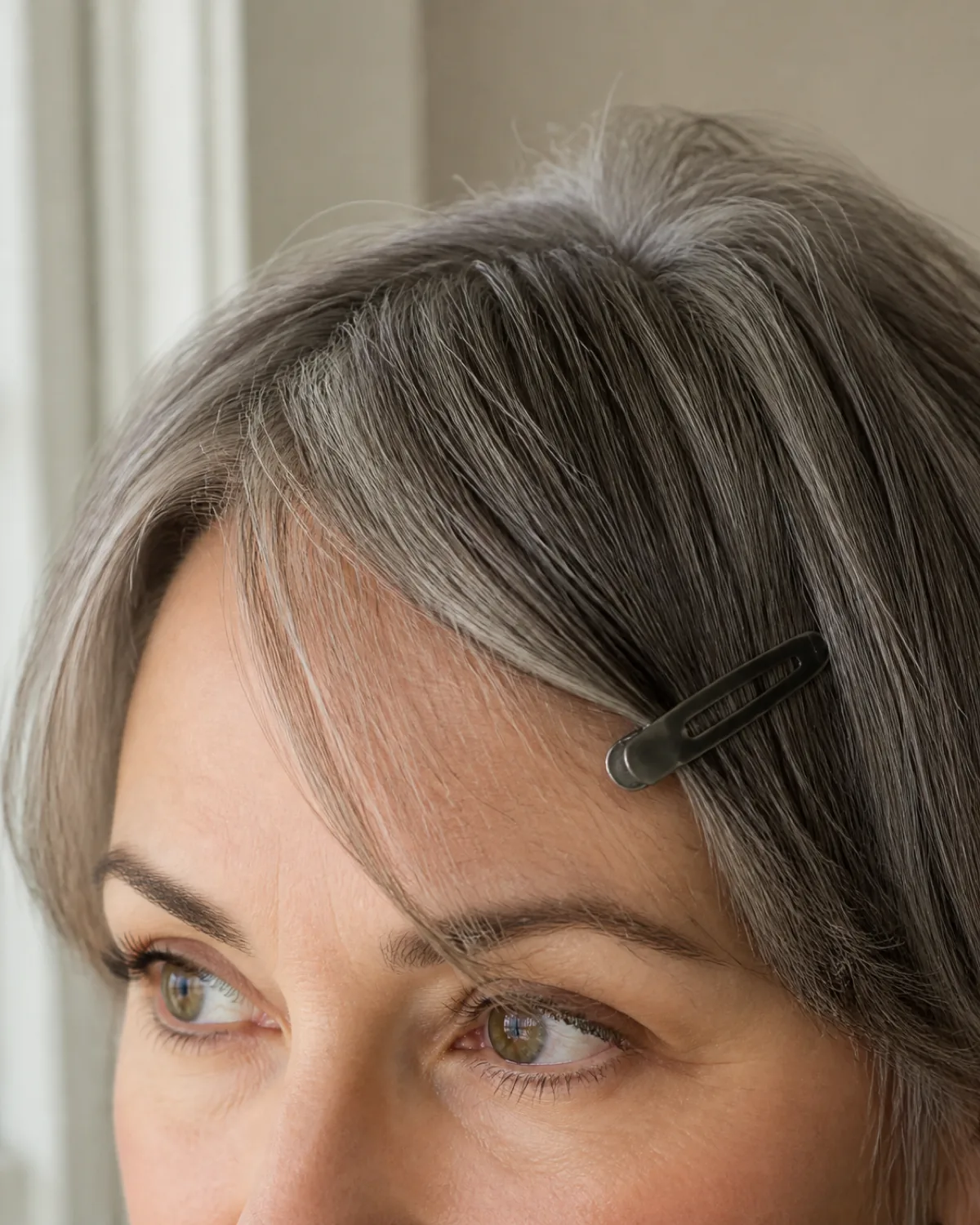
The transition from bangs to no bangs takes four to six months. The close-up here shows the hardest stage: the fringe sits between the eyebrow and the cheekbone, too long to stay above the brow and too short to tuck behind the ear. A small dark clip at the temple holds the growing fringe to one side.
The judgment is whether to commit to the grow-out or abort early. Side-sweeping and pinning are the two management strategies for the middle months, and neither involves cutting. The clip in this image is the kind of practical solution that gets you through the transition zone without reaching for the scissors.
- If your bangs fall in your eyes, you are in the middle stage and the temptation to cut will peak here
- Side-sweeping the growing fringe keeps it out of the way while it adds length
- A small flat clip holds the fringe against the temple during the worst weeks
- The grow-out is a four-to-six-month commitment and knowing the timeline helps you decide whether to start it
Where the checkable claims come from
- Face Shapes and Hairstyles — Pivot Point International
- Fine Hair: Causes and How to Care for It — Philip Kingsley Trichological Clinic
Keep this one
Save it for the appointment
Pin the image above to the board you actually open before a salon visit. This guide is written to be re-read, not read once.
Tonight, before you close this tab
- Pull your front hair straight down over your forehead and check whether it covers the skin completely or shows gaps to know if blunt or textured bangs are realistic
- Measure from your hairline to your brow bone with three fingers because if all three fit your forehead is tall enough for a heavier fringe
- Sweep your front section to one side and check in a mirror whether the diagonal changes how round or long your face reads
- If you already have bangs mark your calendar three weeks out because if you have not trimmed them by then you may not want high-maintenance bangs
- Write down two questions about bangs to bring to your next salon visit so the conversation starts with your face shape not a photo from a magazine