7 Ways to Know Your Face Shape Before Your Next Haircut
Seven practical ways to identify your face shape so you can ask for a cut that works with your proportions. Round, oval, square, heart, oblong explained.

Booking an appointment soon? Save this page. It is easier to skim in the chair than to remember.
At a glance
Works
- Measuring the widest point of your face to separate round and square from oval and oblong
- Checking whether your jawline curves or angles to split round from square
- Bringing a pulled-back photo to the salon so the stylist can see your bone structure
Depends
- Whether your face reads as heart or oval, which depends on how much your chin narrows relative to your cheekbones
- Whether side volume helps or hurts, which depends on whether your face is already wider than it is long
Skip
- Online face-shape quizzes that ask about your personality instead of measuring proportions
- Assuming your face shape is the same as it was at thirty, when soft tissue shifts can change the dominant read
- Picking a cut based on a celebrity match without checking whether your hair density can hold the same structure
Every haircut guide for women over 50 starts the same way: know your face shape first. Then it skips the part where you actually figure it out. This guide does not skip it.
What follows are seven practical checks that take you from a vague sense of your proportions to a specific piece of information you can carry into a salon.
The goal is not a perfect label. It is one clear fact about where your face is widest, so you can ask for a cut that works with that width instead of against it.
1. The Mirror Test You Actually Need

One measurement does most of the work. Pull your hair back so your entire face outline is visible, stand in front of a mirror in flat, even light, and compare two distances: the widest point across your face and the length from hairline to chin.
If those two distances are close to equal, you are in the round or square group. If the length is noticeably greater, you are in the oval, heart, or oblong group. That single comparison narrows five shapes down to two or three possibilities.
- Pull your hair fully back with a clip or elastic so no strands cover your jawline or temples
- Face a mirror in even light, not side-lit or overhead, and photograph yourself straight on
- Compare cheekbone width to hairline-to-chin length by holding a pencil horizontally and then vertically
- Write down which is larger, because you will forget by the time you book a cut
- If the two are nearly equal, read sections two and four next; if length is clearly greater, read three, five, and six
2. Round Face: Width and Length Are Nearly Equal
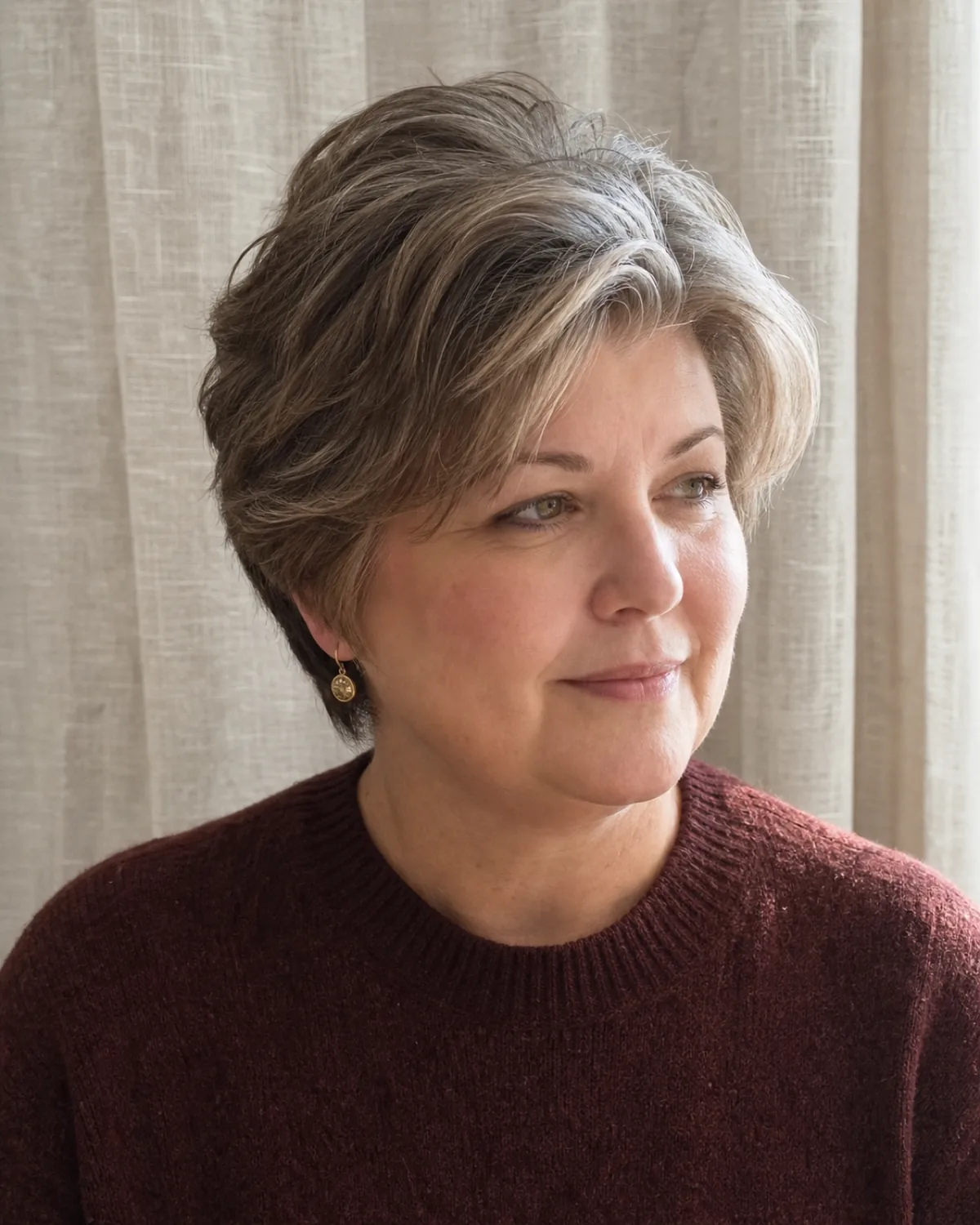
A round face measures roughly equal in width and length, with the cheekbones as the widest landmark and a jawline that curves rather than angles. The proportions are balanced but circular, which means cuts that add horizontal volume at the sides reinforce the circle.
Volume placed on top shifts the visual upward and lengthens the overall read. A layered cut with height at the crown, like the textured short cut shown here, creates vertical interest without removing width at the cheekbones.
- Check whether your cheekbones are the widest point and your jawline has no sharp corners
- If both are true and width roughly equals length, you are in the round group
- Tell a stylist you want vertical interest: height at the crown, not width at the sides
- Avoid blunt chin-length bobs that end exactly at the widest point, which locks the circular read in place
- Read the round face hairstyles guide for specific cuts
Where to start
Find your situation, skip ahead
You have never figured out your face shape and every guide confuses you
Start with the mirror test in section one. One measurement splits five shapes into three groups.
You know your face is round but cuts keep making it look wider
Read the round-face section and then the overlap section. The fix is usually vertical volume, not shorter sides.
02 Round Face: Width and Length Are Nearly Equal07 When Two Shapes Overlap (And They Often Do)
Your face seems to be two shapes at once and you do not know which to go by
Most faces overlap. Read section seven first, then the two shapes yours sits between.
07 When Two Shapes Overlap (And They Often Do)03 Oval Face: Length Is Longer, Nothing Dominates04 Square Face: Strong Jaw, Matched Width
3. Oval Face: Length Is Longer, Nothing Dominates

An oval face is longer than it is wide, with the forehead slightly wider than the jaw and an even taper from cheekbones to chin. No single feature dominates. The profile here shows that smooth transition: forehead, cheekbone, and chin step down evenly without any abrupt angle.
This shape has the widest range of cuts that sit well because the proportions are already balanced. The real constraint is your hair texture and density, not geometry. The risk is choosing a cut that hides proportions that were already working.
- Check whether your face is clearly longer than it is wide and no single feature stands out
- The forehead is slightly wider than the jaw but neither is dramatically so
- Most lengths and layers work here, so the conversation with your stylist shifts to texture and maintenance
- Avoid heavy curtain bangs that cover the balanced forehead, which trades your best feature for a trend
- If you are between oval and oblong, the tiebreaker is how long your face reads vertically in a pulled-back photo
4. Square Face: Strong Jaw, Matched Width
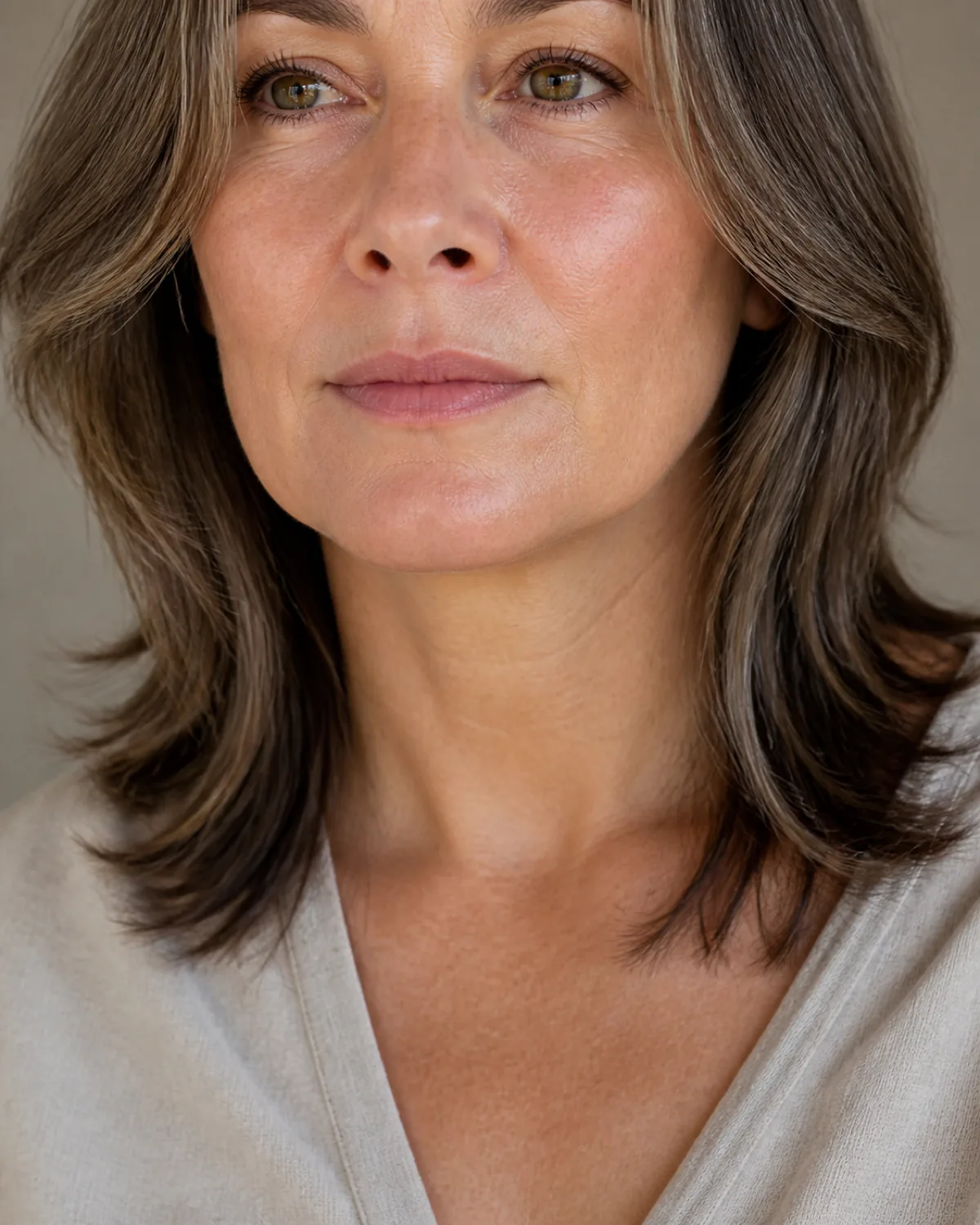
A square face has a jaw and forehead that are close in width, with visible corners at the jawline. The angle at the jaw is the defining feature. The close crop here shows those corners clearly, with soft layers falling about two inches past the jawline to demonstrate how hair can soften the angles without hiding them.
The distinction from round is the jaw: round curves, square corners. If you see a visible turn where the jawline meets the ear, you are in the square group.
- Look at your jaw where it meets your ear and check for a visible angle or corner
- If the jawline angles rather than curves and your jaw width is close to your forehead width, you are square
- Layers that fall past the jawline by one to three inches soften the angles; layers that end exactly at the jaw emphasise them
- Tell your stylist: ends past or above the jawline, not at it
- Read the double chin guide if jaw-area softness is part of the picture
5. Heart Face: Wider Forehead, Narrow Chin

A heart-shaped face is widest at the forehead or cheekbones and narrows distinctly at the chin. The narrowing is the key: if your chin comes to a noticeably smaller point than your forehead, you are likely in this group.
The chin-length bob shown here demonstrates the balancing principle. Hair that ends at chin level adds width where the face narrows, counteracting the taper. Side-swept bangs reduce the forehead's visual span by breaking the horizontal line across the top.
- Check whether your forehead or cheekbones are clearly wider than your chin
- If the chin narrows to a distinct point, you are in the heart group
- Cuts that add width at or below the chin balance the taper
- Side-swept bangs reduce the forehead's visual weight without hiding it entirely
- Full blunt bangs can make the forehead look even wider by creating a hard horizontal line at the brow
6. Oblong Face: Length Dominates Everything
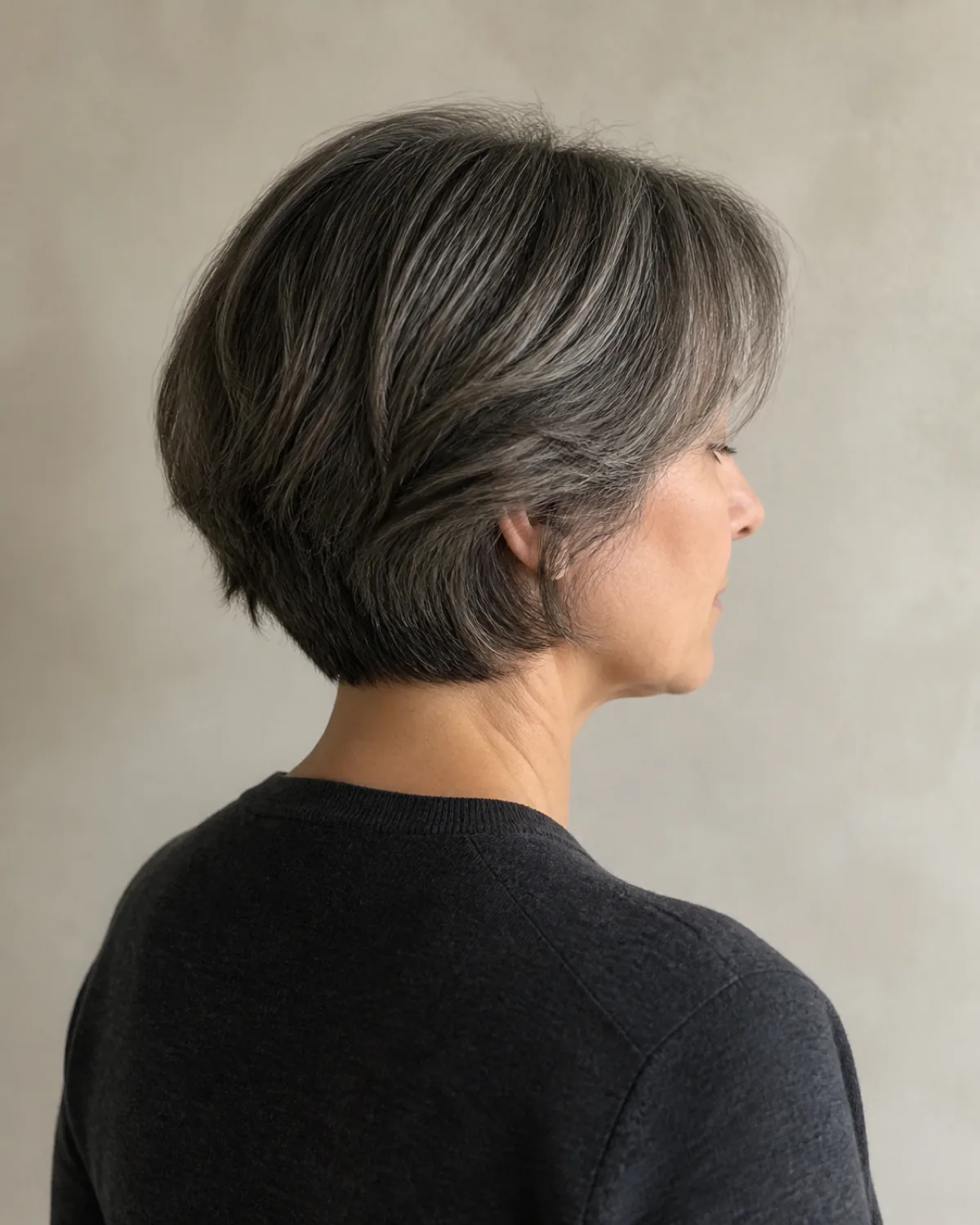
An oblong face is noticeably longer than it is wide across every horizontal measurement. If your mirror test shows length winning by a clear margin and your jaw is neither rounded nor angular but just narrow, this is your group.
Horizontal elements shorten the visual. Side volume, which you can see in the layered bob shown from the back here, pushes width outward. Bangs that break the forehead line, particularly curtain bangs that sit at the temples, interrupt the eye's downward path and reduce the perceived length.
- Check whether length clearly dominates width, even when you measure at the cheekbones
- If your face is long and relatively narrow without a defining jaw angle, you are oblong
- Side volume redirects the eye horizontally, which shortens the visual
- Curtain bangs break the forehead's vertical line without hiding it completely
- Avoid single-length hair with no layers that pulls the eye straight down and adds to the vertical read
7. When Two Shapes Overlap (And They Often Do)

Most faces sit between two categories. The woman shown here does not fit neatly into round or heart. Her jawline has the softness of a round face, but her forehead is slightly wider, which pulls toward heart. That ambiguity is normal, not a problem to solve.
The practical move is to identify which feature dominates and use that as the conversation anchor with your stylist. If the jaw is the most visible feature, start there. If the forehead width is what you notice first, start there. Perfect classification matters less than knowing which proportion to address first.
- Write down the two shapes your face sits between
- Decide which feature is most visible: jaw width, forehead width, or overall length
- Use that dominant feature as your starting point when talking to a stylist
- Bring the pulled-back photo from section one so the stylist can see the proportions without the hair
- Accept that "somewhere between round and heart" is a perfectly useful piece of information to give a professional
A stylist who can see your hair in person outranks anything written here. What this guide gives you is the vocabulary to start the conversation and the one fact, your widest point, that makes the rest of it concrete. More face-shape specific cuts sit in the face shape collection.
Where the checkable claims come from
- Face shape — Wikipedia
- Facial symmetry — Wikipedia
- Graduation vs. Elevation: The Subtle Distinction That Impacts Every Cut — Above Shears
- Bangs (hair) — Wikipedia
Keep this one
Save it for the appointment
Pin the image above to the board you actually open before a salon visit. This guide is written to be re-read, not read once.
Tonight, before you close this tab
- Pull your hair back, face a mirror in flat light, and photograph yourself straight on
- Compare the width across your cheekbones to the distance from hairline to chin and write down which is larger
- Look at your jawline and note whether it curves smoothly or turns at a visible angle
- Bring the pulled-back photo to your next salon visit and ask the stylist what they see