18 Hairstyles for Women Over 60 With Glasses That Let the Cut and the Frames Work Together
Eighteen hairstyles judged on how they work with glasses after 60 — when density has thinned, texture has shifted, and frames are often larger. Each cut is assessed for frame compatibility.

Booking an appointment soon? Save this page. It is easier to skim in the chair than to remember.
At a glance
Works
- A cropped silver cut with crown lift because it pulls the eye above the frame line and works with thinning density
- A chin-length bob ending below the temple-arm hinge because the gap prevents the hairline and frame line from merging
- Side-swept bangs that clear the outer lens edge because the diagonal breaks the horizontal bar on any frame
Depends
- A textured pixie with temple volume only if your frames are not thick acetate, because bulk at the temples competes with wide frames
- A soft shag at the collarbone only if your hair has natural wave or curl, because straight fine hair separates into strings below the frames
- Feathered layers starting below the ear only if your crown is not noticeably thin, because keeping the top one-length magnifies the density gap
Skip
- A one-length shoulder cut tucked behind one ear with heavy round frames because the exposed full frame widens the face
- A textured pixie with thick bold frames because temple bulk and frame width fight each other
- Micro-bangs if your forehead is short because the bangs compress the space between hairline and frame top
The question at 50 was whether the cut echoed or broke the frame line. At 60 the question adds variables: thinner density at the crown, coarser gray texture, and deeper progressive lenses.
Each cut below is judged on whether it still cooperates with your frames given those shifts.
If your face shape is something you have not mapped out, a face-shape guide is a useful starting point before choosing a cut.
1. Cropped Silver Cut With Lifted Crown
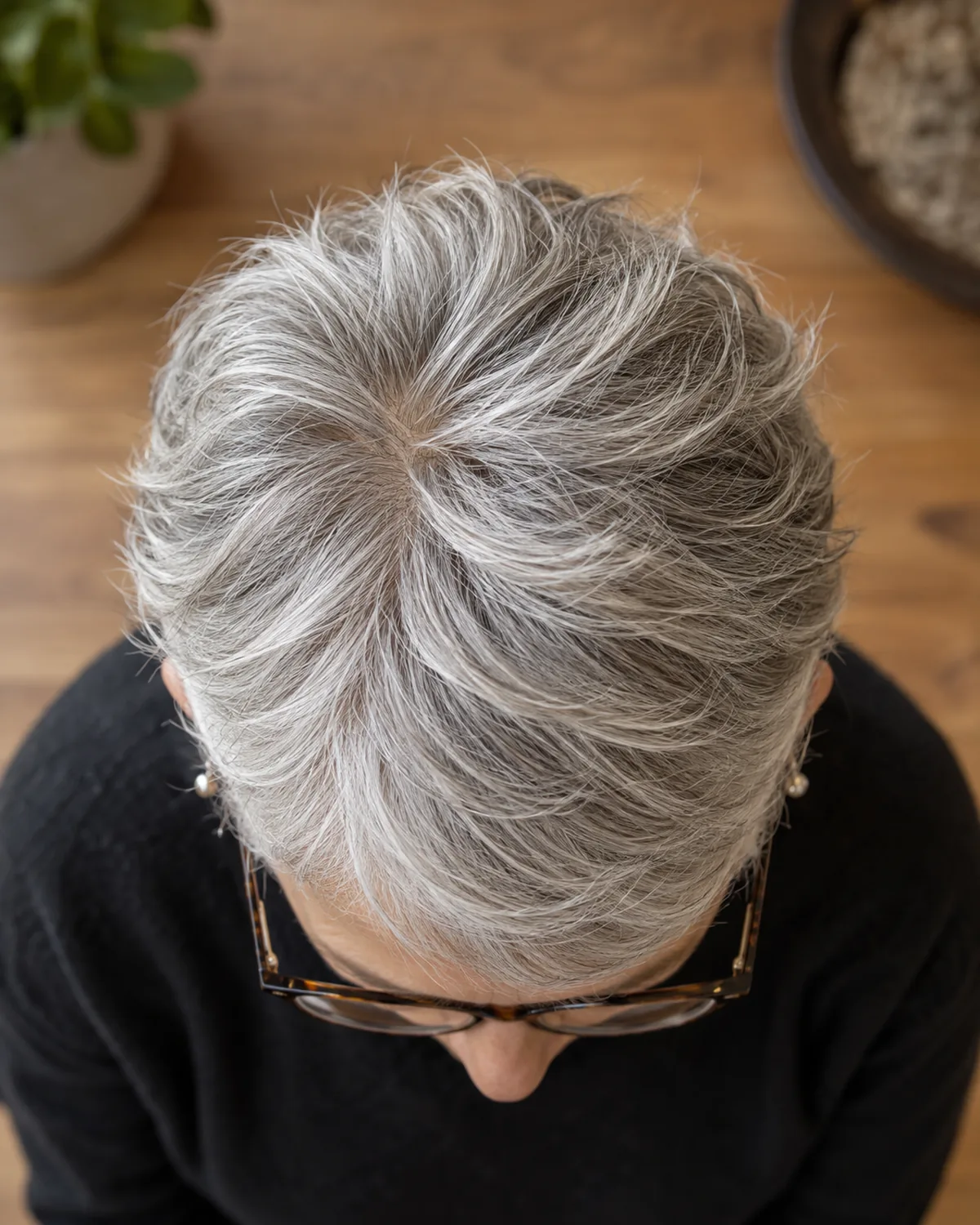
A short all-over crop where the crown is left slightly longer and finger-styled upward. The lifted crown draws the eye above the glasses rather than behind them. On thinning hair this is a strategic redirect — the height at the top makes the frames sit in the middle third of the face instead of dominating the upper half.
- Suits rectangular and cat-eye frames where the strong top bar needs a counterweight above it
- The crown lift works best on hair that still has enough body to hold a finger-styled shape without product buildup
- Skip if the crown has significant bald patches — lifting exposes them rather than concealing them
- Ask for dry cutting so the stylist can see exactly how much lift the crown hair produces before committing to the length
2. Chin-Length Bob Ending Below the Temple Arm

The hemline falls one to two inches below where the temple arm meets the frame hinge. That gap is the entire point — it separates the hair line from the glasses line and prevents the striped effect that happens when both lines run at the same height.
- Works on straight and wavy hair with adequate density; the blunt hemline needs enough hair to read as a clean line
- Oval and long face shapes benefit most because the vertical gap between frame and hemline lengthens the lower face proportionally
- Skip if the jaw is soft and round — the horizontal hemline doubles the width at exactly the wrong place
- Measure the distance from your temple-arm hinge to your jawline before the appointment; two inches of gap is the minimum that reads as intentional
3. Side-Swept Bangs That Clear the Outer Lens Edge

A diagonal fringe swept from one side, ending past the outer edge of the lens. The diagonal breaks the horizontal bar of the glasses — and at 60, when the frames tend to be wider because progressive lenses need deeper housings, that horizontal bar is more dominant than it was a decade ago.
- Works with all frame shapes because the diagonal crosses the top bar at an angle rather than running parallel to it
- The swept end should clear the outer lens edge; if it stops short, the fringe frames one lens and leaves the other exposed, which reads lopsided
- Skip if hair is very fine at the temple — the bang section looks sparse against the frame and draws attention to the thinning rather than masking it
- Side-swept bangs behave differently from curtain bangs: curtain bangs frame the top bar symmetrically, while a side sweep crosses it at an angle
4. Textured Pixie With Volume at the Temples

A pixie cut with extra length and point-cut texture at the temples and crown. The texture creates fullness exactly where glasses compress the hair against the skull. On fine-to-medium hair, this fills the gap between the temple arm and the scalp that makes glasses look like they are sitting on bare skin.
- Works on fine-to-medium hair where the point-cut ends create volume without adding bulk
- Skip if you wear thick acetate frames — the texture at the temples competes with the frame width, and both elements cancel each other out
- The shorter the sides behind the ear, the more the temple texture reads as intentional volume rather than grow-out
- Ask for point-cutting rather than razor work — razor on fine hair frays the ends instead of building texture
5. Layered Bob With Movement at the Jaw

A chin-length bob with internal layers that create movement at jaw level. The layers soften the rigid line of the frame arms by adding texture below the glasses rather than beside them. The movement sits in a zone the glasses do not occupy, so the two elements share the face without competing.
- Suits medium-density hair on oval and heart face shapes; the jaw movement adds width where a narrow chin needs it
- Internal layers create movement without reducing the visible density of the perimeter — the bob still reads as full from the front
- Skip if hair is too fine to hold layers at this length; the ends separate and the bob loses its shape between washes
- The graduated bob solves a different problem: graduation moves weight to the back, while internal layers distribute movement through the front
Where to start
Find your situation, skip ahead
Your hair has thinned noticeably at the crown and you wear progressive lenses with deep frames.
A cropped cut with crown lift or a volume pixie with a deep side part — both create height above the large lenses without exposing sparse areas.
01 Cropped Silver Cut With Lifted Crown13 Volume Pixie With a Deep Side Part
Your hair still has decent density but you want the glasses and the cut to look like one thought.
A chin-length bob below the temple arm or a French bob above the chin — both occupy a zone that neither competes with nor ignores the frames.
02 Chin-Length Bob Ending Below the Temple Arm18 Classic French Bob Just Above the Chin
You have gone fully gray and want the glasses to be a style feature, not a necessity marker.
A natural gray bob with dark frames reads intentional. A swept-back cut showing bold temple arms reads confident.
16 Natural Gray Bob With Minimal Layers07 Swept-Back Ear-Length Cut With Visible Temple Arms
6. Soft Shag Hitting the Collarbone

A mid-length shag with curtain-like layers that begin at the cheekbone and graduate down. The face-framing layers interact with the glasses without crowding the top bar — they sit beside the lenses rather than on top of them. The length at the collarbone gives the overall silhouette enough weight to balance larger frames.
- Works on wavy-to-curly hair that holds texture; the shag layers rely on natural movement to create the curtain effect
- The cheekbone start point is deliberate — layers that begin at the brow crowd the frame top, while layers starting at the jaw miss the frame entirely
- Skip on straight fine hair; the layers separate and the shag reads as stringy below the frames rather than textured
- A collarbone shag is one of the few mid-length options that keeps enough hair near the face to interact with the glasses while avoiding the bulk that shoulder-length one-length cuts pile on
7. Swept-Back Ear-Length Cut With Visible Temple Arms

A short cut swept back behind the ears, deliberately showing the temple arms as part of the look. This turns the glasses from an object the hair works around into a visible design element. The swept-back hair frames the arms the way a setting frames a stone.
- Works when the frames are statement pieces — bold colour, interesting pattern, distinctive shape
- The ear-length cut means the temple arms are fully exposed from bridge to hinge; this is the intent, not a side effect
- Skip with thin wire frames — exposed wire arms against the scalp read medical rather than styled
- This cut is the opposite of the approach that hides the arms under layers; choose this when you want the glasses to lead and the hair to support
8. Graduated Bob With a Short Nape

Shorter at the nape, longer toward the chin. The graduation stacks weight at the occipital bone and pushes volume forward, framing the glasses from below. The short nape keeps the back clean — a preference many women settle into after 60, when the neckline hair often thins first.
- Works on all densities because graduation creates the illusion of volume through stacking, not through having more hair
- The forward weight means the glasses sit in the thickest part of the silhouette, which makes them look proportional rather than heavy
- Skip if hair is very curly — curly graduation stacks unpredictably and the shape is difficult to maintain without frequent trims
- A graduated bob and a layered bob with jaw movement solve different geometry problems: graduation moves weight backward and forward, while internal layers distribute it side to side
9. Wispy Side-Parted Fringe With Progressive Lenses

A light, wispy fringe parted to one side, designed to work above progressive lenses. Progressives have deeper lens housings than single-vision glasses, which means the top bar sits higher on the forehead. A dense fringe presses against that higher bar and looks crowded. A wispy fringe sits above it without weight.
- Works on fine hair where the wispy texture is natural rather than forced; thick hair needs heavy thinning to achieve this, and the blunt-cut ends behind the wispy fringe create a visible line
- The side part directs the fringe away from the nose bridge, keeping the reading zone of the progressive lens clear
- Skip if hair is thick and straight — thick hair makes a dense wall behind the lens that defeats the wispy effect
- This is the fringe option for progressive wearers who want some forehead coverage without the pressure a full bang creates against the frame top
10. Feathered Layers Starting Below the Ear

Layers feathered from below the ear down, leaving the crown and temple area one length for density. The feathering adds movement at the bottom half of the hair without thinning the top half where glasses already flatten the silhouette.
- Suits medium-to-thick hair where the feathering removes bulk below the ears and creates visible movement at the ends
- The one-length top preserves density exactly where thinning usually strikes first — the crown and temples — while the feathered bottom keeps the overall shape from reading as heavy
- Skip if hair is thin at the crown — keeping the top one-length magnifies the density gap between the flat top and the feathered bottom
- Ask the stylist to feather with the glasses on; the transition point from one-length to feathered should sit below the temple arm, not at the same height
11. Close-Cropped Nape With Longer Top

A two-length cut: the nape and sides are close-cropped, the top is two to three inches and styled forward or to the side. The disconnection reads as a deliberate design choice above the glasses. At 60, when simpler cuts risk reading as low-effort, the visible disconnection signals intention.
- Works with bold frames because both elements — the sharp cut lines and the strong frame shapes — share the same visual register
- The longer top can be directed toward the forehead to interact with the top bar, or swept to the side to cross it diagonally
- Skip if hair is fine and limp on top — the longer section collapses and the disconnection looks like uneven grow-out rather than a design decision
- This cut benefits from short return visits every four to five weeks; the disconnection blurs as the nape grows and the contrast that makes the look work disappears
12. One-Length Shoulder Cut Tucked Behind One Ear

Medium-length hair worn with one side tucked behind the ear, the other side falling forward past the frame. The asymmetry breaks the symmetry of the glasses — one temple arm is exposed, the other is curtained by hair. The contrast gives the face two different readings from each side.
- Works on hair with enough weight to stay tucked; fine slippery hair slides forward within minutes and the asymmetry disappears
- Oval and long face shapes benefit because the asymmetry shortens the perceived face length on the exposed side
- Skip with heavy round frames — the one-ear tuck exposes the full frame on that side and makes the face look wider
- The tucked side shows the temple arm and earring together; if you wear statement earrings, this cut turns three accessories — earring, arm, and hair — into one composition
13. Volume Pixie With a Deep Side Part
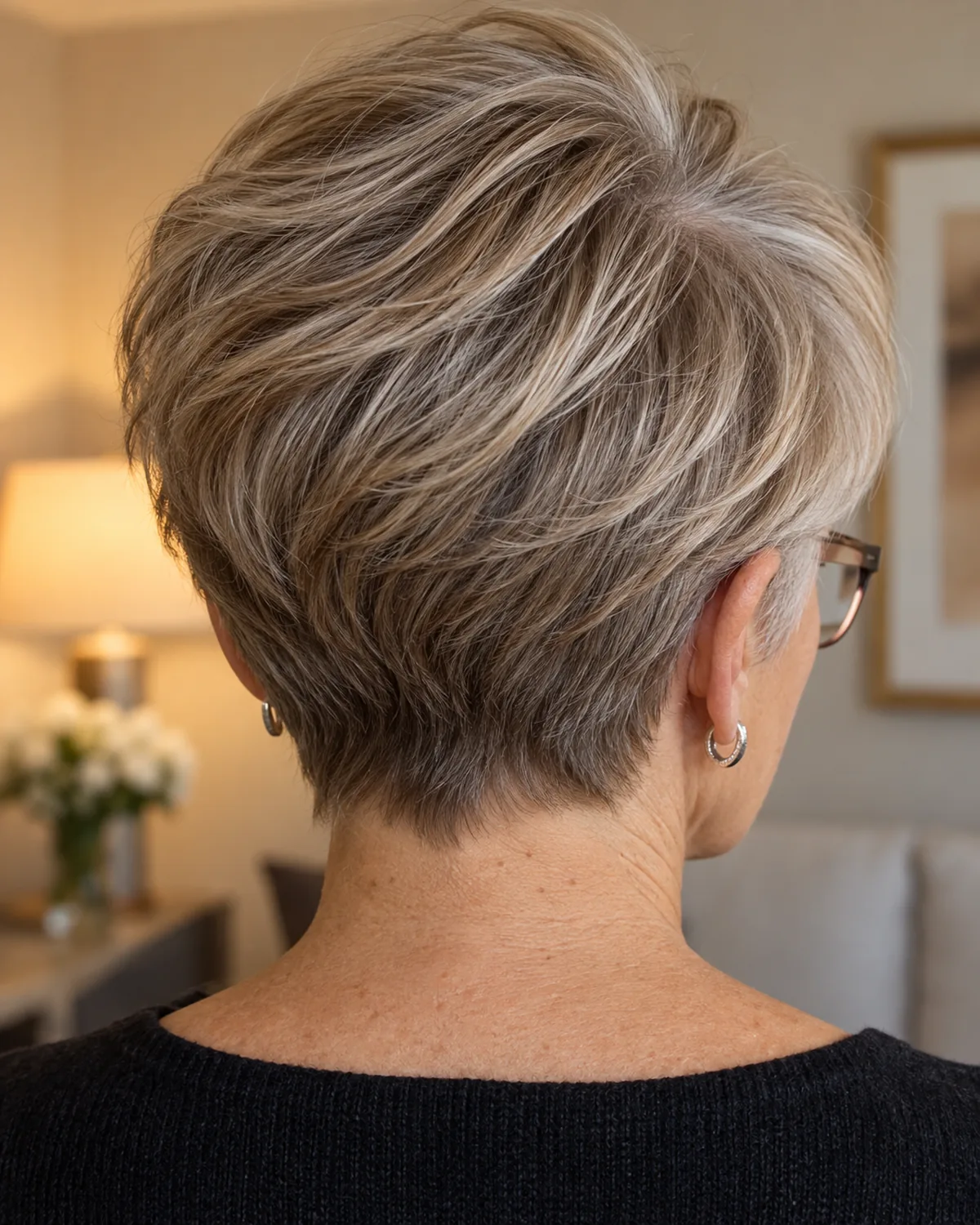
A pixie where the bulk of the volume sweeps across the crown from a deep side part. The sweep creates a diagonal line that offsets the horizontal bar of the glasses. On thinning hair, the deep part redistributes the remaining density to one side, creating the appearance of fullness without needing more hair.
- Suits fine-to-medium hair where the sweep builds volume from root direction rather than from bulk
- The diagonal of the sweep should cross the top bar of the glasses at a visible angle; if the sweep runs parallel to the bar, the effect is lost
- Skip with aviator frames — the sweep and the teardrop shape compete for the same diagonal, and neither one wins
- This is the crown-thinning solution that avoids the lifted-crown approach of idea 1; if lifting exposes sparse spots, sweeping covers them
14. Soft Waves at Ear Length

An ear-length cut with soft waves or curls, whether natural or from a texture perm. The curves interrupt the geometric lines of the glasses — every frame is made of straight lines and hard angles, and the waves introduce a visual counterpoint that softens the upper face.
- Works on naturally wavy or curly hair where the waves form without daily heat styling
- The ear length keeps the waves close to the frames so the contrast between curve and angle is immediately visible
- Skip if hair is dead straight — forcing waves at this length requires daily effort, and the straight pieces that escape read as a mistake rather than a style choice
- Wavy texture at this length adds the impression of density; for women with fine hair over 60, the waves create body that the straight version cannot
15. Tapered Nape With Face-Framing Pieces

A short-to-medium cut with a tapered nape and two chin-length pieces left around the face. The face-framing strands interact with the outer lens edges — they sit alongside the temple arms and create a soft border around the frames. The tapered back keeps the profile clean.
- Works on all densities because the face-framing pieces are the only length commitment; the rest of the cut can be as short as needed
- The face-framing pieces should end near the outer lens corner or just below, creating a frame-within-a-frame effect
- Skip if you push hair behind your ears — the face-framing pieces are the entire design, and tucking them back turns this into a plain short cut
- This cut splits the difference between a full bob and a pixie: the back reads short, but the front has enough length to interact with the glasses
16. Natural Gray Bob With Minimal Layers

A one-length or near-one-length bob on fully gray or white hair. Gray hair has a different texture — coarser, sometimes wiry — and a one-length cut preserves the density visual while the white colour creates a built-in contrast with dark frames. The contrast makes both elements read as intentional rather than incidental.
- Works when hair has enough density for a blunt line; sparse gray hair in a one-length bob shows gaps at the hemline that undermine the clean effect
- The frame colour matters here: dark frames against white hair create the strongest contrast; clear or light frames disappear
- Skip with clear or pale frames — the contrast effect that makes this pairing work vanishes, and the cut needs a different frame strategy
- Gray texture often has more body than the coloured hair it replaced; a bob that fell flat when dyed may hold its shape naturally once the gray grows in fully
17. Brow-Skimming Micro-Bangs With Short Hair

Very short bangs cut at mid-forehead, above the frame top bar. The gap between the bang line and the frame bar creates a clean visual break — forehead, then bang, then gap, then glasses. This layered reading gives the upper face three distinct zones instead of two crowded ones.
- Works with rectangular and semi-rimless frames where the top bar is thin enough to sit below the micro-bangs without competing
- The gap between bang and frame should be at least half an inch; less than that and the two lines merge visually
- Skip if your forehead is short — micro-bangs compress the space further, and the three-zone effect collapses into a single narrow band
- Micro-bangs require trimming every three weeks; they grow into the frame zone quickly, and once they touch the top bar, the clean break is gone
18. Classic French Bob Just Above the Chin

A short bob ending just above the chin with a slight inward curve and no layers. The French bob sits above the jaw and below the temple arm, occupying a neutral zone that neither echoes nor fights the frame lines. The inward curve closes the silhouette at the bottom, giving the face a contained shape below the glasses.
- Works on straight-to-wavy hair with medium density; the inward curve relies on the hair having enough weight to turn under naturally
- The neutral zone placement — below the arms, above the jaw — makes this the safest bob option for anyone unsure whether to match or contrast the frames
- Skip with very large frames — the short bob leaves the face dominated by the frame, and the neutral-zone advantage disappears when the frame occupies most of the zone
- A French bob and a chin-length bob differ by one to two inches, but that small difference changes the relationship to the glasses entirely: below the arm versus inside the neutral zone
Where the checkable claims come from
- Face shape — Wikipedia
- How to Choose Glasses for Your Face Shape — All About Vision
- Understanding Graduation and Layering — Sam Villa / Redken Education
- Milady's Standard Cosmetology — Milady / Cengage Learning
Keep this one
Save it for the appointment
Pin the image above to the board you actually open before a salon visit. This guide is written to be re-read, not read once.
Tonight, before you close this tab
- Put on your everyday glasses and photograph your face from the front, then draw an imaginary line across the photo where the temple arms sit — that line is the one your haircut must avoid echoing or crowding
- Hold a strand from your crown straight up and let go: if it drops flat immediately, your density has shifted and crown-volume cuts will need to be conservative rather than dramatic
- Bring your glasses to the salon appointment and ask the stylist to check the cut with them on before finishing — this one step catches frame-line conflicts that disappear when the glasses come off
- If you are considering new frames, take a photo of your current haircut to the optician so the frame choice accounts for your cut, not the other way around