14 Short Hairstyles for Women Over 60 That a Stylist Can Actually Recreate
Fourteen short hairstyles for women over 60, each judged by what it does for fine or changing hair, which face shapes it rewards, and what to tell the stylist.

Booking an appointment soon? Save this page. It is easier to skim in the chair than to remember.
At a glance
Works
- A graduated or stacked back that builds volume without blow-drying — the structure does the work for fine or thinning hair
- A side-swept or micro fringe that reshapes the face without committing to heavy bangs
- Feathered crown layers that add height on top and lengthen a round or square face
Depends
- A tight taper at the nape on very curly hair — the curl fights the close crop and the transition reads as a shelf rather than a line
- An angled bob — the forward sweep narrows a wide jaw but lengthens a face that is already long, so it depends on proportion
- A layered shag — needs natural wave or curl to hold the shape, goes limp on fine straight hair
Skip
- Any cut that depends on daily blow-drying and product to look finished — if it falls apart after a shampoo, it was styled, not cut
- A straight-across blunt fringe on a round face — it compresses what you want to lengthen
- Tight tapers at the nape on very curly hair — the curl fights the close crop and creates a shelf
Hair after 60 does not behave like it did at 40. Density shifts, grey comes in coarser, and growth slows enough that a bad cut takes longer to escape.
These fourteen cuts work with those changes rather than ignoring them.
Every idea is judged by what it does structurally — where it puts volume, how it handles changing texture, and whether it looks finished without effort.
1. Classic Tapered Pixie
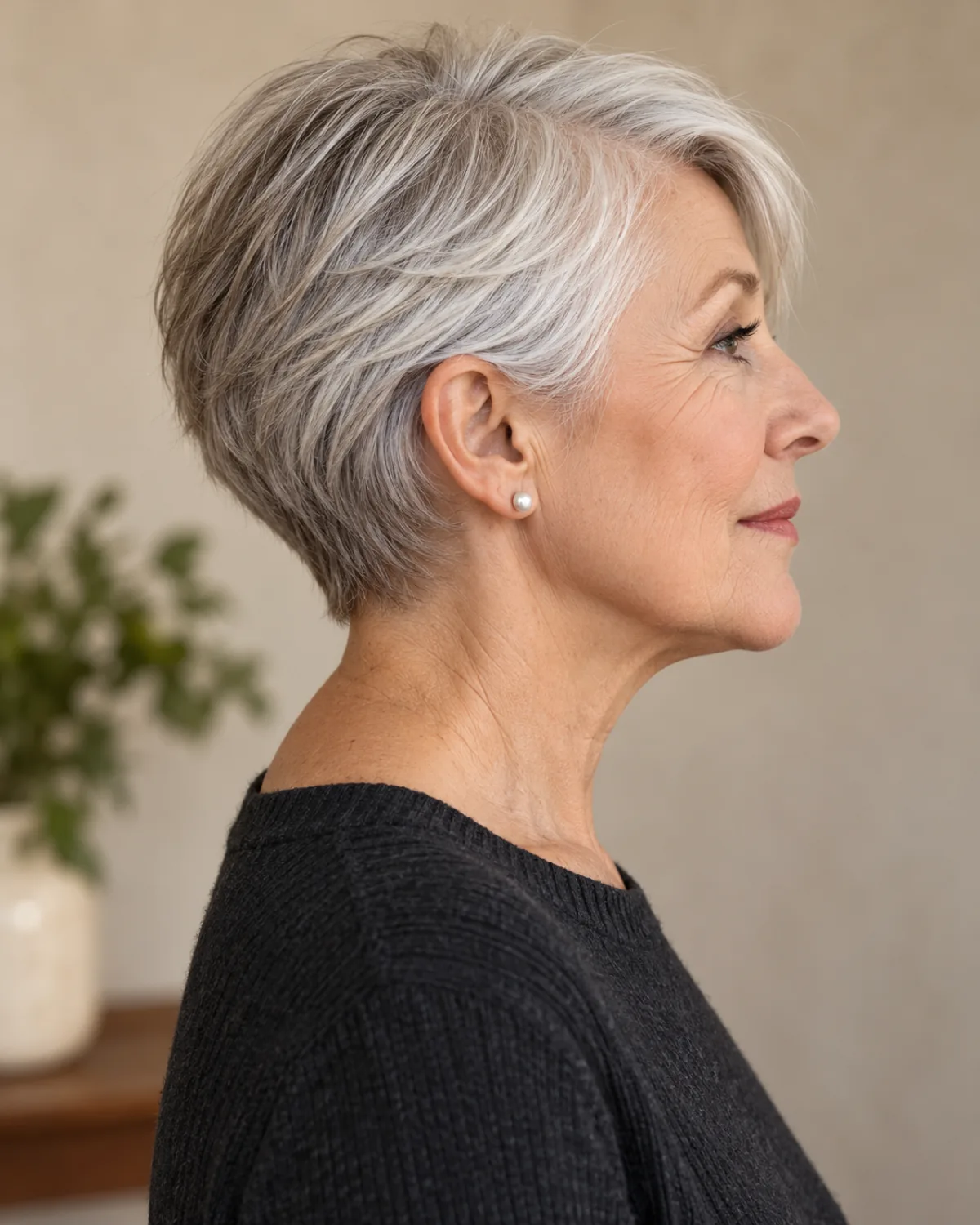
The graduation at the nape is what separates this from a basic short cut. The back is cropped close and the layers gradually lengthen toward the top, leaving just enough length to push to one side or sweep forward. The shape holds itself because the taper creates a built-in weight line.
- Works on fine to medium hair because the cut does not depend on bulk to hold its shape — the graduation is the structure
- The nape taper keeps the back clean and prevents the cut from looking grown-out between appointments
- Skip on very curly hair — the tight taper fights the curl pattern at the nape and the transition reads as a shelf rather than a smooth line
- Ask the stylist to cut the taper with the grain of your natural nape growth, not against it — cutting against the grain causes the new growth to bristle outward
- For related guidance on how fine straight hair behaves differently in short cuts
2. Soft Layered Pixie With Side-Swept Fringe
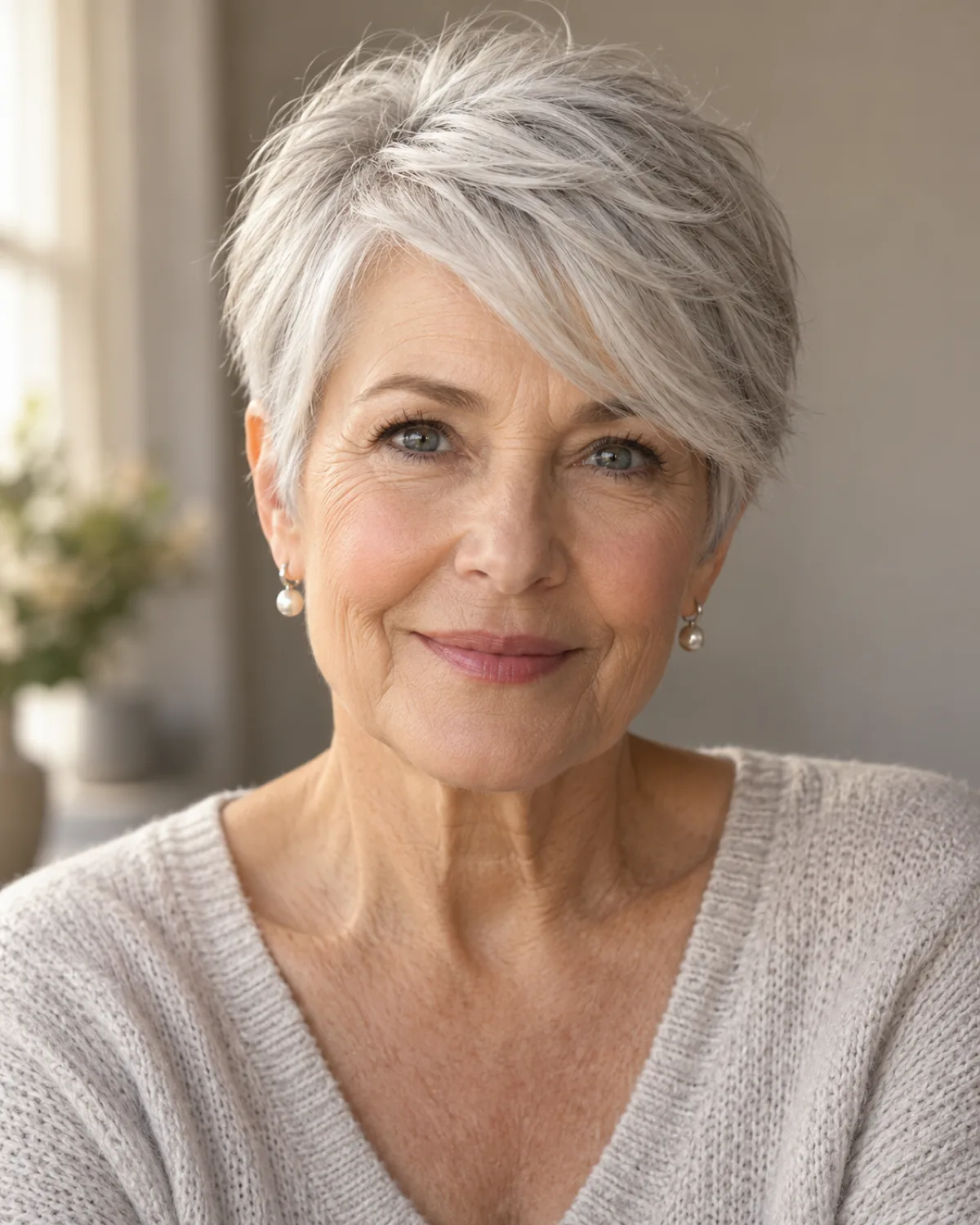
The fringe does double duty here. Swept to one side, it creates a diagonal across the forehead that interrupts the face's symmetry — good for round and square faces because the eye follows the diagonal rather than measuring the width. The feathered layers through the crown keep the top from lying flat.
- The side sweep needs enough hair to hold the arc without product — if the hair is too fine to hold the sweep on its own, the fringe collapses flat and reads as an afterthought
- Works on straight and wavy hair where the fringe can be trained to one side over a few washes
- The feathering at the crown adds height without volume at the sides, which lengthens the face rather than widening it
- Skip if your fringe area is significantly thinner than the rest — a sparse sweep draws attention to what is missing
- Ask your stylist to cut the fringe dry so you see exactly where it will sit when it is not wet and stretched
3. Angled Bob With a Longer Front

The angle creates a forward sweep that visually narrows the lower face. The back is shortest at the nape, and the length increases progressively toward the front, ending near the collarbone. The weight pulls forward, so the hair falls into place rather than needing to be styled into it.
- Works on straight and wavy hair with medium density — the angle holds because the weight naturally pulls the front pieces forward
- The forward sweep narrows a wide jaw but will lengthen a face that is already long, so the cut depends on your starting proportions
- Skip on very curly hair — the curl shortens the front piece as it springs up and kills the diagonal that makes the cut work
- Maintenance is moderate: the back grows out faster than the front, so trims every five to six weeks keep the angle clean
- For related reading on which bob shapes suit different face structures
4. Textured Crop With Soft Bangs
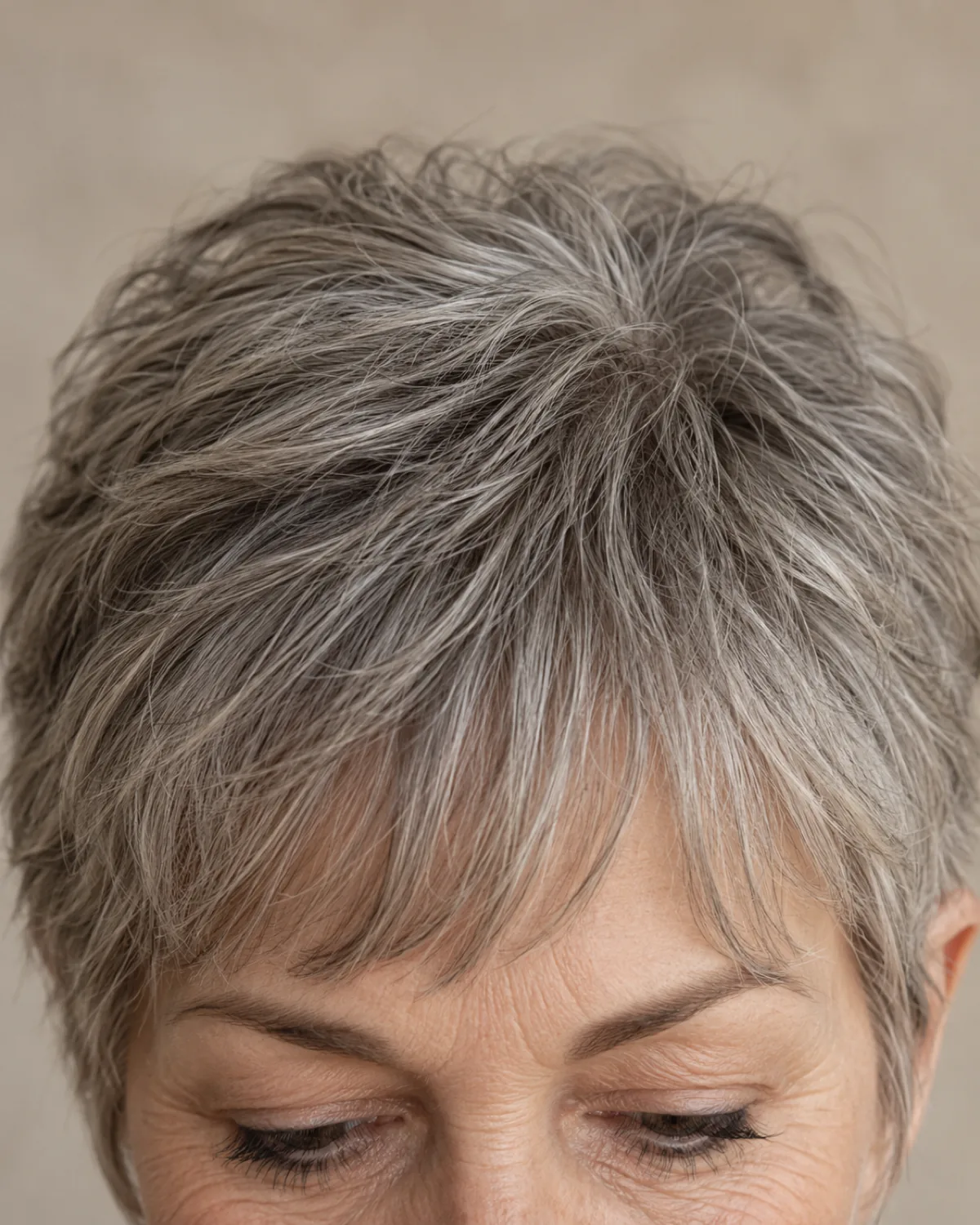
The texture is what makes this cut wearable. Without it, an all-over crop this short reads as severe. Point-cutting removes weight from the ends at an angle so each strand tapers to a thinner point, which gives the surface a piecey, lived-in finish rather than a uniform blunt edge.
- The soft fringe at the brows frames the face without the commitment of a heavy blunt bang — it can be swept aside or left to fall naturally
- Works on medium to thick hair where there is enough density for the texture to read as deliberate
- Skip on very round faces unless the fringe is side-swept — a straight-across fringe on a short crop compresses the face and makes it read rounder
- The crop grows out evenly, which means you get a longer window between cuts than an asymmetric style — six to eight weeks is typical
- Bring a photo of the exact fringe weight you want. Point-cut bangs and blunt bangs look very different, and the distinction matters more on a crop this short
Where to start
Find your situation, skip ahead
Your hair has become finer or thinner at the temples and you want a cut that disguises it
Go with graduation or feathered crown layers — they manufacture volume from the cut itself, not from product.
01 Classic Tapered Pixie05 Graduated Bob With Stacked Back07 Feathered Pixie With Volume at the Crown
You have a round or square face and want a short cut that lengthens rather than widens
Choose a cut with height at the crown and a diagonal element — a side-swept fringe or a deep side part.
02 Soft Layered Pixie With Side-Swept Fringe06 Side-Parted Ear-Length Cut07 Feathered Pixie With Volume at the Crown
You want a wash-and-go short cut with almost no daily styling
A one-length ear cut or a graduated bob — the shape holds because the geometry does the work.
05 Graduated Bob With Stacked Back08 Wavy Bob Just Below the Jaw13 Sleek Ear-Length One-Length Cut
5. Graduated Bob With Stacked Back

The stacking is the engine. At the back, shorter layers sit on top of longer ones, and each layer pushes the one above it slightly outward. The result is built-in volume at the crown and the upper back that does not require a round brush or blow-drying — the geometry of the cut manufactures the body.
- Works on fine and medium hair because the graduation creates lift where density alone cannot
- The front graduates to a longer length that touches the jaw, giving the face some framing without the length of a full bob
- Skip on thick curly hair — the stacking plus natural curl creates too much bulk at the back and the shape balloons
- Ask the stylist to show you the graduation angle before cutting — a steeper angle creates more volume, while a shallow angle creates a subtler shape
- For related guidance on cuts that add volume to thin hair after 50
6. Side-Parted Ear-Length Cut

This sits in the space between a pixie and a bob. Cropped to the ear on both sides with a deep side part, the silhouette is less predictable than either — and that unpredictability is the point. The deep part throws more hair to one side, creating asymmetry without an asymmetric cut.
- Works on wavy hair that adds natural movement — the wave gives the ear-length ends enough body to avoid lying flat against the head
- The deep side part pushes volume to one side, which creates a diagonal line across the face and flatters round and square shapes
- Skip on very straight fine hair — without some wave, the ear-length pieces just hang flat and the cut reads as unfinished
- This is a low-maintenance cut: the uniform length means it grows out evenly, and the side part can be adjusted as the hair lengthens
- For related guidance on how face shape affects which short lengths work best
7. Feathered Pixie With Volume at the Crown
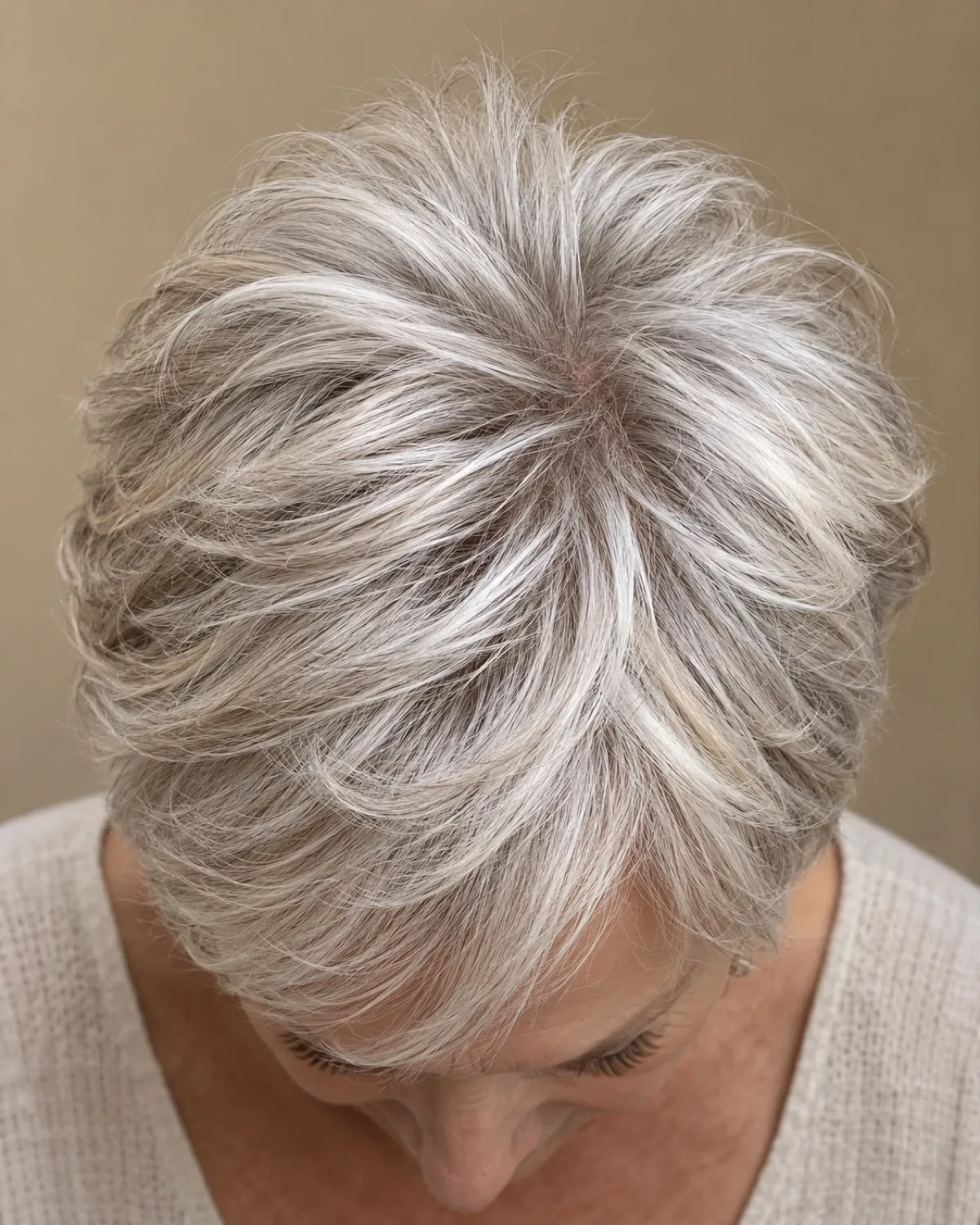
The vertical layers at the crown are doing the heavy lifting. By cutting the crown layers with a vertical holding angle rather than pulling them flat, the stylist builds height directly into the structure. The hair lifts away from the scalp at the top without needing to be blown upward — the cut itself creates the elevation.
- Works on fine to medium hair because the feathering technique spreads the existing density upward rather than relying on bulk
- The height at the crown lengthens a round or square face by adding vertical proportion above the temples
- Skip on very thick hair — too much feathering on thick hair makes the crown mushroom and the silhouette balloons
- The short back and sides keep the cut contained, so the volume reads as intentional height rather than all-over fullness
- Ask the stylist to build the feathering gradually — over-feathering thins the crown too much and exposes the scalp
8. Wavy Bob Just Below the Jaw

The length past the jaw gives the wave room to form. Cut an inch below the jawline with layers that encourage the natural curl pattern, this bob is designed around movement. The layers prevent the ends from bunching into a thick line and let each wave separate individually.
- Works on wavy and loosely curly hair where the texture does the styling — this is a genuine wash-and-go cut for the right hair type
- The wave pattern and the length past the jaw create a softness around the neck and shoulders that frames without closing in
- Skip on stick-straight hair unless you want a blunt-line version — this cut assumes the hair will move, and straight hair will just hang
- The layers need to be cut into the wave pattern, not against it. Ask the stylist to cut dry so the curl shows its true length before the scissors touch it
- Grows out well because the wave disguises the growing-out stages — you can stretch appointments to seven or eight weeks
9. Disconnected Pixie With Longer Top

The disconnect is visible and deliberate. The temples and nape are cropped close while the top section is left distinctly longer — long enough to style forward, to the side, or to push back. There is no blending between the two zones, which is what makes the cut read as designed rather than grown out.
- Works on medium to thick hair because the contrast between the short sides and the longer top requires density in the upper section to cast a visible shadow line
- The longer top gives you styling options that most pixies do not — swept forward it creates a fringe effect, pushed to the side it creates an asymmetric line
- Skip on very fine hair — the longer section lies too flat against the head and the disconnect reads as thinning rather than intentional
- The close-cropped sides grow back fastest, so plan on touch-ups every three to four weeks to keep the contrast visible
- For related reading on other pixie variations and who they suit
10. French Bob With Micro Fringe

The French bob shape is rounder and softer than a standard bob. The back curves inward slightly rather than sitting in a straight line, and the sides fall straight to the jaw. Paired with a micro fringe that sits above mid-forehead, the combination shortens the visible face length — which makes it a strong choice for long and oval face shapes.
- The micro fringe is what makes this version distinct. It creates a horizontal line above the brow that visually shortens the forehead
- Works on straight hair with enough density to hold the rounded back shape — the inward curve is subtle and requires weight to stay in place
- Skip on round faces — the short fringe and the rounded back together compress the proportions that a round face wants to lengthen
- Low-maintenance once the shape is established: the bob grows out evenly and the micro fringe needs a trim every three weeks to stay above mid-forehead
- The French bob is one of the few short cuts that reads as polished without any styling — the shape does the work
11. Layered Shag at Chin Length
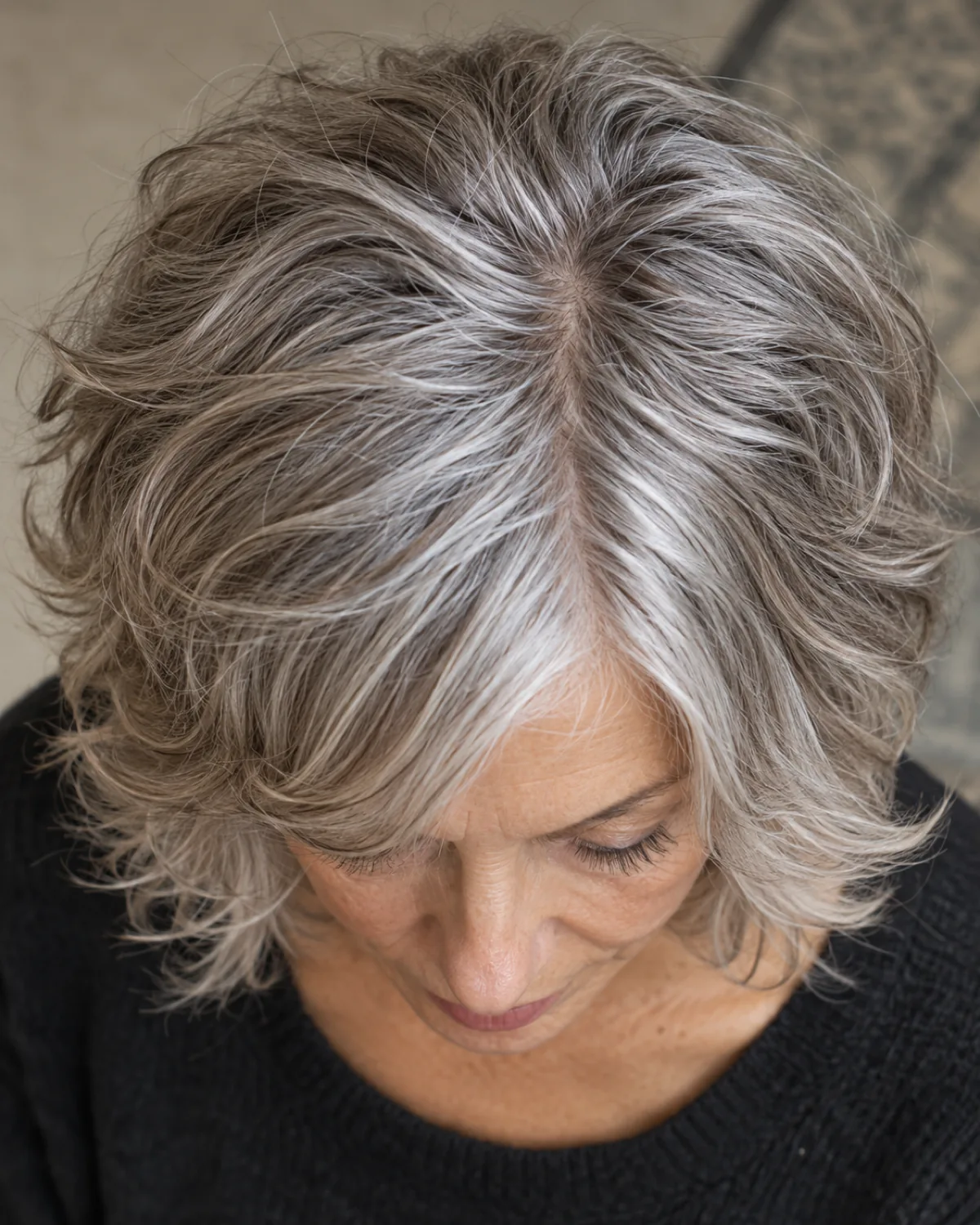
The shag distributes weight away from the bottom and into the middle of the hair. Heavy interior layering creates shorter layers at the crown that blend into longer feathered ends at chin length. The effect is fullness through the middle and sides rather than a heavy bottom line.
- Works on wavy and curly hair where the texture holds the layered shape — the shag needs natural movement to separate the layers visually
- A longer curtain fringe adds a parted frame around the face that softens without hiding — it splits at the centre and falls to each side
- Skip on very fine straight hair — the interior layering removes the weight that fine hair needs to look full, and the shag collapses
- The shag grows out into a longer bob shape over time, so the transition between cuts is natural rather than awkward
- Ask the stylist to cut the interior layers with a point-cut technique rather than blunt — point-cut ends sit lighter and the shag moves more naturally
12. Cropped Back With Forward-Falling Fringe
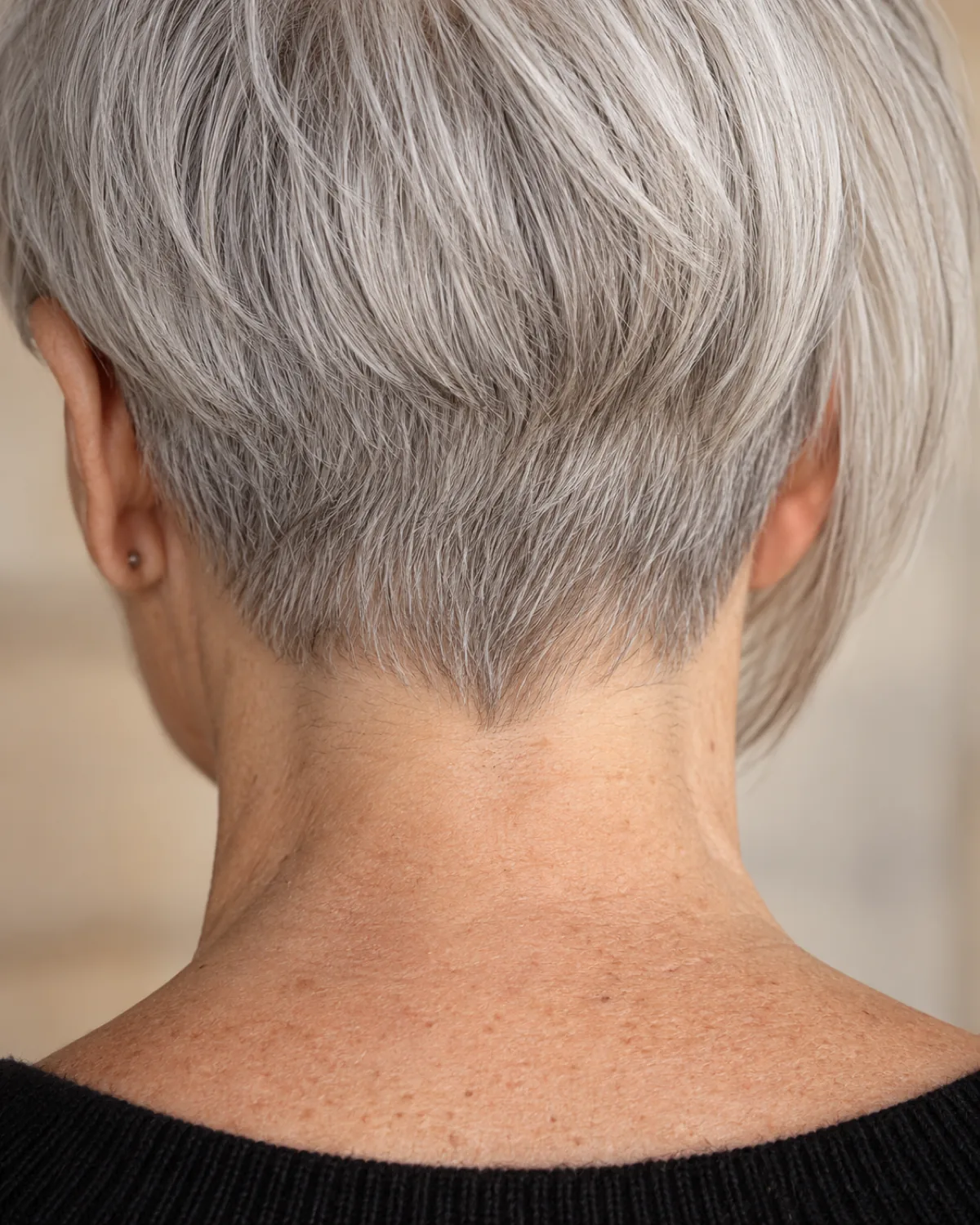
All the weight is in the front. The back and sides are cut very short — close enough to see the natural hairline — while the front section is left long enough to fall forward past the brow. The contrast between the exposed back and the heavy front creates a silhouette that is unmistakably directional.
- Works on straight and wavy hair where the forward piece falls where it is cut to sit — the weight of the front section pulls it into position
- The cropped back is essentially maintenance-free between cuts, and the forward fringe can be tucked behind the ear when you want it out of the way
- Skip on curly hair — the forward-falling piece curls up rather than falling forward, and the intended sweep becomes a bounce
- This cut reads as designed from every angle because the contrast between front and back is visible whether you are facing the room or walking away
- The fringe grows out first, which means you can let it lengthen into a side-swept fringe over time without losing the shape at the back
13. Sleek Ear-Length One-Length Cut

No layers, no fringe, no styling required. The hair is cut to one uniform length at the ear, and that geometric simplicity is the entire point. The clean line reads as sharp and deliberate, and the cut requires almost nothing except a shampoo to look finished.
- Works on straight to slightly wavy hair with enough density to fill the line — the one-length edge needs weight behind it to look clean rather than sparse
- The geometric shape suits angular face shapes (square, diamond) because the clean horizontal line at the ear echoes the bone structure
- Skip on very curly hair — one length on curly hair reads as an unfinished grow-out because the curl lifts the ends unevenly
- Maintenance is minimal: one trim every six to eight weeks to keep the line sharp
- This is the lowest-effort cut on the list. If your priority is spending zero time on your hair and still looking put together, this is the one
14. Pixie With Extended Sideburns
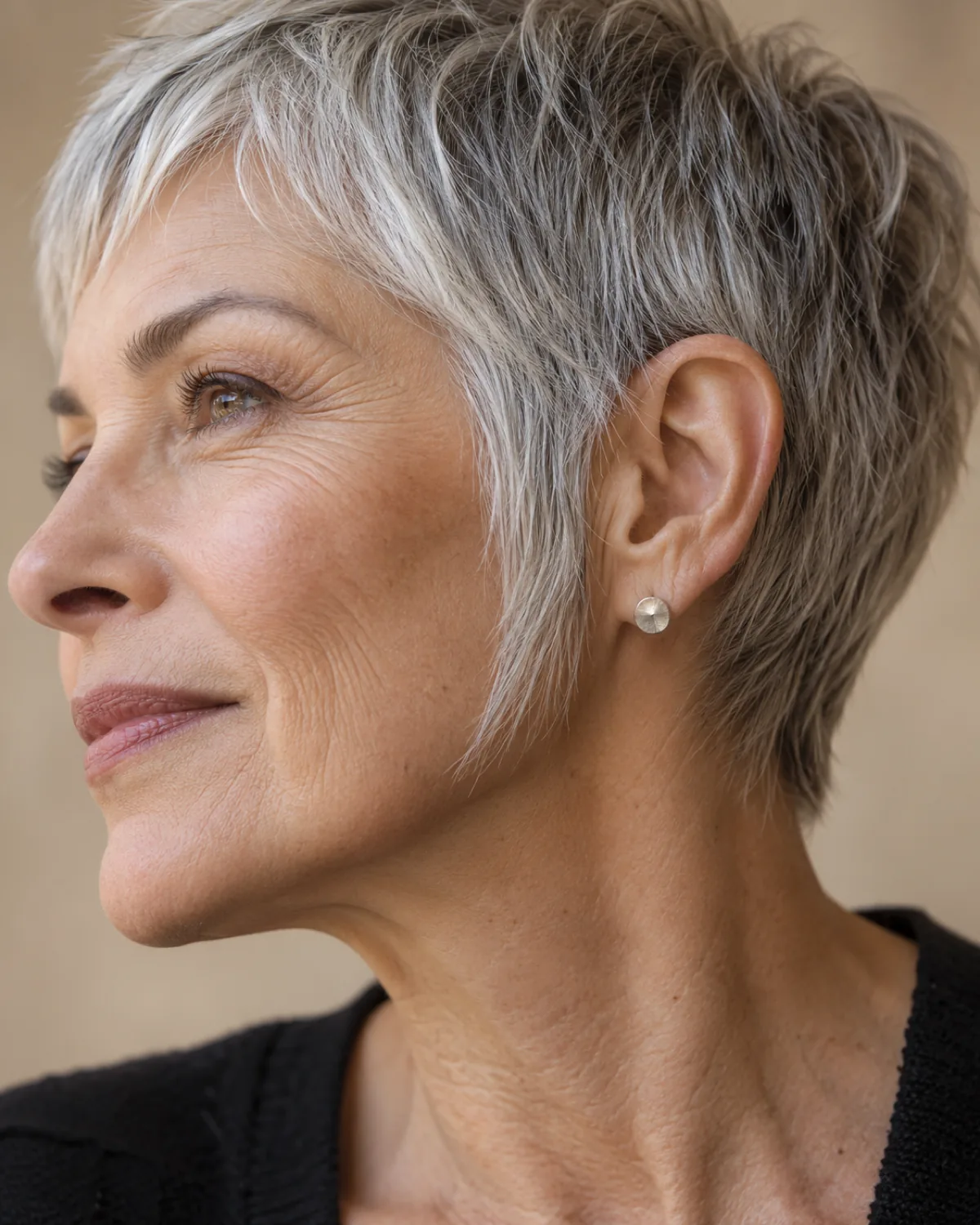
Most pixies stop above the ear. This one extends the sideburn area past the ear and tapers it to a point at the jawline. That extension reframes the lower face — the tapered pieces sit against the jaw and soften the transition from the cut to the neck in a way that an abrupt pixie ending does not.
- Works on straight and wavy hair where the sideburns lie flat against the face — the taper needs to follow the jawline, not stick out from it
- The sideburns frame the jaw from both sides, which narrows a wide lower face and draws attention to the jawline rather than the neck
- Skip on very thick hair — thick sideburns tend to bush out rather than lie flat, and the taper loses its point
- The sideburn area grows quickly, so a touch-up every three to four weeks keeps the taper sharp and the point at the jaw visible
- For related reading on how grey pixie cuts handle the texture changes that come with silver hair
The best short cut after 60 is one that looks finished the moment you leave the salon and still looks right three days later without a round brush. Bring the photos, point at the structure, and tell the stylist what your hair does on its own — that conversation is worth more than any trend.
Where the checkable claims come from
- Understanding Graduation in Haircutting — Sam Villa
- How to Choose the Right Bangs for Your Face Shape — Byrdie
- Layering Techniques for Fine Hair — Redken
- How Hair Changes After 60 — Harvard Health Publishing
Keep this one
Save it for the appointment
Pin the image above to the board you actually open before a salon visit. This guide is written to be re-read, not read once.
Tonight, before you close this tab
- Stand in front of a mirror and pull your hair back flat — note where density is thinnest (temples, crown, nape) so you can tell the stylist
- Save two or three photos from this guide that match your face shape and hair density — bring them to your next appointment
- Write down the one thing you want the cut to do (add height, frame the jaw, hide thinning) and the one thing you want to avoid
- Ask your stylist how the cut will look on day three without styling — if they cannot answer, it is the wrong cut