What to Ask Your Hairdresser For After 50 — The Words That Get the Cut You Actually Want
A guide to communicating with your hairdresser after 50. Which words work, which ones get misread, and how to confirm your stylist heard what you said.
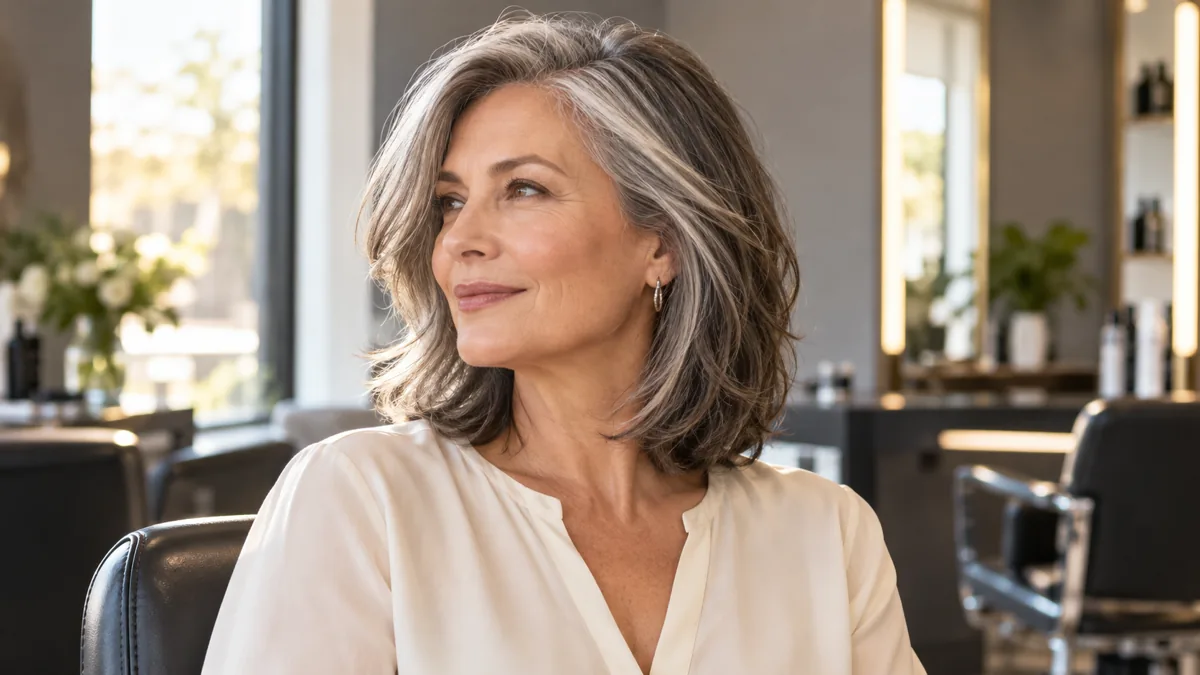
Booking an appointment soon? Save this page. It is easier to skim in the chair than to remember.
At a glance
Works
- Bringing two reference photos (one for length, one for layers) and pointing to the specific feature you want in each one rather than saying 'I want this'
- Using a body landmark to describe length: 'I want the ends to land at my collarbone' removes every ambiguity that 'just a trim' creates
- Stating your daily styling time as a number of minutes rather than saying 'low maintenance,' which your stylist will interpret three different ways
Depends
- Asking for layers only after you know whether you mean face-framing pieces, interior texture removal, or a graduated weight line. Your stylist needs to hear which one
- Bringing photos from Pinterest only if the hair in the photo was not blown out, filtered, or shot on a model half your age. Otherwise the reference confuses more than it helps
Skip
- Saying 'just do whatever you think' when you actually have a preference. Your stylist cannot read your mind, and the result will be their default cut, not yours
- Asking for 'something different' without specifying what you disliked about the last cut. This gives your stylist nothing to work with
Most women over 50 already know the cut they want. They leave the salon unhappy because what they said and what their stylist heard were two different things.
The gap is not about taste. It is about vocabulary. "Layers" means one thing to you and three things to the person holding the scissors. "Low maintenance" could be a pixie, a bob, or a trim schedule.
This guide closes that gap. Each section gives you the specific words that mean the same thing to you and to your hairdresser, so the cut you leave with matches the one you walked in asking for.
What Photos to Bring and What They Actually Tell Your Stylist
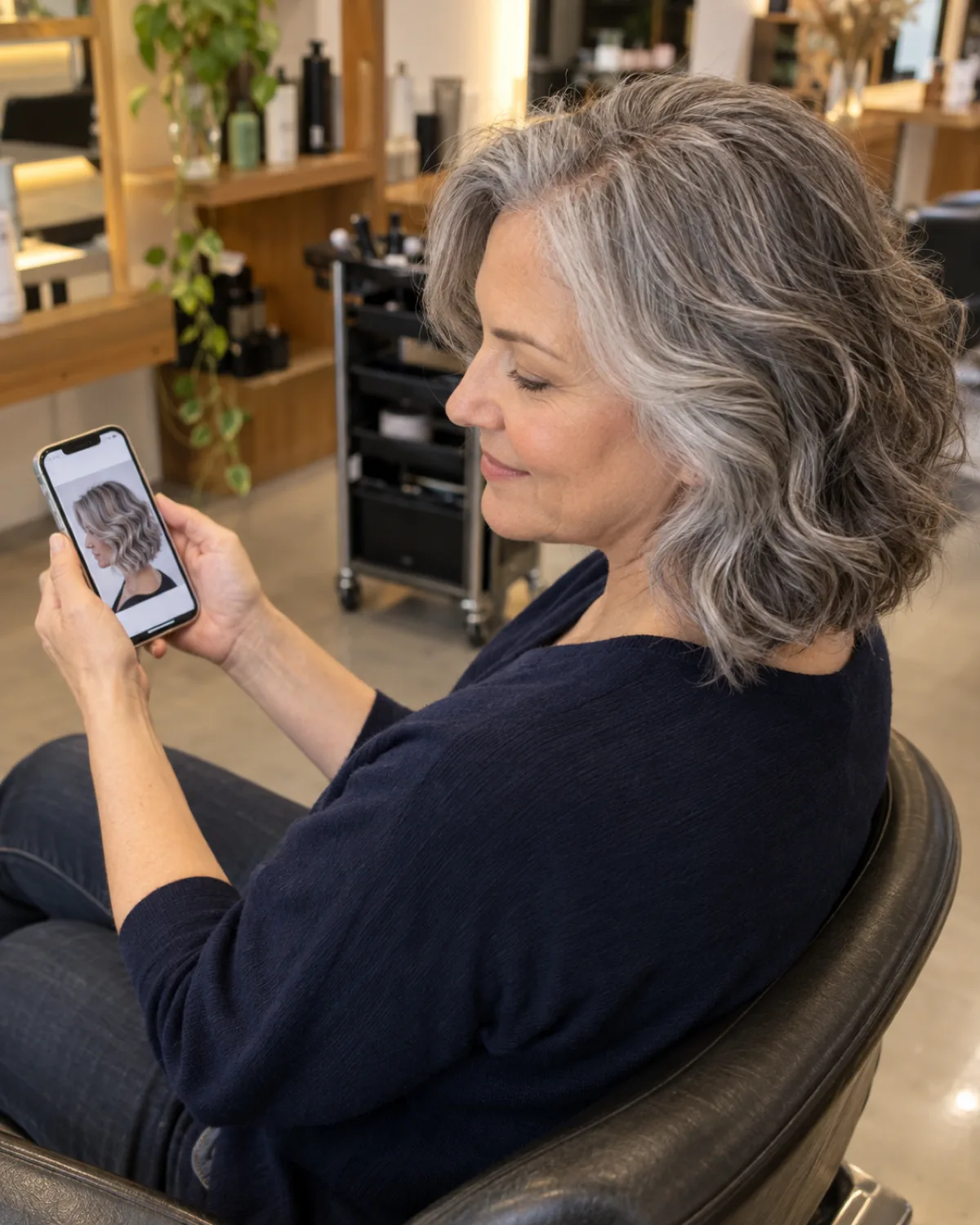
A reference photo works only when you tell your stylist which part of it you are pointing to. Saying "I want this" while showing a full-length shot gives your stylist a dozen things to guess at: the length, the layering, the parting, the colour, the texture, the volume at the crown.
- Point to one feature per photo: "I like where the length falls on her neck" or "I like how the layers frame her jaw, but not the fringe"
- Bring two photos, not ten. One for length, one for shape or texture; more than three and your stylist will pick the one they like best, which may not be the one you care about most
- Avoid photos that were clearly blown out, filtered, or shot on a model decades younger. These create an expectation the stylist cannot meet without tools and time you may not want to commit to; an unfiltered photo of a real haircut in natural light is the strongest reference you can bring
- If you cannot find a photo, describe what you liked about a haircut you saw on someone in real life. "Her hair ended right at the collarbone and swung when she turned" is more useful than a filtered image
How to Describe the Length You Want
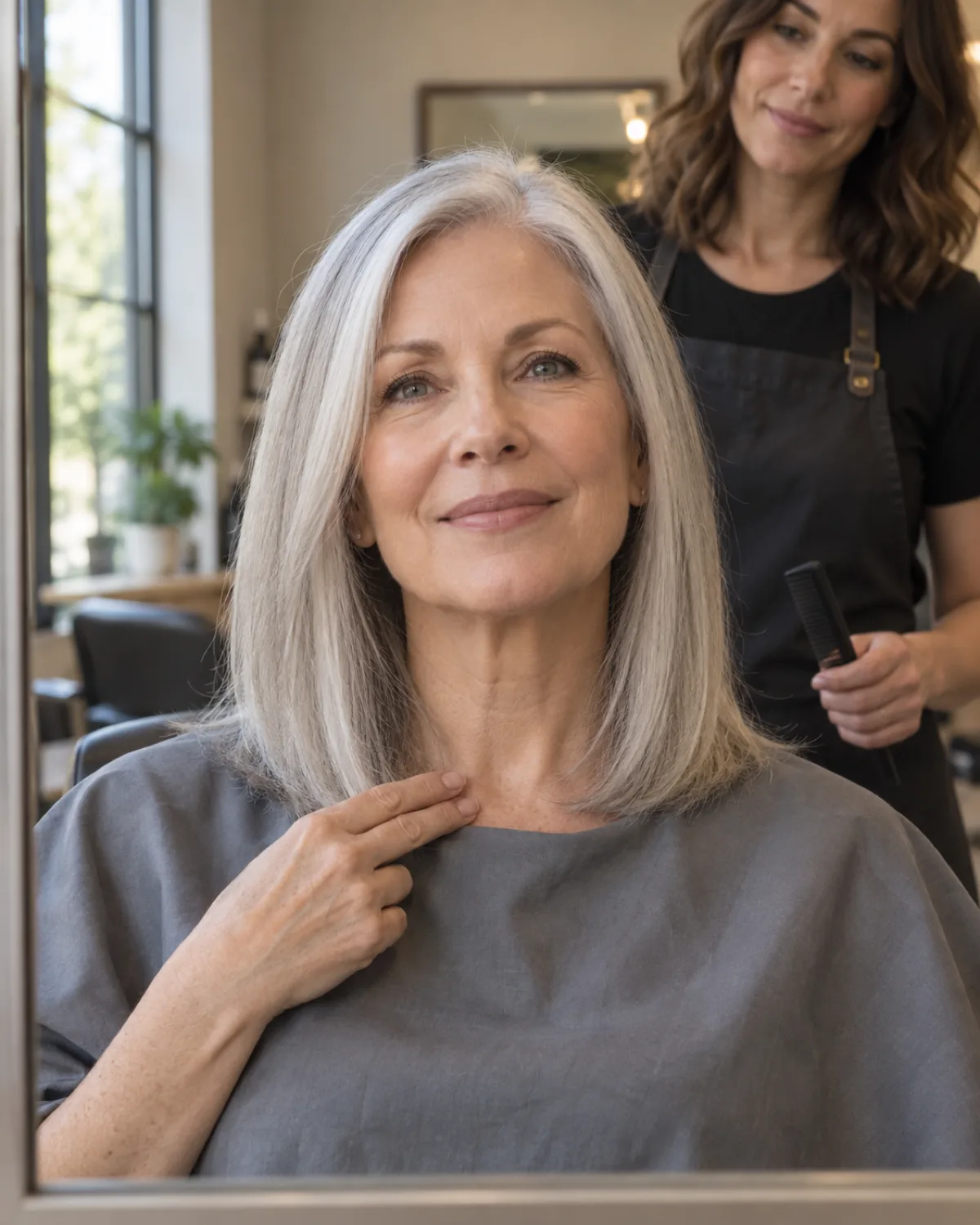
"Just a trim" is the most misread phrase in any salon. To you it means "keep the shape, take off the minimum." To your stylist it can mean anything from a quarter-inch dusting to two inches of dead weight removed. The only way to close the gap is to anchor the length to your body.
- Touch the spot where you want the longest pieces to fall: earlobe, jawline, chin, collarbone, or mid-chest. Say the body part out loud
- If you want to keep your current length, say "I want the ends to stay where they are now" and touch the point; "just a trim" leaves the amount to your stylist's judgment
- If you are growing out a shorter cut, tell your stylist the destination: "I am growing this to my collarbone. Today I only want you to shape the sides and clean up the nape." This tells them what not to cut, which is more useful than telling them what to cut
- Take a side-view selfie at home with your finger on the length point and show it at the appointment. This eliminates the mirror-angle confusion that makes salon consultations harder than they need to be
Where to start
Find your situation, skip ahead
You know what you want but do not know how to describe it
Start with a body landmark for length and one reference photo for shape. Sections two and three will give you the exact words.
02 How to Describe the Length You Want03 Layers, Texture, and What Those Words Mean to the Person Holding the Scissors
You are not sure what you want and want your stylist to help you decide
Bring three photos you like and tell your stylist what draws you to each one. Then ask the three questions in section eight before they start.
01 What Photos to Bring and What They Actually Tell Your Stylist08 What to Ask Before They Start Cutting
You left the salon unhappy last time and do not want it to happen again
Write down one sentence about what went wrong and read section six for the phrases that get misread. Then use the confirmation technique in section seven.
06 Phrases That Get Misread and What to Say Instead07 How to Confirm Your Stylist Understood You
Layers, Texture, and What Those Words Mean to the Person Holding the Scissors
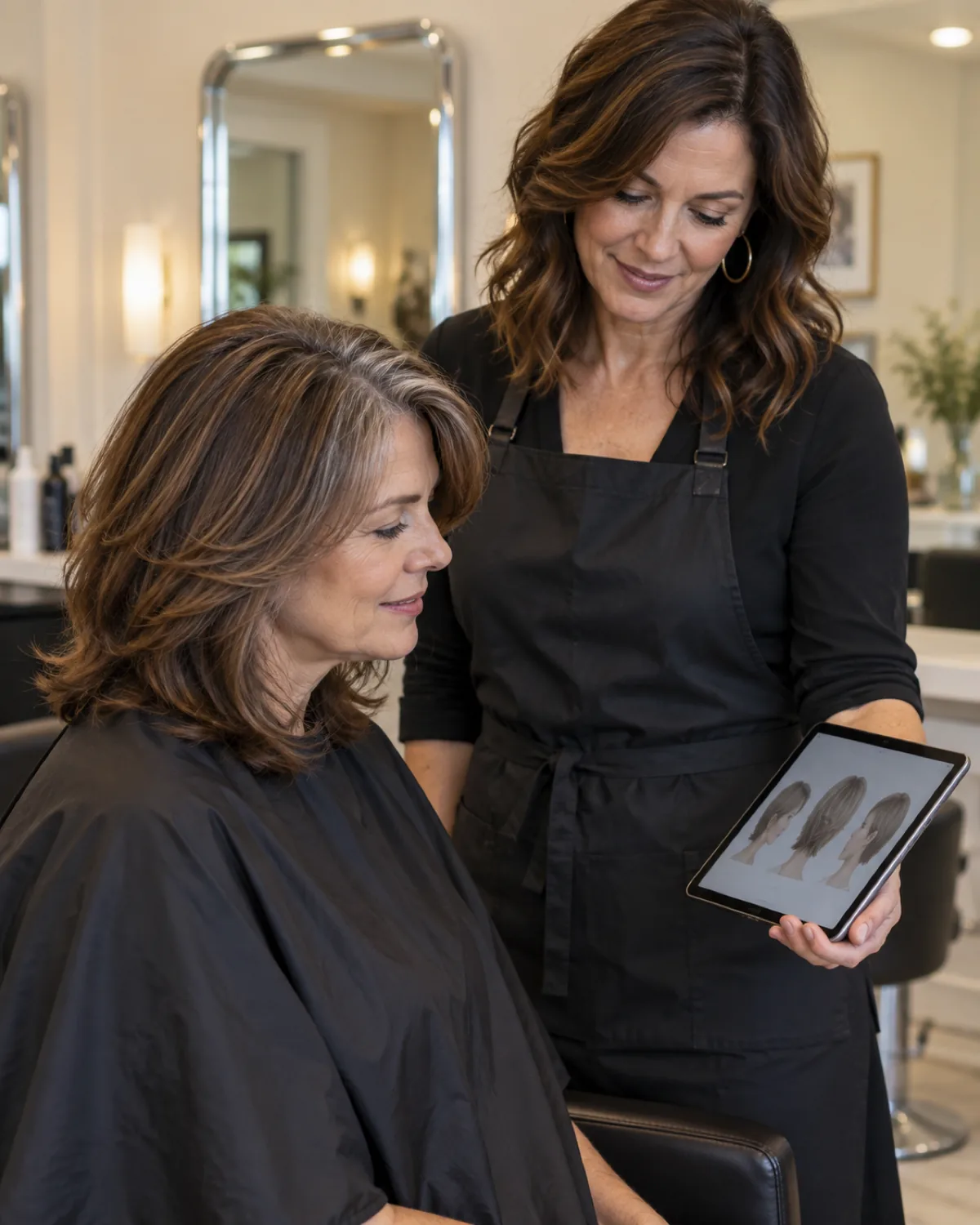
"Layers" is not one thing. When you say it, your stylist hears three possible requests and has to guess which one you mean. According to professional education standards, layering refers to graduation (shorter at the top, longer at the bottom), but clients use the word to mean face-framing pieces, interior thinning, or all-over movement. Those are three different cuts.
- Face-framing layers start at the cheekbone or jawline and get longer toward the back; say "I want shorter pieces around my face that blend into the length." This is the version most clients picture when they say "layers"
- Interior texturising removes bulk from inside the hair without changing the outline; say "the shape is fine but the ends feel too thick and heavy." Your stylist will point-cut or razor the interior, which is a different tool and a different outcome from layering
- Graduated layers create a stacked, shorter-in-back silhouette; say "I want the back to be shorter and sit closer to the head, with the front longer." This is the only version that matches the technical definition of layering
- If you say "thin it out," many stylists will reach for thinning shears, which removes bulk by cutting some strands shorter inside the section. This is not the same as layers, and on fine hair it can create see-through patches that take months to grow back
How to Talk About Volume Without Saying Too Much
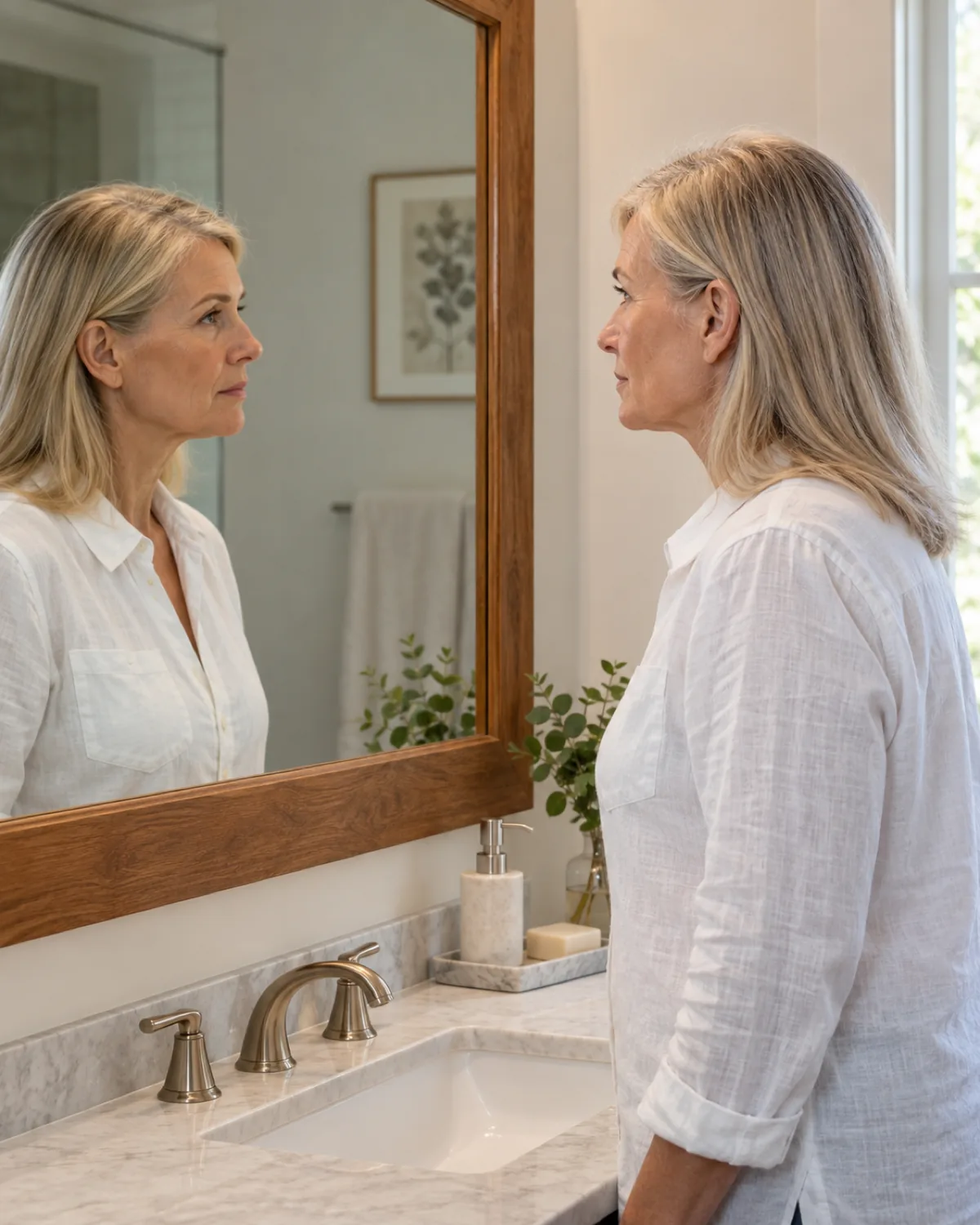
There is a difference between wanting more volume and noticing your hair is thinner than it was. The first is a styling request. The second is a structural change that affects which cuts will work and which ones will not. Your stylist needs to know which conversation you are having.
- If you want more volume at the crown, say "I want the top to sit higher." This tells your stylist to leave length at the crown and may lead to a rounded layer shape or a root-lift technique
- If your hair has become finer overall, say "my ponytail is half the diameter it was five years ago." This is concrete information your stylist can use to choose a cut that makes the most of your current density, rather than fighting it
- Do not say "my hair is thinning" unless you mean it. That word can lead your stylist to recommend a cut for hair loss rather than a cut for naturally fine hair, which is a different structure and a different approach
- If you are not sure whether your hair has changed or you just want a different shape, say so: "I cannot tell if my hair is thinner or if this cut just is not working. Can you look at my density and tell me what you see?" Your stylist can assess this in thirty seconds and it changes every recommendation that follows
What Low Maintenance Actually Means to a Stylist

"Low maintenance" is one of the most common requests after 50 and one of the least useful. Your stylist hears it and has to guess which of three things you mean: a cut that air-dries well, a cut that requires fewer salon visits, or a cut that takes less time to style each morning. Those lead to three different haircuts.
- If you mean "I do not want to use a blow dryer," say exactly that. Your stylist will choose a cut with enough built-in shape to hold without heat, which usually means more texture and a shorter length that sits above the shoulders
- If you mean "I do not want to come back every four weeks," say "I want a cut that still looks good at eight weeks." Your stylist will avoid sharp geometric lines and blunt fringes that grow out conspicuously and will instead lean toward soft, grown-in shapes that blur the line between fresh and lived-in
- If you mean "I want to spend less than five minutes in the morning," say the number. "I have three minutes, no tools, just my hands" is a brief your stylist can design around; "low maintenance" is not
- All three meanings are valid, but they produce different cuts, and your stylist will default to whichever one they assume you meant unless you tell them
Phrases That Get Misread and What to Say Instead
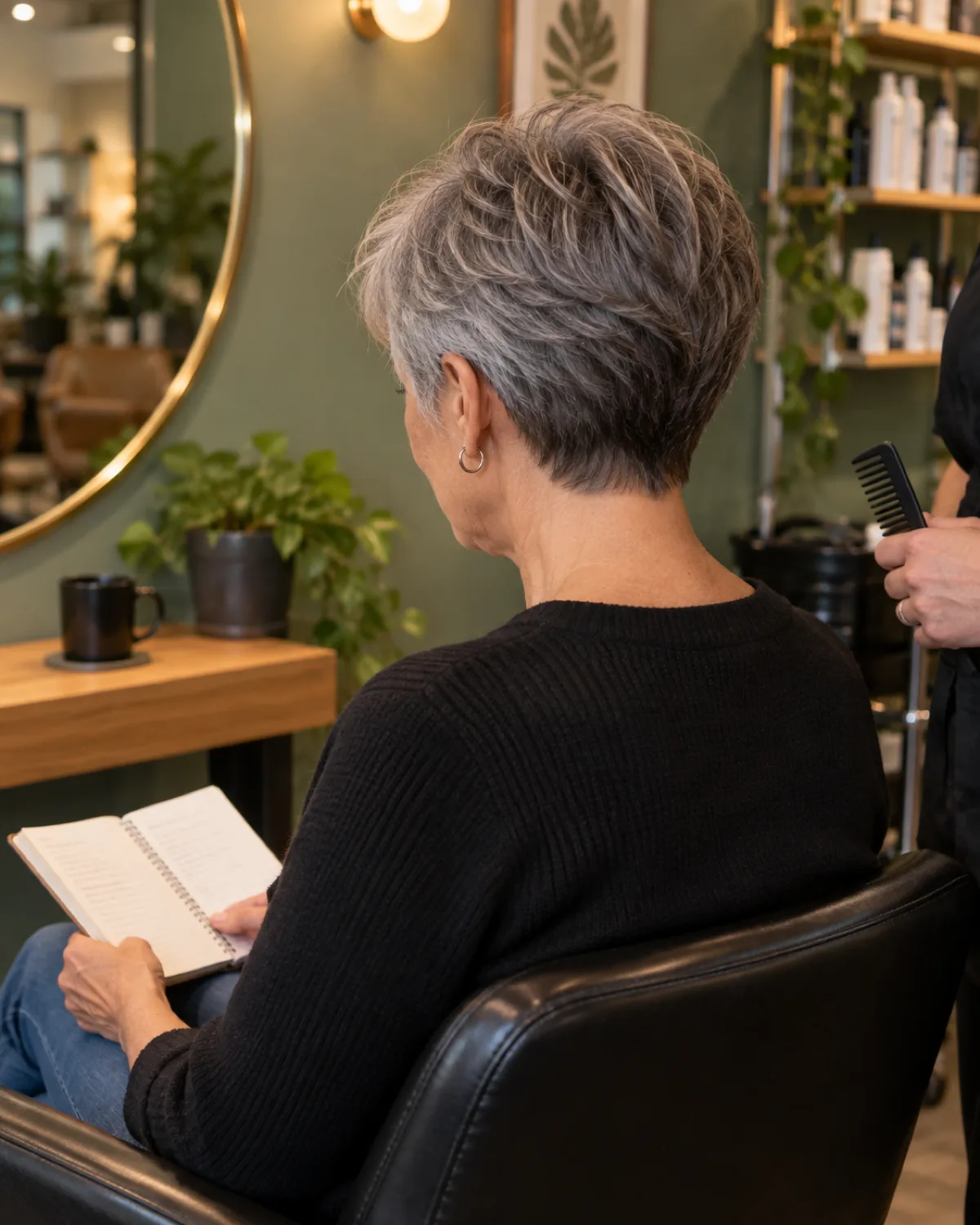
Certain phrases carry a clear meaning in everyday English but land differently in a salon. The problem is not that your stylist is not listening. The problem is that these words have a technical meaning that overrides the casual one.
- "Take off the dead ends": you mean a quarter inch; your stylist may interpret this as permission to cut until the damage is gone, which could be two inches or more; say "take off half an inch, no more, even if the ends are not perfect"
- "I want it shorter": shorter than what? Say "I want the longest piece to end at my chin" or "take it up to here" and touch the spot; "shorter" without an anchor is the single most common source of too-short surprises
- "Make it fuller": you mean volume; your stylist may hear "add more hair to the outline," which leads to blow-drying or extensions rather than the layering or root lift you had in mind; say "I want more height at the crown" or "I want it to look thicker"
- "Something modern": every stylist has a different mental image of modern; say "I want clean lines" or "I want movement around my face" or "I do not want it to look dated" and describe what dated means to you
- "Blend my grey in": this can mean highlights, lowlights, a glaze, or letting the grey grow in with a transition cut; say which one you mean, or say "I want to stop colouring and I need the grow-out to look intentional rather than neglected"
How to Confirm Your Stylist Understood You
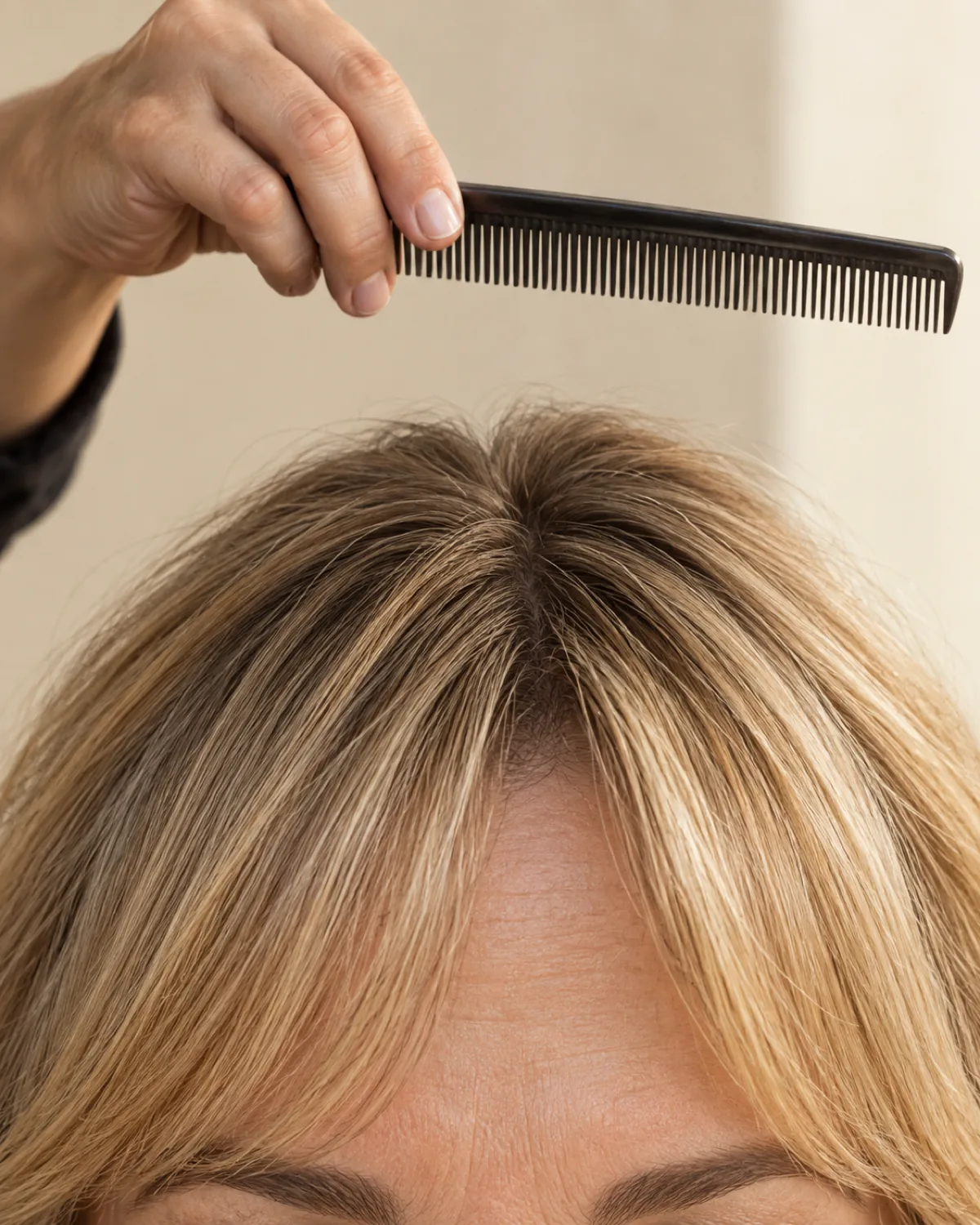
The most important moment in a salon visit is not the first cut. It is the thirty seconds after the consultation and before the scissors start, when your stylist repeats back what they are about to do. If this does not happen, ask for it.
- Say "Before you start, can you tell me back what you are planning to do?" A good stylist will describe the cut in their own words: where the length will fall, whether they are adding or removing layers, what the nape will look like, and how long it will take to style at home
- Listen for specifics: "I am going to take the length to your collarbone and add face-framing pieces starting at your cheekbone" is a plan; "I am going to clean it up and add some movement" is not. If the repeat-back is vague, ask "where exactly will the shortest piece be?"
- If the repeat-back does not match what you asked for, say so now. "I said collarbone, but you said chin; can we stay at the collarbone?" is a one-sentence correction that prevents a two-month regret
- This is not confrontational and no competent stylist will take it that way; it is the industry-standard consultation close taught in professional training programmes, and the stylists who skip it are usually the ones in a hurry
What to Ask Before They Start Cutting
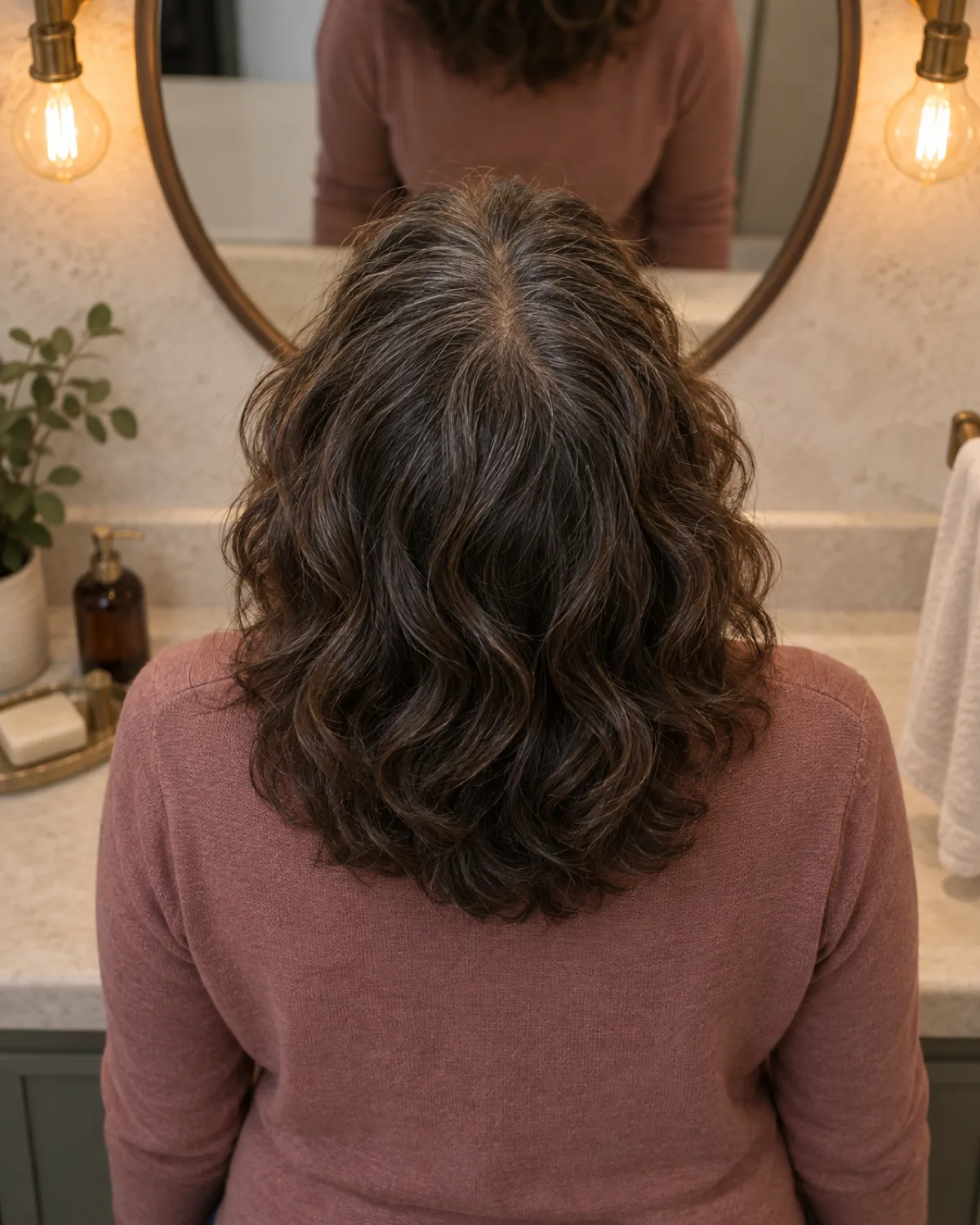
Three questions before the first cut will save more miscommunications than any amount of after-the-fact feedback. They work because they force your stylist to translate the plan from their head into terms you can verify.
- "Where will the shortest piece be?" This catches the most common surprise; if you asked for layers and the shortest piece is at your ear, that may be fine or it may be a shock, but now is the time to know
- "How will this look at eight weeks?" A cut that looks sharp on day one but shapeless at six weeks is a cut that does not match your maintenance budget; if your stylist cannot describe the grow-out, they may be designing for the moment rather than for your life
- "What will I need to do every morning to make this look like this?" If the answer involves a round brush, a flat iron, and a volumising spray, and you want to towel-dry and leave, say so before the cut starts; the best time to change direction is when no hair has been removed
Hairdresser Communication FAQ
These are the questions that come up most often when women over 50 are preparing for a salon visit and want the conversation to go well.
Should I bring photos from Pinterest or from real life?
Both work, but real-life photos are more reliable. Pinterest images are often professionally styled, filtered, and shot on younger models, which creates expectations that do not survive a natural-light mirror. If you do use Pinterest, pick photos where the hair looks like it was taken on a phone in normal lighting, and point to one specific feature rather than the whole image.
How many reference photos is too many?
Two is the right number: one for length, one for shape or texture. Three is the upper limit. Beyond that, the photos start contradicting each other and your stylist will pick the one they prefer rather than the one you care about most. If you have saved a dozen, narrow it down before the appointment.
What if my stylist suggests something different from what I asked for?
Listen to the reasoning. A good stylist will explain why. "Your hair texture will not hold that shape without daily heat" or "that length will expose the thinning at your temples." If the reason makes sense, consider it. If it does not, say "I understand, but I would still like to try what I described." You are paying for their skill, not their taste.
Should I wash my hair before the appointment?
Most stylists prefer to see your hair in its natural state: how it falls, where it parts, what the texture does without product. If you wash and style it beforehand, your stylist loses that baseline. Arrive with clean-enough, unstyled hair unless your stylist specifically asks you to come with it freshly washed.
How do I tell my stylist I did not like what they did last time?
Be specific and forward-looking. "Last time the layers were too short and they stuck out at my ears. This time I want the shortest layer to start at my chin" is useful. "I did not like it" without a specific complaint gives your stylist nothing to work with. Write the sentence down before you go so you do not have to find the words under pressure.
Where the checkable claims come from
- Tips for Healthy Hair — American Academy of Dermatology
- Understanding Graduation and Layering — Sam Villa / Redken Education
- The Art of Consultation — Pivot Point International
Keep this one
Save it for the appointment
Pin the image above to the board you actually open before a salon visit. This guide is written to be re-read, not read once.
Tonight, before you close this tab
- Save two reference photos to your phone before the appointment. One should show the length you want, the other the layering or texture you want
- Touch the spot on your body where you want the ends to fall, take a selfie from the side, and bring it to the salon
- Write down the number of minutes you spend on your hair each morning. A number is worth more than the word 'easy'
- If the last cut disappointed you, write one sentence about what specifically went wrong and read it to your stylist before they start