12 Gray Bob Hairstyles Over 50 With Bangs, Judged by Fringe Type
Twelve gray bob hairstyles with bangs for women over 50, each judged by fringe type and hair density. Which bangs suit your gray texture, and which ones expose it.

Booking an appointment soon? Save this page. It is easier to skim in the chair than to remember.
At a glance
Works
- A chin-length blunt bob with curtain bangs when your silver is uniform in density and sits flat naturally
- A textured shaggy bob with choppy bangs when your gray has mixed texture that refuses to sit uniform
- A graduated bob with wispy fringe when fine gray hair needs internal weight without visible layers on the surface
Depends
- A French bob with brow-skimming fringe — only if your gray hair is straight enough for the fringe to hang at the brow without curling up short
- A stacked bob with feathered fringe — only if your gray is fine rather than coarse, because coarse wiry ends spike instead of tapering
- Side-swept bangs on an A-line bob — only if your fringe section has no strong forward cowlick pushing the hair into your face
Skip
- Blunt bangs on fine thinning gray, where every gap in the fringe section becomes a visible stripe of forehead
- Micro bangs on sparse salt-and-pepper, where the thin strands read accidental rather than deliberate
- A feathered fringe on coarse wiry gray, where the ends spike outward instead of softening
Gray hair changes texture before it changes colour. A fringe that draped smoothly on pigmented hair may spike, separate, or curl up short on the gray version of the same strand.
These twelve gray bob and bangs pairings are judged on one question: does your gray density carry this fringe, or does it expose what the fringe is trying to hide?
The strand that turns gray shifts in diameter and stiffness at the same time. What the scissors meet is a texture change, and that decides which bob shape and fringe will hold.
1. Chin-Length Blunt Bob With Curtain Bangs

The curtain split softens a blunt line that can read severe on a fully gray head. The two sides of the fringe part at the centre and sweep toward the temples, so even if density is slightly uneven, the gap reads as intentional design rather than thinning.
- Works when your silver is uniform and your fringe section has enough strands to form two solid curtain panels
- The blunt hem at the chin anchors the shape and keeps the weight line visible
- If your fringe is sparse at the centre part, the gap widens into a stripe of forehead instead of a soft opening
- Ask your stylist to cut the fringe dry so the gray texture shows its true resting sweep
- Skip if your gray has turned wavy at the temples, because curtain bangs on wavy hair flip outward instead of framing
2. Graduated Bob With Wispy Fringe

Graduation builds internal weight without adding visible layers on the surface. On fine gray hair that has gone wiry at the temples, the wispy fringe hides those resistant strands by blending them into a soft, transparent edge at the brow.
- The stacked graduation at the nape pushes volume upward, filling out flat occipital areas common after 50
- Wispy fringe works because it tolerates sparse density — the see-through quality is the point, not a flaw
- Graduation needs trimming every six to eight weeks to hold the shape, so factor maintenance into the decision
- If your gray is coarse and thick, the graduation may create too much bulk at the back instead of a clean stack
- Tell your stylist you want the fringe to look intentionally transparent, not thinned out
3. Soft A-Line Bob With Side-Swept Bangs
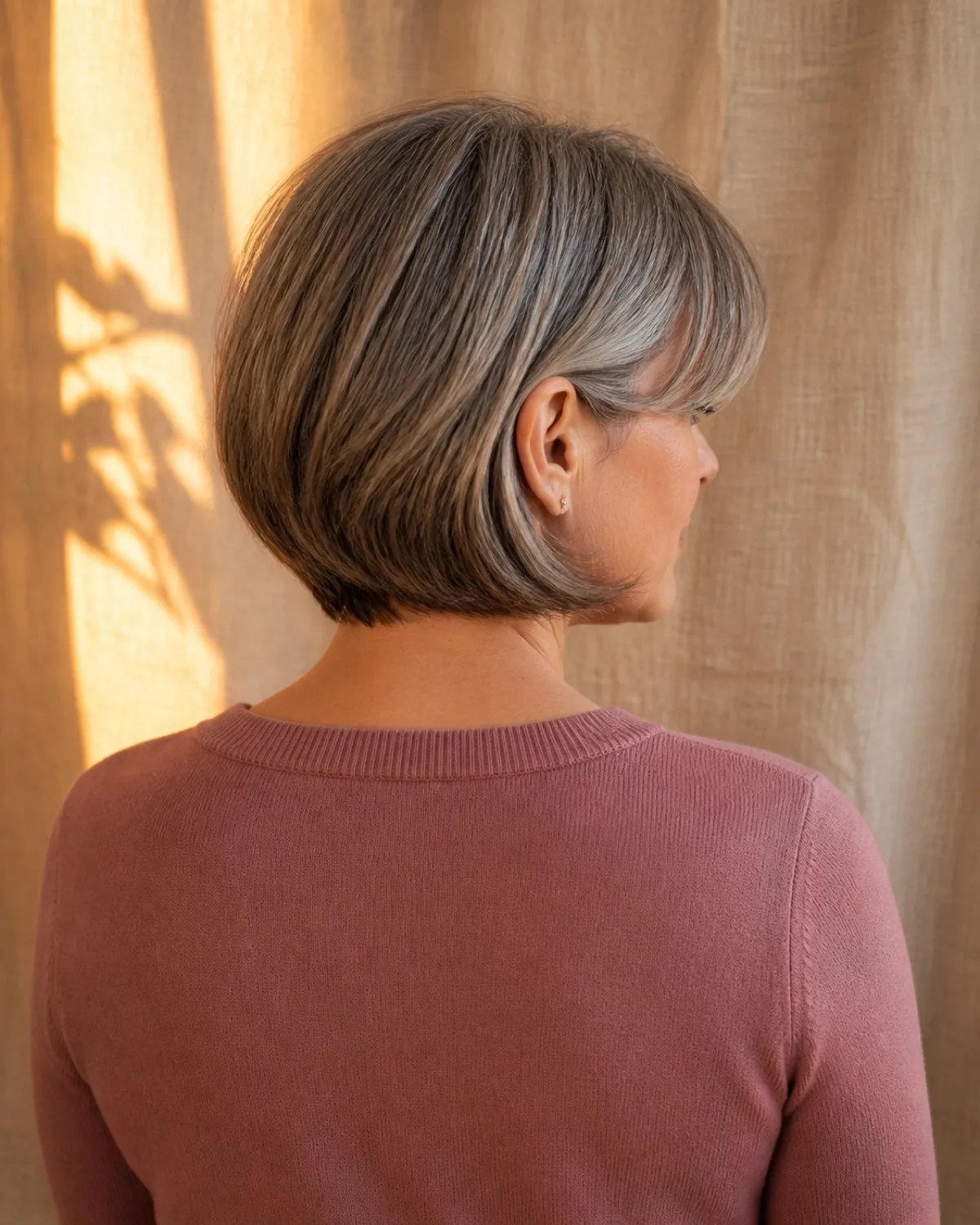
The A-line silhouette angles from a shorter back to longer front pieces that frame the jaw. Side-swept bangs add a diagonal line across the forehead that interrupts roundness, which is why this pairing suits round faces and fuller jawlines.
- The diagonal sweep creates asymmetry that draws the eye along the cheekbone instead of across the widest point
- Works on salt-and-pepper blends because the longer front pieces reveal tonal variation as depth
- Skip if your fringe section grows in a strong forward cowlick, because side-swept bangs fight against that growth direction
- The back-to-front angle needs enough length difference to read as a deliberate line, not a growing-out bob
- Ask your stylist to point-cut the tips of the side-swept section so they taper instead of ending blunt
Where to start
Find your situation, skip ahead
Your gray is uniform silver and your hair is medium or thick density
Start with a blunt bob and a curtain or blunt fringe. Your density can carry clean lines.
01 Chin-Length Blunt Bob With Curtain Bangs09 Classic One-Length Bob With Blunt Bangs07 French Bob With Brow-Skimming Fringe
Your gray is fine or thinning and you need the cut to create volume
Graduation and stacking build internal weight. Pair with a wispy or feathered fringe.
02 Graduated Bob With Wispy Fringe05 Stacked Bob With Feathered Fringe11 Inverted Bob With Tapered Fringe
Your gray is mixed-texture or salt-and-pepper and nothing sits uniform
Textured and layered styles turn inconsistency into movement. Skip anything that demands a clean line.
06 Textured Shaggy Bob With Choppy Bangs10 Layered Bob With Piece-y Curtain Fringe03 Soft A-Line Bob With Side-Swept Bangs
4. Jaw-Length Bob With Micro Bangs
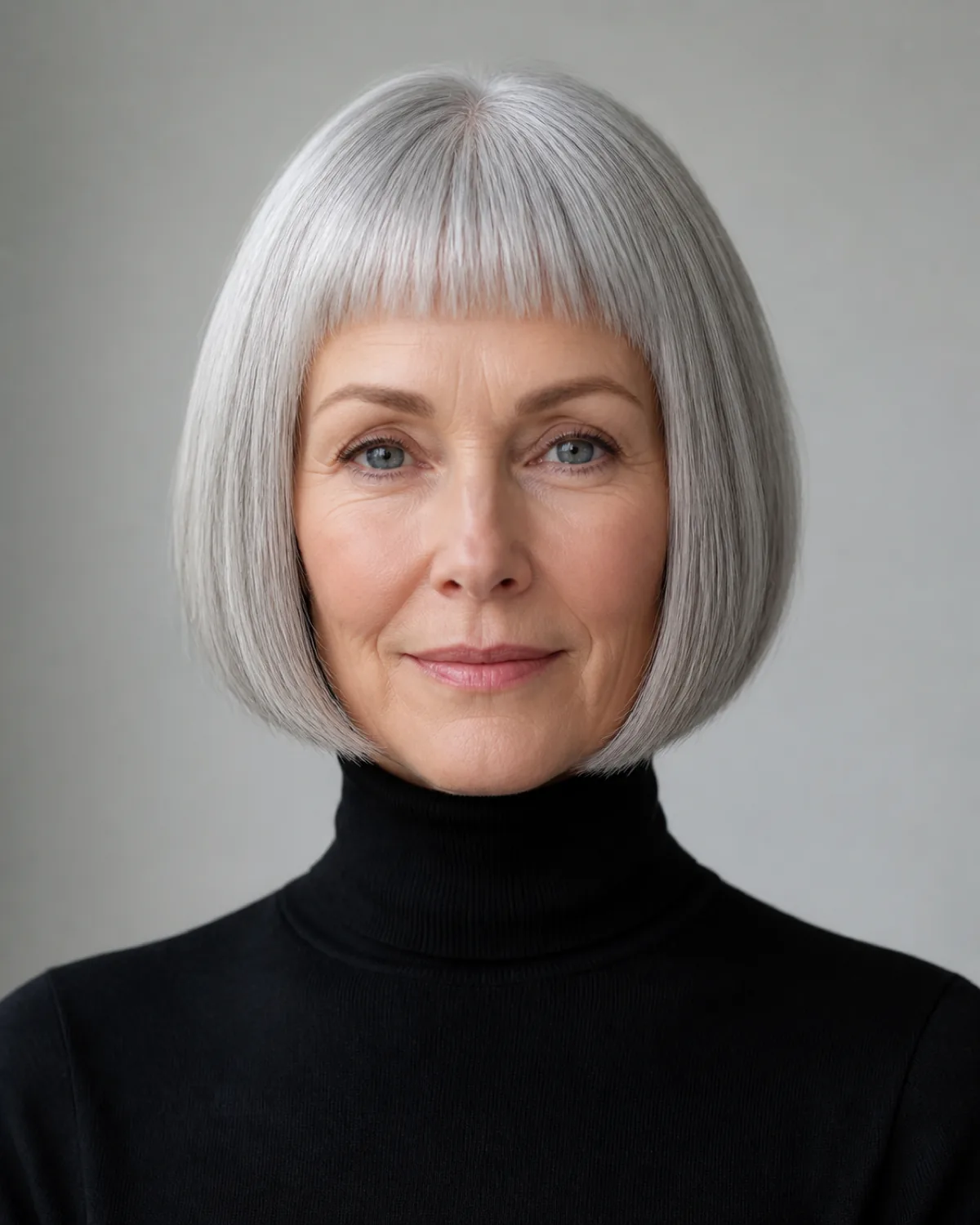
Micro bangs expose most of the forehead and frame the brow bone. On gray hair, this is a statement that works only when the fringe section is dense enough for the short strands to read as a deliberate horizontal line rather than a few wisps that fell short.
- Suits oval faces and confident wearers who want the forehead visible as part of the look
- The jaw-length bob grounds the proportions so the short fringe does not make the head look top-heavy
- Dense gray is essential here — sparse strands at micro length look accidental rather than editorial
- If your gray has thinned at the hairline, the micro bangs will show scalp between the strands
- This is the least forgiving fringe on the list: it either reads deliberate or it reads like a mistake
5. Stacked Bob With Feathered Fringe

Stacking at the nape builds back-of-head volume where fine gray hair tends to flatten. The feathered fringe tapers at the temples instead of ending in a hard line, which means it works even when fringe density is moderate.
- The stacked layers at the nape push the silhouette outward at the occipital bone, creating shape that flat fine hair lacks on its own
- Feathered fringe softens the forehead without demanding the density that blunt or micro bangs require
- Skip if your gray is coarse and wiry — feathered ends on stiff strands spike outward instead of tapering
- The short nape requires regular clean-up (every five to six weeks) or it loses the stacked structure
- Best on fine to medium gray where the strands cooperate with the tapered finish
6. Textured Shaggy Bob With Choppy Bangs
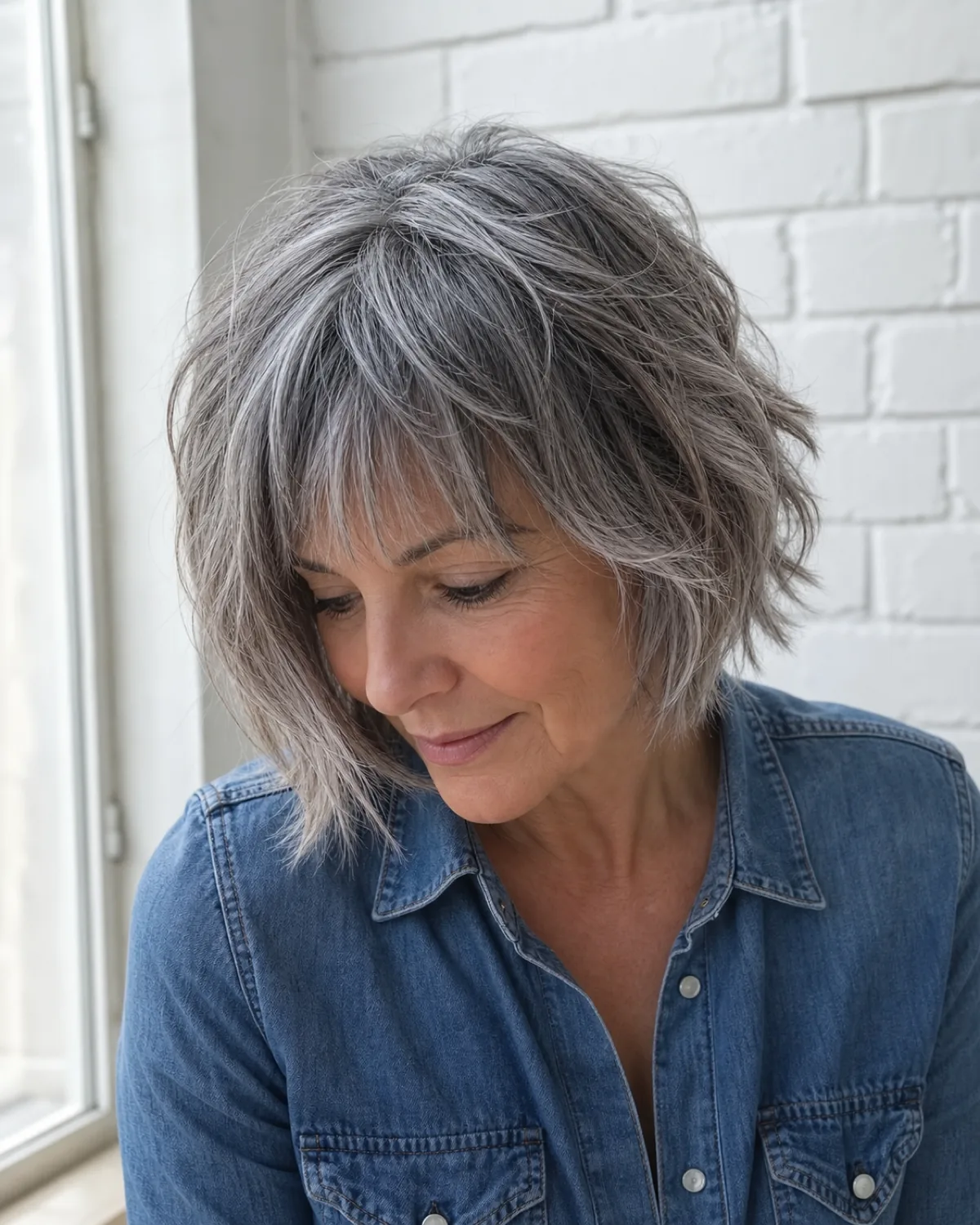
When your gray grows in with mixed texture — some strands wiry, some silky, some wavy — a smooth bob announces every inconsistency. The shaggy structure turns that inconsistency into movement, and choppy bangs complete the effect by making uneven density look designed.
- Works precisely because mixed-texture gray cannot sit uniform — the shag makes that a feature, not a problem
- Choppy bangs at irregular lengths forgive gaps in density because the viewer reads the variation as texture
- This is the lowest-maintenance option on the list because the messier it dries, the better it looks
- Skip if you want a polished finish — shag reads casual by nature and no amount of product changes that
- Tell your stylist to cut into the fringe at different angles so no two pieces end at the same length
7. French Bob With Brow-Skimming Fringe
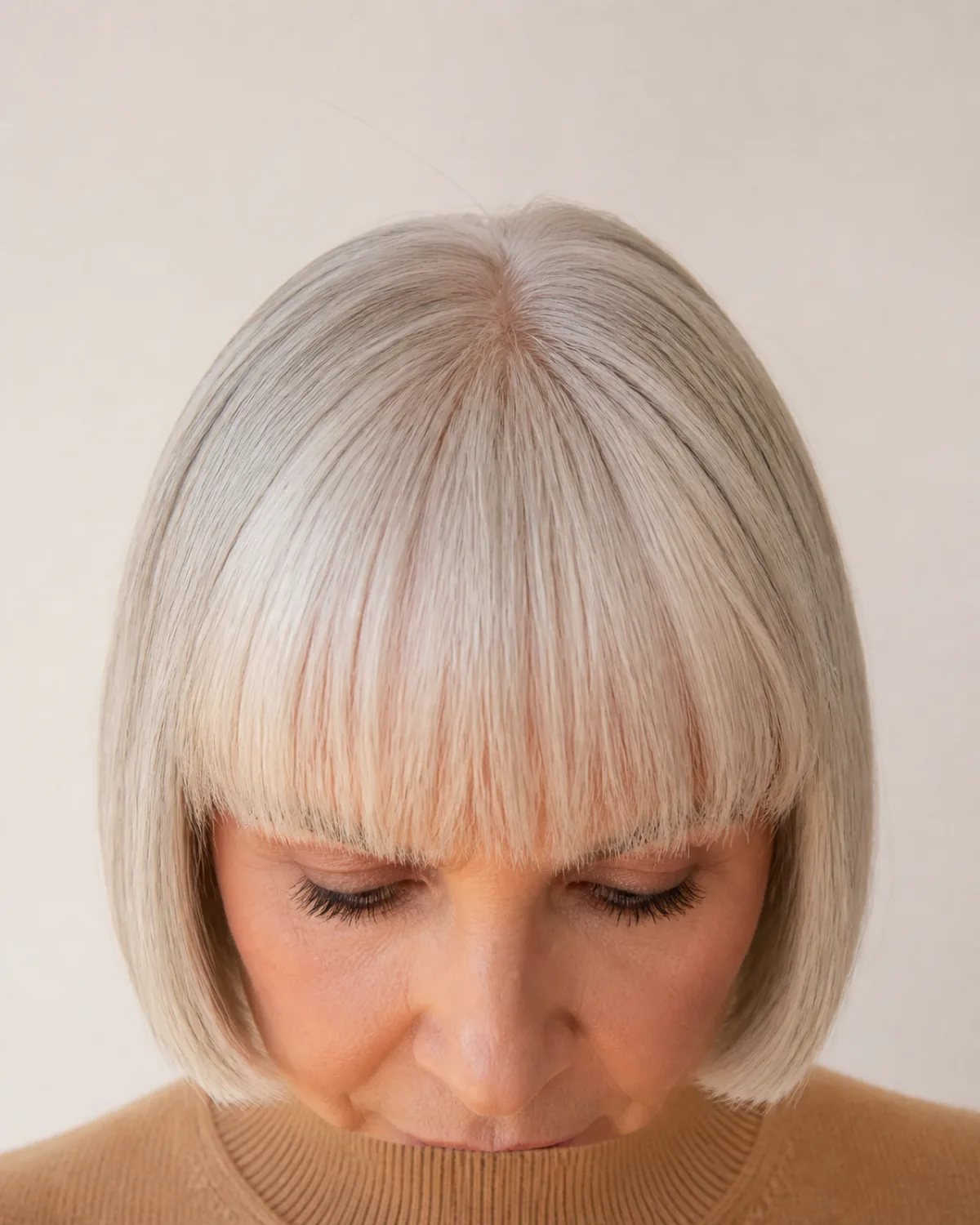
The French bob lives and dies by its fringe. At cheekbone length or shorter, the dense blunt fringe sitting at the brow is the centrepiece. Every strand in the fringe section has to earn its place, because at this length and density, gaps are obvious.
- Suits straight gray hair with enough fringe density to form a solid horizontal line at the brow
- The cheekbone-length hem keeps the overall proportions balanced against the heavy fringe
- If your gray has developed wave or curl, the fringe will shrink upward and expose the forehead unevenly
- This cut reads most Parisian on silver-white hair where the tone is uniform from fringe to nape
- Ask your stylist to check whether your fringe section can form a sheet rather than separate strands before committing
8. Angled Bob With Long Side Bangs
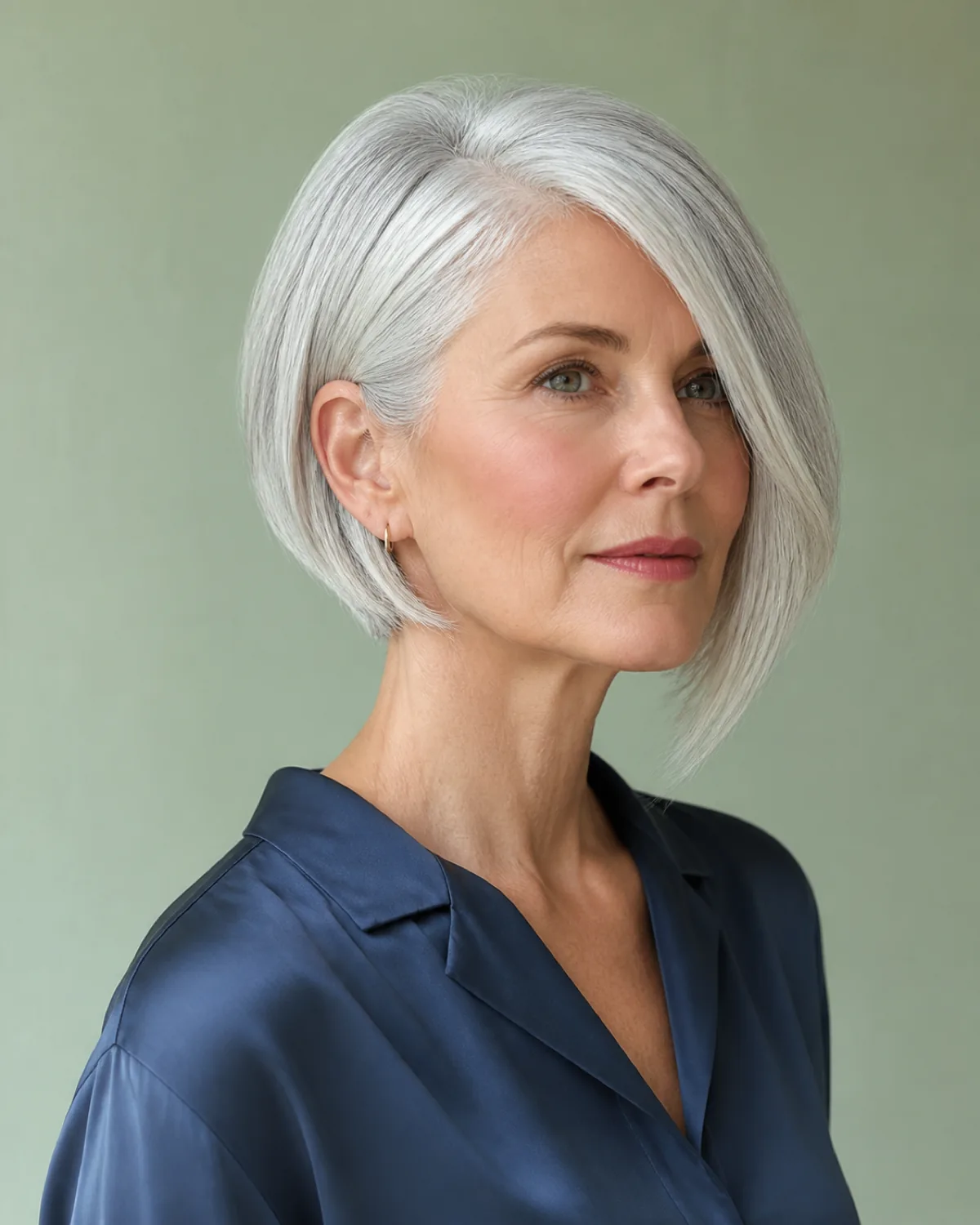
The angled line runs from a shorter nape to longer front pieces that frame the jaw. Long side bangs that sweep past the cheekbone add a second diagonal, softening a square jaw without hiding it entirely.
- The two diagonals — the angled hem and the side bang — create movement that interrupts strong horizontal jaw lines
- Works on silver-white hair because the uniform tone makes the angles read as clean geometry
- Skip if your gray is fine and limp, because the long front pieces will hang flat against the jaw without body
- The side bang needs enough length to sweep past the outer corner of the eye and reach the cheekbone
- If your gray grows forward at the temples, the side bang may resist staying swept and fall into your eyes
9. Classic One-Length Bob With Blunt Bangs
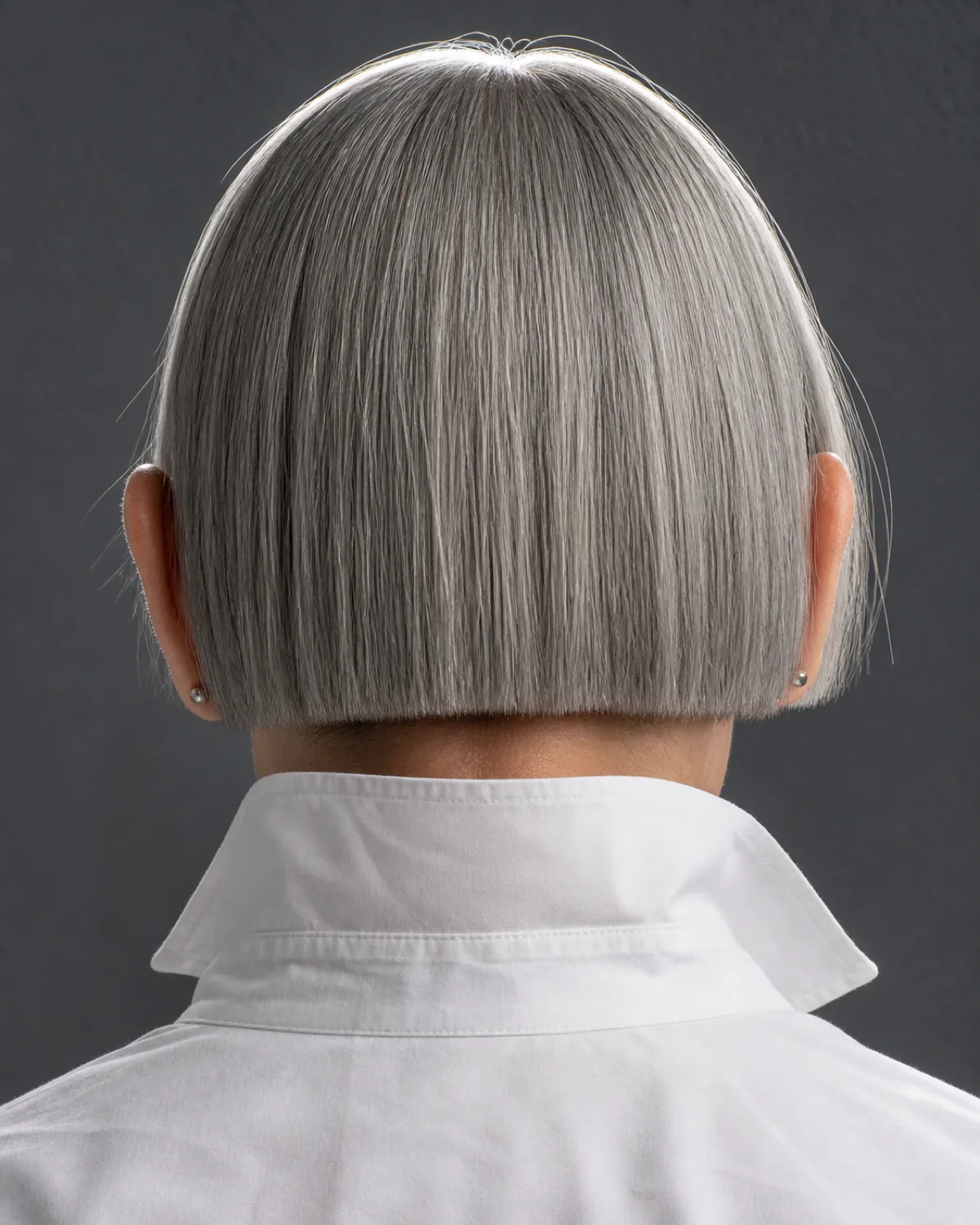
Blunt bangs plus a blunt one-length hem is the most geometric option on this list. Every line is horizontal, every edge is clean, and the shape demands uniformity from root to tip. On thick gray hair, this reads editorial. On thin gray hair, it exposes every gap.
- Suits oval and oblong faces where the strong horizontal fringe balances length
- The one-length back creates maximum weight at the hem, which gives the swing that keeps this shape alive
- Dense uniform gray is non-negotiable — thin or patchy gray turns the precision into a liability
- This is the bob that a stylist can check with a comb and a level, and that exactness is the whole point
- Skip if your fringe section has thinned, because blunt bangs at full width show every missing strand
10. Layered Bob With Piece-y Curtain Fringe

Layers create movement and the piece-y curtain fringe separates into individual strands that reveal the salt-and-pepper blend as depth rather than disorder. This is the best pairing for gray hair that is still transitioning, because the texture variation becomes the design.
- The layers lift the mid-lengths away from the head, so the salt-and-pepper tones show as dimension
- Piece-y fringe means the strands separate on purpose — each piece shows a different tone in the blend
- Works when nothing on your head sits uniform, because that inconsistency is what the cut is built around
- Skip if you want a clean polished line — layers and piece-y fringe read textured and relaxed, not sleek
- Ask your stylist to slice into the fringe with a razor rather than cutting it blunt with shears
11. Inverted Bob With Tapered Fringe

The inverted bob puts the shortest point at the nape and the longest at the jaw, lifting the occipital area where fine gray hair tends to collapse. The tapered fringe thins gradually toward the temples, so it works even when fringe density is not perfectly even.
- The short stacked nape creates back-of-head volume that fine gray hair rarely produces on its own
- Tapered fringe adds softness without requiring the density of blunt or micro bangs
- If your face is very round, check that the longer front pieces reach past the chin, otherwise the short back can emphasise width
- The inversion creates a visible angle from nape to jaw — the greater the angle, the more dramatic the shape
- Works on fine to medium gray; coarse thick gray may produce too much bulk at the stacked nape
12. Collarbone Lob With Face-Framing Bangs
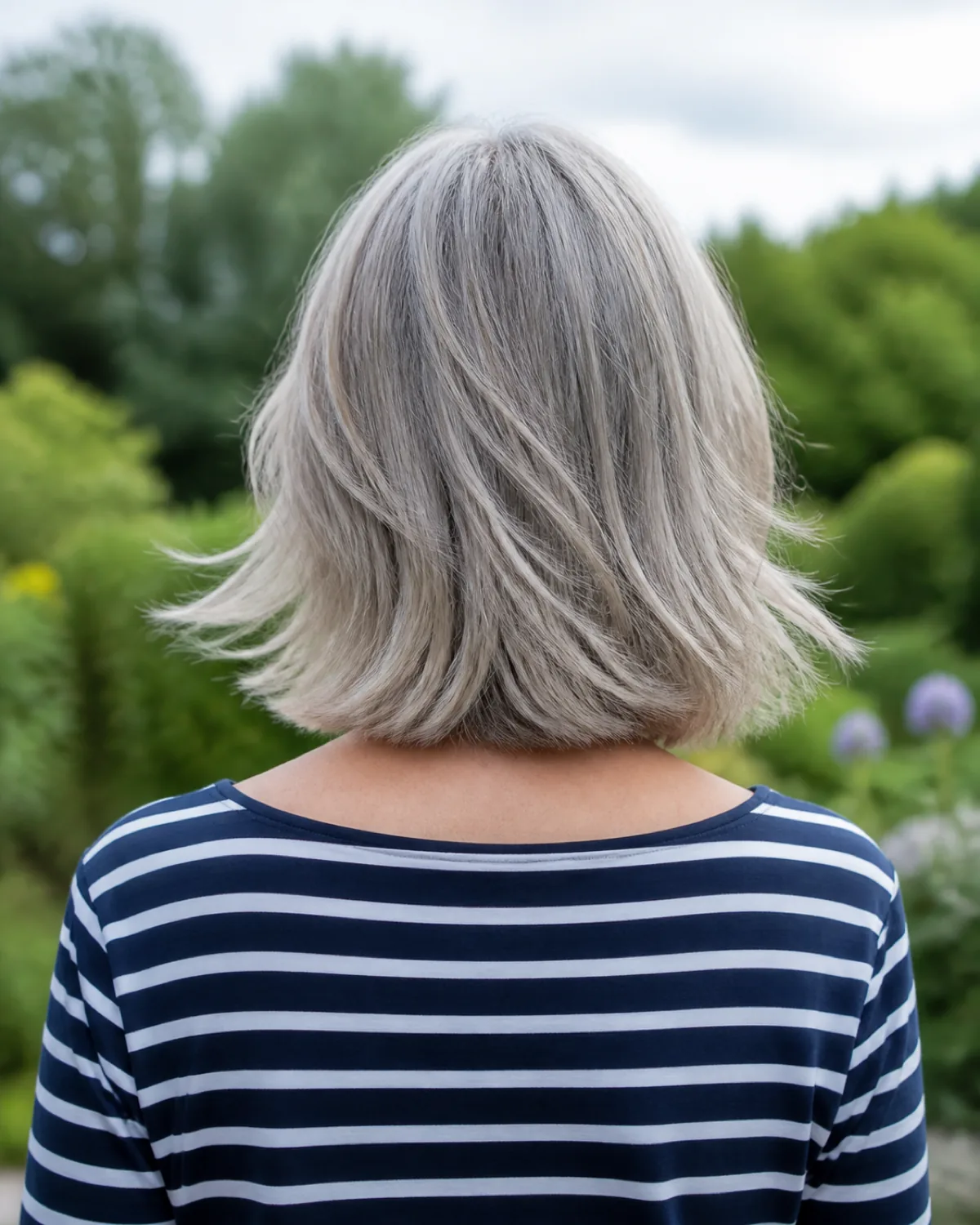
If you want the fringe effect without committing to a full bang, face-framing layers that start at the cheekbone and blend into the front of a shoulder-length cut give you the frame without the maintenance. The lob length keeps options open.
- Face-framing pieces curve toward the jaw and create a fringe-like frame without covering the forehead
- This is the safest entry point if you have never had bangs and want to test how gray hair sits around the face
- The collarbone length means you can still pull the hair back, which true bangs make harder
- Skip if your gray tangles at the collar — the lob length sits exactly in the friction zone where collars and scarves roughen the ends
- Ask your stylist to angle the face-framing pieces so they start just below the cheekbone and taper to the collarbone
The fringe that worked on your pigmented hair may not work on your gray version of the same strand. The density has changed, the texture has shifted, and the strand itself sits differently in the fringe section. Start with what your gray can carry today, not what your hair carried ten years ago.
Where the checkable claims come from
- Why Do Gray Hairs Have a Different Texture? — Encyclopaedia Britannica
- Bob Haircuts: Graduated, Layered & Disconnected Techniques — Sam Villa (Redken Global Artistic Ambassador)
- Which Fringe Suits Me? The Best Bangs for Every Face Shape — Paul Edmonds London
- Graduation vs. Elevation: The Subtle Distinction That Impacts Every Cut — Above Shears
Keep this one
Save it for the appointment
Pin the image above to the board you actually open before a salon visit. This guide is written to be re-read, not read once.
Tonight, before you close this tab
- Pull your fringe section forward under natural light and photograph it from below to see how much forehead shows through the strands
- Feel three gray strands and three pigmented strands from the same area and note whether the gray ones are coarser, finer, or the same
- Check your fringe growth direction by pushing the hair straight down — a strong sideways cowlick rules out centre-parted fringes
- Write down two words for the finish you want — polished or textured — because that answer splits the twelve options in half